
Thank you for reading! Letters from Leo is a reader-supported publication and the fastest-growing Catholic community in the country. To receive new posts and support this movement, consider becoming a free or paid subscriber.
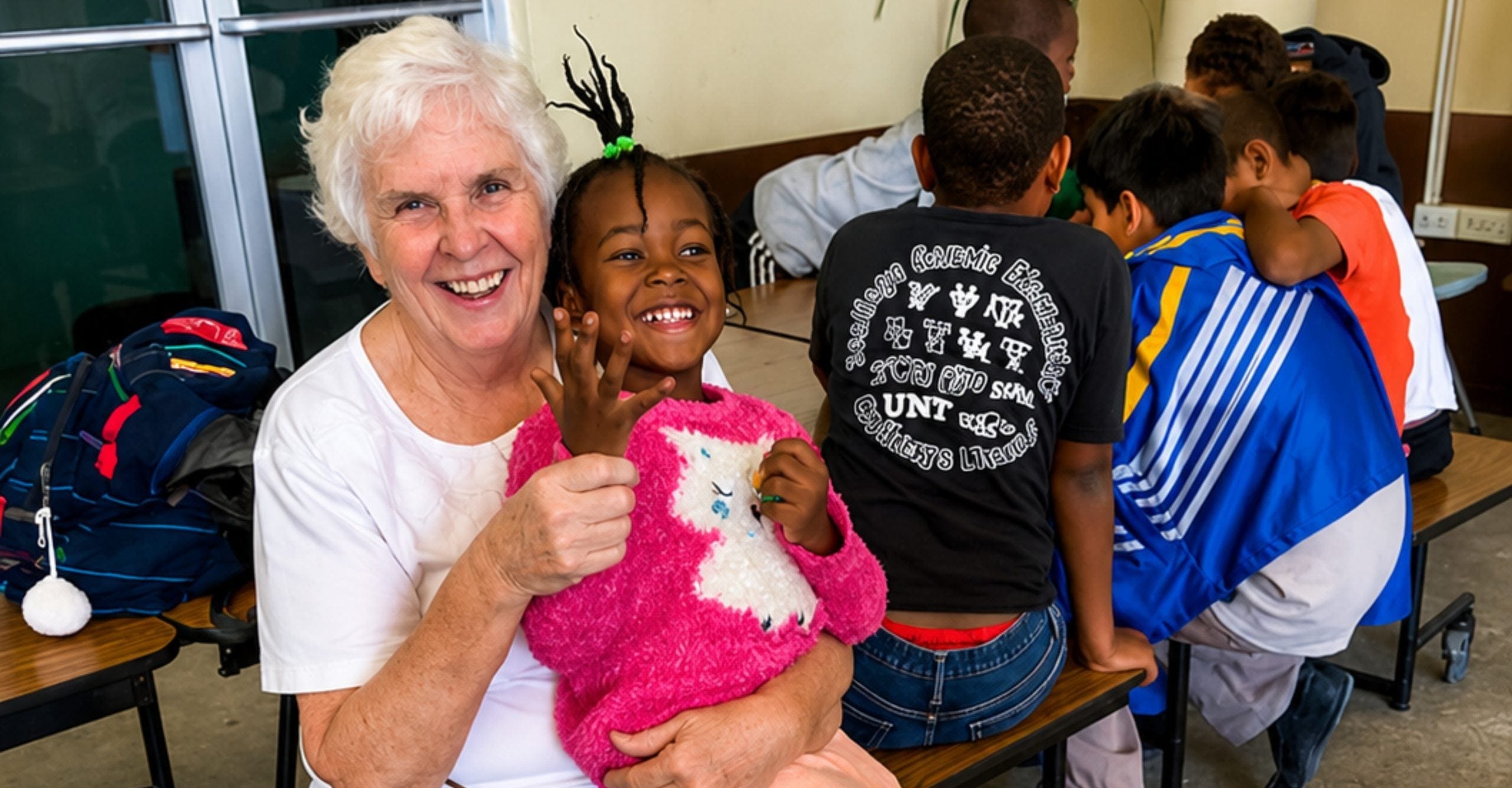
Sister Rose Kuhn goes to Mass in McAllen, Texas, on Wednesday mornings and then drives roughly forty miles east to the federal immigration court in Harlingen. She has no client in the building. What she is doing there, she tells the children who come before the judge, fits in one sentence:
“I introduce myself as a Catholic nun, I tell them I went to Mass this morning for you, and I’m not a hearing officer, I have nothing to do with the whole process, I’m here to accompany you,” she told Dan Stockman of Global Sisters Report in July.
Kuhn belongs to the Sisters, Servants of the Immaculate Heart of Mary, the congregation headquartered in Immaculata, Pennsylvania, whose sisters taught generations of Philadelphia schoolchildren.
She moved to McAllen in 2022 with two other sisters as part of a joint mission of the three IHM congregations. Last year, she started attending hearings in Harlingen with two Jesuit priests. Since then, she has gone on her own every week.
The children she meets come from Honduras, El Salvador, Guatemala, and Mexico. Some are as young as four.
Others traveled as far as 1,500 miles with no adult beside them, and most step into the courtroom without an attorney or a relative, facing a government lawyer whose whole assignment is to argue for their removal.
Sandra Sanchez of Border Report shadowed Kuhn at the Harlingen court this week.
Next Tuesday, she is scheduled to sit with a 12-year-old girl who came to the border without an adult and will go before a judge at the Harlingen immigration court.
“I tell them that they are very valiant,” Kuhn told her. “And I just think they’re really good people, and they would be a great gift for our country if they are allowed to reunite with relatives in the United States, uncles or cousins.”
Most weeks Kuhn goes on Wednesdays because unaccompanied children usually appear on the Harlingen docket that day. This week there were none, so she stayed for the adults — among them Israel Guevara Gonzalez, a 47-year-old rancher from Rio Grande City who has lived in Texas since 2002 and was the only defendant in his courtroom to refuse self-deportation.

Immigration Judge Courtney Chua Stevens, appearing by video from Laredo, told Gonzalez he had been found “removable.” He had no lawyer beside him; he said he had paid two attorneys thousands of dollars before being told his case was hopeless.
In the parking lot afterward, he called Kuhn his “angel.”
“This was all in the plan of God that we met today,” Kuhn replied.

Kuhn asks each child whether she may go in with them, and she stays through the appointment. She permits herself to cry only afterward, in her car.
“They’re just children,” she said. “You wonder what’s going to happen to them.”
What happens to them turns, more than on any other fact, on whether someone with a law degree is sitting with them in the courtroom.
Syracuse University’s Transactional Records Access Clearinghouse found in 2014 that 77 percent of unaccompanied minors without lawyers were ordered deported.
Among children who had counsel, the figure was only 28 percent. The federal government is under no obligation to provide one.
In that system, a four-year-old answers for herself.
Fewer children are coming.
The Office of Refugee Resettlement received nearly 23,000 referrals of unaccompanied minors last fiscal year, down from more than 98,000 the year before and a peak near 129,000 in 2022.
The Trump administration reads that decline as vindication.
Inside the Harlingen courtroom, it means something darker: the children who still arrive are the ones whose circumstances at home were desperate enough to send them anyway, and they now meet a bench under orders to hurry.

The Associated Press reported in May that the administration has pressured immigration judges to speed cases and approve fewer asylum claims, and that it has fired dozens of judges along the way.
Kuhn’s weekly visits are part of a wider Christian witness in the Rio Grande Valley that I have followed for more than a year.
In August 2025, I reported on the Jesuits and women religious who began walking into the same Texas courthouses to stand between migrants and sudden arrest.
The Trump-Vance White House hit Sister Norma Pimentel’s Catholic Charities of the Rio Grande Valley that December with a six-year federal funding ban, a penalty Church leaders in the Valley called a vendetta.

ICE then detained Pimentel’s colleague Sister Letty, a Texas nun, this past July as she walked to Sunday Mass at Our Lady of Sorrows.
The sisters keep coming back anyway, which is the part of this story the administration cannot legislate away.
Pope Leo XIV has said what he thinks of the machinery these children face.
Outside Castel Gandolfo on October 1 of last year, answering reporters, he put it this way: “Someone who says I’m against abortion, but I’m in agreement with the inhuman treatment of immigrants in the United States, I don’t know if that’s pro-life.”
In his NBC interview on July 29, the grandson of immigrants called the country’s habit of welcome “one of the greatest wealths of the United States,” and he spent this year’s Fourth of July with the migrants of Lampedusa rather than at any American celebration.
At his general audience on Wednesday, the day of the week Kuhn drives to Harlingen, the pope told pilgrims that the Church’s share in the world’s joys and griefs “calls on us to leave behind all passivity and indifference in the face of current events, history and people’s lives.”
He was teaching on Gaudium et Spes, the council document that opens by claiming the anxieties of the poor as the Church’s own. A nun in a Texas courtroom is that paragraph with a pulse.
Under Pope Francis, the Church gave a name to what Sister Kuhn does, and the name is accompaniment. The practice is older than the word, and it wins no court motions; it asks nothing of the person accompanied except that she let someone sit nearby until the thing is over.
Jesus practiced it on the road to Emmaus, walking beside two men who did not recognize him and listening a long while before he spoke.
The word companion comes from the Latin for breaking bread together.
When the Eucharist is carried to the dying, the Church calls it viaticum, food for the journey — and Kuhn carries something like it into a room built for the deportation of children.
Consider what the Harlingen court looks like from the height of a 12-year-old.
She will see a judge at a raised bench, an attorney for the government, an interpreter, and a docket on which she is a number. Whatever else happens on Tuesday, she will also have in the row behind her a nun from Philadelphia who went to Mass to pray for her that morning, and who will lean over to be her companion throughout it all.
The administration has budgeted billions of dollars to make that room frightening.
Against all of it, a nun offers a tank of gas a week and a promise to stay until the hearing ends, which is the only item on Tuesday’s docket that will look anything like the Gospel.
At Letters from Leo, we stand with Sister Rose Kuhn and the women religious of the Rio Grande Valley, alongside the millions of American Catholics and people of goodwill who believe a child in a courtroom deserves someone in the row behind her.
Pope Leo told the Church this week to leave passivity and indifference behind. A government that puts four-year-olds before deportation judges depends on both, and it needs the rest of us to look away while the hearings roll on in Harlingen on a weekday morning.
This is the fastest-growing Catholic community in the country because people are hungry for a faith that shows up where the powerful would rather nobody watched. Sister Rose drives forty miles every week to be that faith; our work here is to make sure her witness reaches the people who need to see it.
If you believe this movement matters — Catholics and people of goodwill standing for the dignity of migrant children against a machine built to hurry them out — I am asking you to join us.
If you’d like to invest in our mission, here are three ways you can help:
Subscribe as a paid member to receive exclusive posts about the life and formation of Pope Leo and help sustain this newsletter.
Donate with a one-time gift to fuel this project’s mission.
Share this post (and Letters from Leo) with a friend who might enjoy it.
Paid subscribers receive our ongoing series on Pope Leo’s life and formation, the Epstein-Bannon investigation, and the Sunday Scripture Reflection Series, along with every investigation into how this administration treats the people Christ told us to welcome.
Whether you give $0, $5, $50, $500, $1,000, or more, your presence here matters — no matter your faith or your politics.
Thank you for reading. I’ll see you on the road.


Children, innocent children, should never be put in such positions. People being "asylumed" to countries they have no connection to is abhorrent. This must end
"Com-panion" . . . to break bread with. Now, that's a brief homily worth remembering!