In NBC Interview, Pope Leo XIV Says Immigrants Are One of America’s “Greatest Wealths”
Speaking to NBC before his Concert for Peace, the pope said his American trip will come “in the next couple of years.” He spent this year’s Fourth of July with the migrants of Lampedusa instead.

This is a breaking news story. Pope Leo XIV’s full interview with NBC’s Tom Llamas aired tonight on Nightly News, and I will update this post later this evening as it develops.
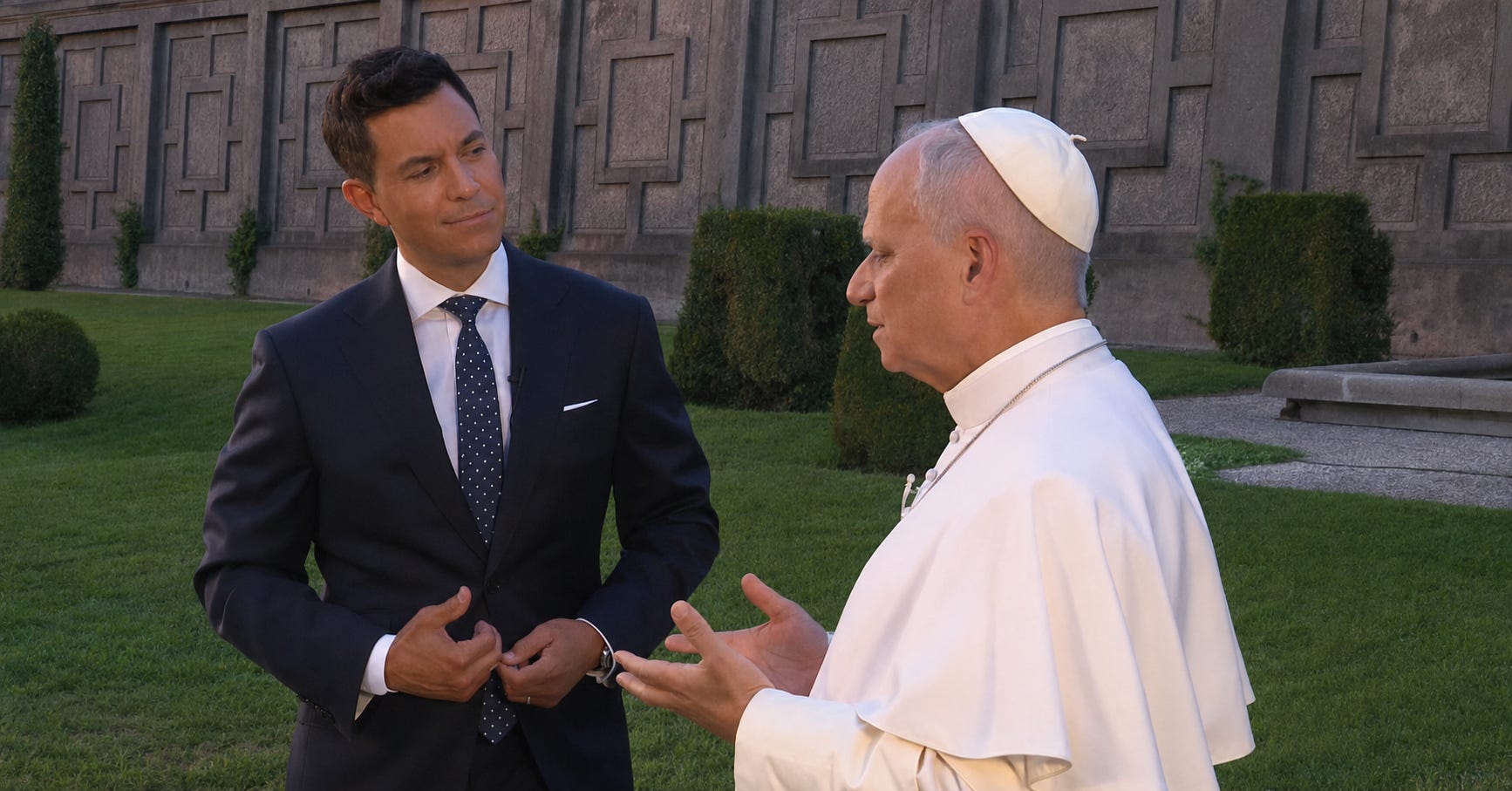
NBC anchor Tom Llamas put one question to Pope Leo XIV in the gardens of Castel Gandolfo on Wednesday: what do you love about America?
“So many things,” the pope answered. “The sense of freedom, the sense of opportunity, the sense of having invited for generations people from around the world to be part of America.”
Then he told Llamas where that answer comes from. “I come from a family where my grandparents were immigrants. On my mother’s side, we have people who were both slaves and slave owners.” That inheritance, he said, taught him to recognize “one of the greatest wealths of the United States” — the people this country has welcomed from everywhere, for generations.
NBC aired the full interview tonight on Nightly News, where Llamas presses the pope on what defines his love for America and what it means to be the first American to hold the office.
Llamas also asked when the pope will visit the United States. “In the next couple of years,” Leo answered.
That timeline carries a history. The Trump White House wanted the pope in America for the nation’s 250th anniversary this summer — Letters from Leo covered the break when Leo chose Lampedusa instead, spending the Fourth of July at Mass with migrants at Europe’s southern door.
I was on the island that morning, and before Mass began I got to wish the first American pope a happy Fourth of July.
Letters from Leo readers know Leo’s family tree well. Henry Louis Gates walked the pope through it last summer — Black ancestors, slaveholders both white and Black, a Creole lineage running through New Orleans.
His mother, Mildred Prevost, grew up inside that inheritance before the family reached Chicago. Until Wednesday, though, Leo had never said the words himself with a camera rolling.
Hours before Llamas’s interview, the same gardens filled with children.
By evening, 164 of them stood on a red stage at Borgo Laudato si’ and sang for the pope who spends his Augusts there. They came from the Holy Land, Uganda, Haiti, and Italy. Andrea Bocelli stood among them and opened the hour with Panis Angelicus, the “Bread of Angels.”
NBC News and Noticias Telemundo carried the Concert for Peace live across the United States, with Llamas anchoring alongside the Dominican friar Fr. Patrick Briscoe. Vatican officials called it the Canticle of Peace, staged to mark eight hundred years since the death of St. Francis of Assisi.
Cardinal Fabio Baggio, who runs the Laudato Si’ Higher Education Center with the Andrea Bocelli Foundation, built the evening around one idea: children who have buried friends and fled violence can still teach the rest of us what peace sounds like.
This is the same lawn where, three weeks ago, Pope Leo set aside his prepared remarks to share a meal with two hundred of Rome’s poorest residents — a pattern Letters from Leo has tracked since he and his predecessor, Francis, first turned Castel Gandolfo into a place for the people Rome usually keeps at arm’s length.
Between the choir’s sets, readers took turns with Scripture and papal teaching. One voice opened the Book of Genesis, the world spoken into being line by line.
A choir member recited St. Francis’s Canticle of the Creatures. Someone else read the peace prayer attributed to the saint, the one that asks to sow love where there is hatred and pardon where there is injury.
And then, read aloud on the pope’s own grounds, came a passage from Pope Francis’s encyclical Fratelli Tutti: that the goods belonging to one nation cannot be withheld from “a needy person coming from elsewhere,” because, in the encyclical’s own words, “each country also belongs to the foreigner.” Whether someone was born in Ohio or Kampala does not change what is owed them.
It’s important to consider what that means. The pope has just told an American news anchor that same day that his own grandparents were immigrants and that his own bloodline holds both the enslaved and their owners.
The Church’s argument about the foreigner is not an abstraction to him. It is a family story.
America’s bishops have been making the same argument for two years, through a Trump-Vance administration that keeps running deportation raids through parishes and courthouses.
Cardinal Dolan invoked Jesus and the Statue of Liberty and was branded a traitor for it. Archbishop Farrell called the administration’s rhetoric what it is on the same day Pope Leo prayed with migrants on Lampedusa. Detroit’s Archbishop Weisenburger stood outside an ICE facility to say immigrants deserve a voice. None of it has slowed the raids.
The concert’s sharpest political statement was the guest list.
A girl from Bethlehem stood with the other children and asked the pope, and asked God, why adults find peace so hard. The children’s own prayer put it plainer than any homily could: war, they said, is “a dark night that takes away our friends, our parents, our schools, and our homes,” and no one can tell them why.
Pope Leo answered them the way he answers most things: gently, and without a single reference to any president. He told them beauty works like a stream flowing back toward its source, and that following it leads somewhere real — “the beauty of music invites us to encounter the one who is beauty itself.”
He thanked the Bocelli Foundation for its work with “young people who experience educational and social disadvantages,” then prayed that peace would reign “in your homes, and in all those places throughout the world that continue to suffer from violence.”
Llamas closed the broadcast by noting, almost in passing, that the pope had touched on the plight of migrants during the hour. Fr. Briscoe, watching beside him, said what struck him most was how much hope the moment supplied. Neither man needed to spell out why an American audience might need that reminder more than most.
A pope descended from immigrants, from enslaved people, and from the men who owned them stood in a garden outside Rome and let children from the Holy Land, from Uganda, from Haiti, and from Italy sing together as equals, with no hierarchy of whose suffering counted more.
Then a reading from his predecessor’s encyclical told the audience that a country belongs to the foreigner too. Meanwhile, the country that gave this pope his accent — and his ancestors their chains — is running raids that split families over paperwork.
Letters from Leo has covered the raids, the bishops’ rebukes, and the pope’s own appeals for two years now, because the gap between Castel Gandolfo and the border keeps widening instead of closing. Wednesday did not close it either.
But between a morning confession about slavery and an evening of children singing for peace, the first American pope showed his country its own reflection — the immigrant, the enslaved, the slaveowner, all in one family, all in one man.
At Letters from Leo, we stand with the 164 children who sang at Castel Gandolfo, and with every American Catholic who has watched this pope insist, again and again, that a nation’s goods and a nation’s welcome do not stop at a fence.
We believe, with Pope Leo and with Pope Francis before him, that the foreigner has a claim on this country too — not because of any party’s platform, but because human dignity does not check a passport first.
This is the fastest-growing Catholic community in the country because people are hungry for something more honest than the cruelty on their television screens.
They are looking for a Church that still believes a choir of children who have known war can teach a superpower something about peace — and on Wednesday, at the pope’s own summer home, it did.
If you believe this movement matters — Catholics and people of goodwill standing for human dignity against a politics that treats children like these as a border problem to be solved — I am asking you to join us.
If you’d like to invest in our mission, here are three ways you can help during this critical time:
Subscribe as a paid member to receive exclusive posts about the life and formation of Pope Leo and help sustain this newsletter.
Donate with a one-time gift to fuel this project’s mission.
Share this post (and Letters from Leo) with a friend who might enjoy it.
Paid subscribers get the fuller picture: the ongoing series on Pope Leo’s Life & Formation — including the story of the Black Creole mother who made the pope — and the investigations most outlets won’t touch.
Whether you give $0, $5, $50, $500, $1,000, or more, your presence here matters — no matter your faith or your politics.
Thank you for reading. I’ll see you on the road.


“The generations of people America has welcomed from around the world one of the country’s greatest wealth” YES!!!
Wonderful!! Thank you so much!