
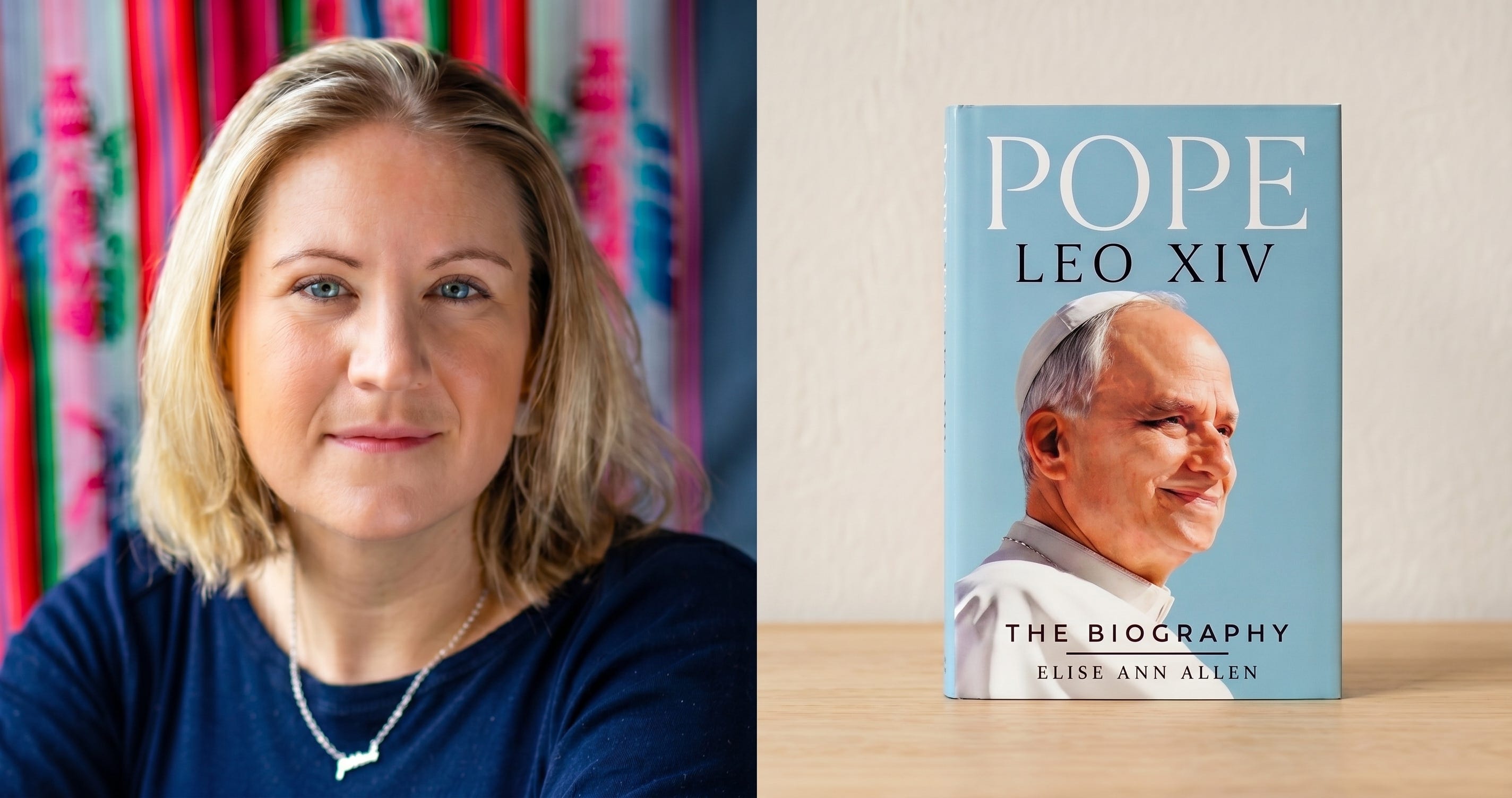
‘Citizen of the World’ — Elise Ann Allen’s Historic Biography of Pope Leo XIV
The first English-language Pope Leo biography built around three hours of on-the-record interviews with the pope himself — and the years of Peruvian reporting that earned Allen the room.
Dear friends —
Before you read today’s essay, one important note:
Anyone who purchases a yearly subscription to Letters from Leo or donates $80 or more from this post will receive a free copy of Elise Ann Allen’s Pope Leo XIV: The Biography.
This offer is available through Friday, May 1, at 11:59 PM PDT.
If you’ve been considering joining our community, this is the moment — and this is the book. I’ll explain why below.
On an afternoon in July 2025, Elise Ann Allen sat across from Pope Leo XIV in the gardens of Castel Gandolfo with an iPhone recording them.
They met again a few weeks later inside the papal apartment at the Holy Office in the Vatican for a second session — ninety minutes apiece across two days, producing a thirty-five-page transcript that became the first sustained, on-the-record conversation any English-speaking journalist has had with this pope since white smoke rose over St. Peter’s Square last May.
The book is Pope Leo XIV: The Biography, released this week by Penguin Random House and now climbing the charts.
Its Spanish predecessor — published last fall by Penguin Peru as Leo XIV: Citizen of the World, Missionary of the XXI Century — made Allen the first journalist anywhere to publish an extended interview with this pope. The English edition arrives carrying that scoop into the country where Robert Prevost was born.
I tore through it in one sleepless night. I know I’m not alone. The English-speaking Catholic world has been waiting for this book since May 8.
This book is a great companion to Christopher Lamb’s exquisite biography of Leo XIV, with a thorough explanation of political implications, published last month, which I covered here, and which so many of you bought through a yearly subscription to Letters from Leo.
What makes Allen’s book unique is the interview itself — the first long-form, on-the-record sit-down of Leo’s pontificate.
Leo speaks in his own voice about the conclave, his Augustinian formation, his childhood on Chicago’s South Side, the church’s relationship with women and LGBT Catholics, Ukraine, China, the United States, and the abuse crisis that has shadowed his episcopate. There is no ghost-writer’s hedge here. The transcript runs the final 35 pages of the book, in English.
To understand how she got those three hours, you have to understand what came before. For the better part of a decade, Allen has been the world’s most stubborn investigator of the Sodalitium Christianae Vitae, the Peruvian movement that Pope Francis suppressed last year after years of documented psychological, sexual, and spiritual abuse.
She is herself a former member of the women’s branch. Her reporting from Lima, Piura, and Chiclayo earned her a long string of attacks and rebuttals from people powerful enough to bury most reporters.
It also brought her into the orbit of a quiet Augustinian bishop named Robert Prevost. As the Vatican investigation tore through the diocese of Chiclayo — where Prevost had served before his elevation to the Dicastery for Bishops — Allen stayed on the story while most of the English-speaking press looked away.
She knew the actors by name and had absorbed the cost of telling that truth firsthand, in a country where reporters who name names get sued and worse. Prevost, by every account, watched her work and remembered.
Allen’s own account in the book’s introduction makes that relationship plain. They first met in December 2018, when she traveled to Lima to investigate Sodalitium, and he was the president of the Peruvian bishops’ Safeguarding Commission.
After their first interview, he handed her his personal card — a gesture, she notes, that bishops do not typically extend to investigative journalists. Years later, when Francis brought him to Rome to lead the Dicastery for Bishops, Elise and her husband hosted him for dinner at their home; he traded jokes about sports, Peru, and the Vatican.
When Allen sat down with him at Castel Gandolfo on July 10, 2025 — the inaugural session of the interview that anchors this book — the new pope met her with an outstretched hand and an immediate question about her husband’s journey with stomach cancer.
That history is why Leo agreed, two months into his papacy, to do something that has never happened in the two millennia history of the Catholic Church — an unedited English-language interview with the Vicar of Christ.
Anyone who read Allen’s exchanges with Leo released by Crux last fall — drawn from those same Castel Gandolfo and Vatican sessions, ranging across Gaza, the deportations, and the Holy See’s posture toward Beijing — already glimpsed what the book makes plain.
Leo trusts her. He answers like a man who knows she has done the work. The biography turns those exchanges into a full portrait of a pope who is more politically relevant, more theologically pointed, and far more recognizably American than the early caricature allowed.
A word on the personal weight Allen has carried this year: her husband, the great Vatican journalist John L. Allen Jr., founder of Crux, died in Rome on January 22 after a long battle with cancer.
Elise carries on her husband’s legacy. But anyone who knows Elise knows that this book is hers alone — the reporting, the relationships, the voice — and that she was Crux’s senior Rome correspondent in her own right long before she was a widow.
What the biography reveals — and this is why every American Catholic should read it — is a pope whose moral seriousness has been radically underestimated. He grew up on Chicago’s South Side, in a working-class Catholic world that shaped his pastoral instincts long before Peru did.
The Augustinian assignments in Trujillo and Chiclayo taught him what the church owes the poor by demanding that he live among them.
The conclave, by Allen’s telling, did not move him by faction or bloc; he entered it as the candidate who had refused both. He took the name Leo, he tells her, in honor of Leo XIII — the father of modern Catholic social teaching — because the artificial-intelligence revolution and its threat to working people is, in his words, the moral test ahead of us.
And in his answers to Allen on Ukraine, on Gaza, on Donald Trump, on Elon Musk and the coming trillionaire economy (“if that is the only thing that has value anymore, then we’re in big trouble”), Leo speaks like a man who has decided which moral lines he will not let go uncrossed.
On the clerical abuse crisis, Leo gives the answer of a careful canon lawyer. He calls it “a real crisis, unlike finances” that the Church “has to continue to address because it’s not solved,” and insists victims must be treated “with great respect” because their wounds “sometimes carry … for their entire lives.”
Then he talks about rights of the accused, the presumption of innocence, and his Francis-cited view that abuse “cannot become the central focus of the Church.” It is the answer of a man who lived through Chiclayo and knows the cost of abuse.
Gaza is where his voice sharpens.
Leo names the “innocent people in Gaza” and the children facing “not only deprivation but actual starvation,” acknowledges that the word genocide is “being thrown around more and more” — including by “two human rights groups in Israel who have made that statement” — and concedes that the Holy See has declined, for now, to make that declaration itself.
“We can’t grow numb,” he tells Allen, “and we can’t ignore this.”
His lines on the United States cut a different way. Leo has not met Donald Trump, who has publicly clashed with the pope over the Iran war.
Asked by reporters at the White House earlier this month whether he planned to meet Leo, the president said, “I haven’t met him, but I disagree with the pope” — though he allowed that Leo’s brother Louis Prevost is “actually a great guy.” Leo, for his part, tells Allen that if a chance to engage on specific issues arises, he would have no problem taking it.
His one sustained conversation with JD Vance, he says, turned on “human dignity and how important that is for all people, wherever you’re born.” He will not get involved in partisan politics, he tells Allen, but he will not stop raising “real gospel issues” that “people on both sides of the aisle” need to hear.
The book is also, quietly, the first real accounting of how a Vatican investigator from Chicago became the man who would inherit Francis’s reform agenda. Allen does not flinch from the Peruvian record — she lays it out, gives the survivors the page, and presses Leo on every line of the questions that have followed him since the conclave.
That is the book Allen has given us. The journalist who wrote it earned every page through years that almost no other reporter was willing to spend, and the relationship she built in those years will keep producing the clearest English-language window into this papacy for as long as Leo lives.
Buy this book. Read it cover to cover. Give it to the person in your life who wants to understand who this pope really is.
And if you want a free copy, join our community as a yearly paid subscriber or make a one-time donation of $80 or more — directly from this post — before Friday, May 1, at 11:59 PM PT.
At Letters from Leo, we honor the reporters who do the hard work that the rest of the press will not.
Elise Allen at Crux, who has spent years investigating the Peruvian abuse story, sitting with survivors and ex-members that most outlets never bothered to find, and filing copy long after most newsrooms have moved on.
The biography she has just published is the fruit of that decade of labor, and the English-speaking church is better for every page of it.
This is the fastest-growing Catholic community in the country because we are hungry for something deeper — for writing that takes the Gospel and the abuse of the Gospel with equal seriousness, and for a movement that refuses to bow to the idols of fear, secrecy, and power.
If you believe that hunger matters — and that this papacy deserves a serious American readership grounded in the dignity of every human being — I am asking you to join us.
If you’d like to invest in our mission, here are three ways you can help this Easter season:
Subscribe as a paid member to receive exclusive posts about the life and formation of Pope Leo and help sustain this newsletter.
Donate with a one-time gift to fuel this project’s mission.
Share this post (and Letters from Leo) with a friend who would read the book.
Paid members receive my full biographical series on the life and formation of Pope Leo XIV, the American pope who now carries Francis’s mission into a new era. You’ll also get access to exclusive investigations, including my ongoing Epstein-Bannon Investigation, and the best of our full archive.
Whether you give $5, $50, $500, or more, your presence here matters — no matter your faith or your politics.
Thank you for reading. I’ll see you on the road.


I just bought this and I’m looking forward to reading it.
I, too, just got this for my Kindle. I have a feeling I’m going to be a bit short on sleep this weekend….