Thank you for reading! Letters from Leo is a reader-supported publication and the fastest-growing Catholic community in the country. To receive new posts and support this movement, consider becoming a free or paid subscriber.
The Vatican has advanced Dorothy Day’s cause for inclusion among the Church’s recognized saints.
On July 15, Casey Mullaney of the Dorothy Day Guild announced that the Dicastery for the Causes of Saints had approved the first portion of Day’s canonization file — two summaries, one drawn from the testimony of people who knew her, the other from her own writings and records.
Waldery Hilgeman, the canon lawyer pleading Day’s case in Rome, shared the news in a recorded message to her guild. Her official biography is finished, he reported, and he is now at work on the informatio, the document that must show she practiced Christian virtue to a heroic degree. He expects the completed brief to reach Rome before the end of the year.
Once it arrives, the dicastery’s theologians and cardinals will weigh whether Day, a Servant of God since 2000, should be declared Venerable — the pope’s formal finding that she practiced heroic virtue.
The ordinary path from there runs through a verified miracle attributed to her intercession, which would make her Blessed, and then a second one after beatification for canonization. Popes bend that timetable when they choose; Francis waived the second miracle entirely when he canonized John XXIII in 2014.
The Archdiocese of New York is sponsoring the cause and paying a good portion of its bills. Cardinal Timothy Dolan sealed the final archival box at St. Patrick’s Cathedral in December 2021, and the archdiocese shipped 137 boxes to Rome, more than 50,000 pages of diaries, columns, interviews, and arrest records. Her sainthood dossier includes her FBI file.
The timing is providential. New York opened the cause under Cardinal John O’Connor in 2000, and the American bishops endorsed it overwhelmingly in 2012. It advances now under Leo XIV, the first American pope, and the archdiocese that owns it answers to Archbishop Ronald Hicks, installed in February as the eleventh archbishop of New York.
Like the pope who appointed him, Hicks came up through the Church in Chicago. The cause belongs to him and his team now.
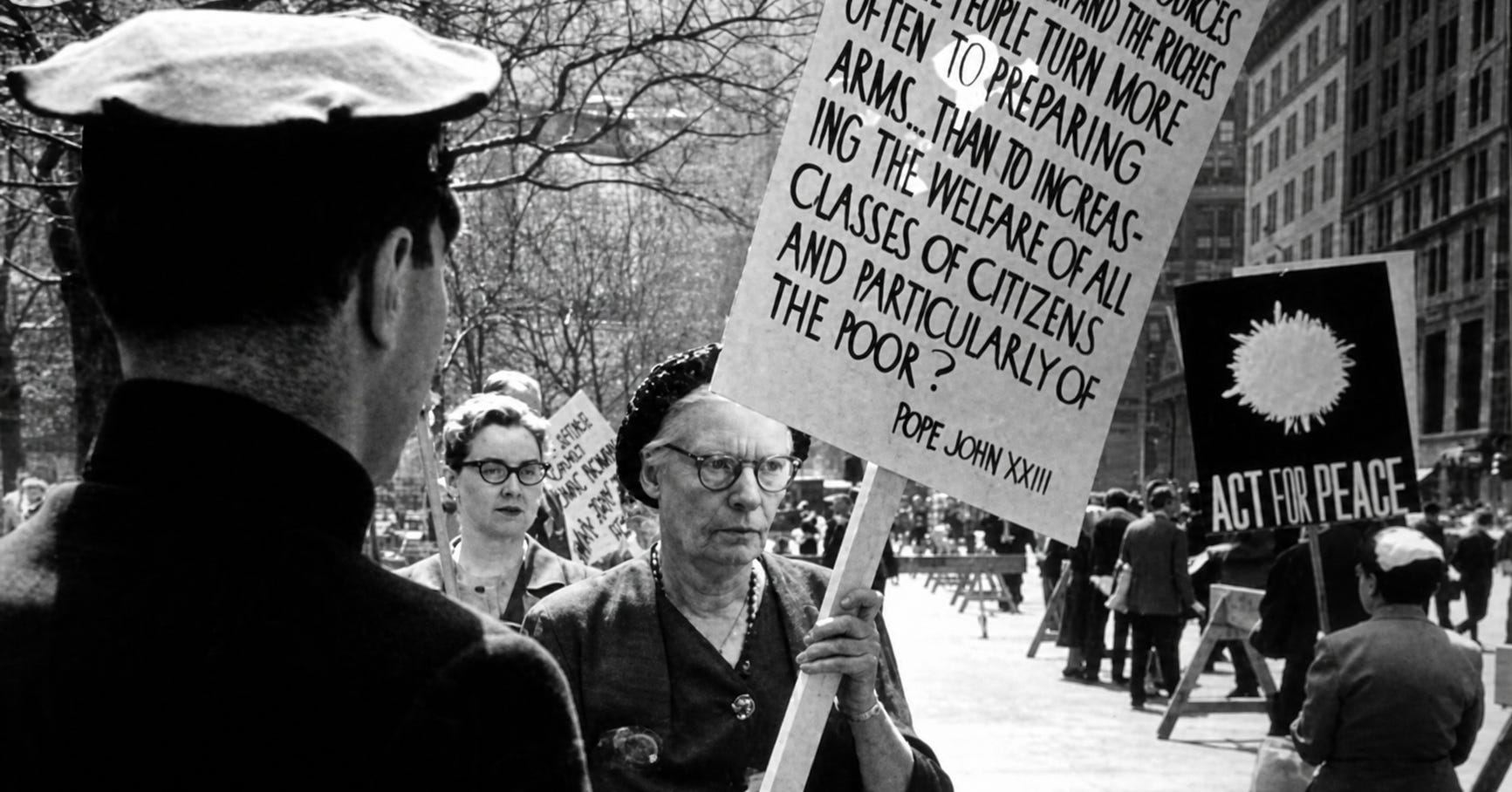
Day would be an unusual saint by any measure. In 1933, in the pit of the Depression, she founded the Catholic Worker with the French-born peasant philosopher Peter Maurin — first a newspaper that sold for a penny a copy (it still does), then houses of hospitality where the poor and the volunteers who fed them shared one table. She lived in those houses until her death in 1980.
Her road there was crooked. Before her conversion in 1927, she ran with the anarchists and playwrights of the Lower East Side, and she carried the grief of an abortion for the rest of her life; the birth of her daughter, Tamar, is what finally drew her into the Church. Police arrested her for the last time in 1973, when she was 75 years old, on a United Farm Workers picket line in California.
In Michael Fox’s essay, the Day he met at Tivoli in those same years was “severe, unsentimental, entirely unlike the woman on the holy card” — formidable enough that being near her was intimidating.
None of it makes her comfortable company for the American right. Day described capitalism in 1954 as “this rotten, decadent, putrid industrial capitalist system,” and she conducted her life accordingly. She never voted. Federal income tax struck her as a subscription to war, so she declined to pay it.
She opposed every American conflict of her lifetime, including the war against Hitler, and First Things has published an assessment of what it calls her complicated cause, worrying that such absolute pacifism cannot be squared with the Church’s own just-war teaching.
The Vatican under Pope Leo XIV, evidently, is proceeding anyway.
J. Edgar Hoover found her harder to dismiss than her modern critics do. His bureau tracked her for decades and recommended her for detention in the event of a national emergency.
One internal memo complained that she “maintains a very hostile and belligerent attitude toward the Bureau.” Hoover himself called her an “erratic and irresponsible person.” The erratic and irresponsible person fed the hungry every morning for nearly fifty years.

And then there is the socialism. Michael Harrington arrived at the Catholic Worker’s Chrystie Street house in 1951, a young Catholic out of St. Louis, and edited Day’s paper before politics carried him elsewhere. The organization he founded three decades later was the Democratic Socialists of America. As I reported in August, the DSA was born in the Catholic Church — and Day was the woman who raised it.
Whatever cable news imagines socialism to be, its American roots run through a Catholic soup line.
The last two popes have both vouched for her. Addressing Congress in September 2015, on the first visit any pope had made to that chamber, Francis held up four Americans for the nation to study: Abraham Lincoln, Martin Luther King, Dorothy Day, and Thomas Merton. “Her social activism, her passion for justice and for the cause of the oppressed, were inspired by the Gospel, her faith, and the example of the saints,” he told the lawmakers.
Leo picked up the thread this summer. In his foreword to the Vatican book Disarmed and Disarming: Peace Is a Gift, released in July, he placed Day beside the Italian statesman Giorgio La Pira and the young Congolese martyr Floribert Bwana Chui as figures “emblematic of many men and women who fostered peace in first person.”
He had already written her into Magnifica Humanitas, the encyclical he signed in May, which honors her among the Church’s “courageous and generous” women in the company of St. Teresa of Calcutta.
An American pope is saying the American woman Hoover’s FBI wanted locked up read the Gospel right.
A Dorothy Day canonization broadens the idea of what it means to be a modern-day saint — permanently. If Pope Leo XIV does make her a saint, the Church will be teaching undeniably that a woman who fed the poor for decades, and who never made peace with the system that produced them, lived the faith at full strength.
That lesson will cost some people something.
A loud school of American religion has spent the past decade insisting that the free market carries God’s endorsement and that socialism is the faith’s sworn enemy. Day stands in the way of that ideology, holding a ladle. She answered her critics decades before they showed up. “We are all called to be saints,” she wrote. “We might as well get over our bourgeois fear of the name.”
At Letters from Leo, we stand with the Catholic Workers who still keep Dorothy Day’s houses of hospitality open — and with the millions of American Catholics, and people of goodwill far beyond the Church, who recognize in her the faith they are trying to practice.
In an era when the loudest voices in American religion preach contempt for the poor and call it economics, this community stays rooted in the tradition Day lived out on the Lower East Side, where you feed whoever is hungry first and let the comfortable ask their questions afterward.
This is the fastest-growing Catholic community in the country because people are hungry for a faith with Day’s spine, for love made visible in action. If you believe this movement matters — Catholics and people of goodwill standing for human dignity against a politics organized around cruelty — I am asking you to join us.
If you’d like to invest in our mission, here are three ways you can help:
Subscribe as a paid member to receive exclusive posts about the life and formation of Pope Leo and help sustain this newsletter.
Donate with a one-time gift to fuel this project’s mission.
Share this post (and Letters from Leo) with a friend who might enjoy it.
Paid members receive the full biographical series on the life and formation of Pope Leo XIV and every installment of the Sunday Scripture Reflection Series, along with every investigation in our archive.
Whether you give $0, $5, $50, $500, $1,000, or more, your presence here matters — no matter your faith or your politics.
Thank you for reading. I’ll see you on the road.


I’m a parishioner at St. Patrick’s Cathedral. Cardinal Dolan has been working hard behind the scenes for the last several years with the Vatican to help make this happen. Glad to see we’re getting closer to the finish line! Great article by Mr. Hale.
Happy news. She represents the words of Jesus. Whatever you do for the least of my people… She is and represents the real Catholic from the world I grew up in with my priest uncle as the cornerstone. All Catholics today need to learn from her. Treat everyone with respect, recognizing the God-given dignity of every person.