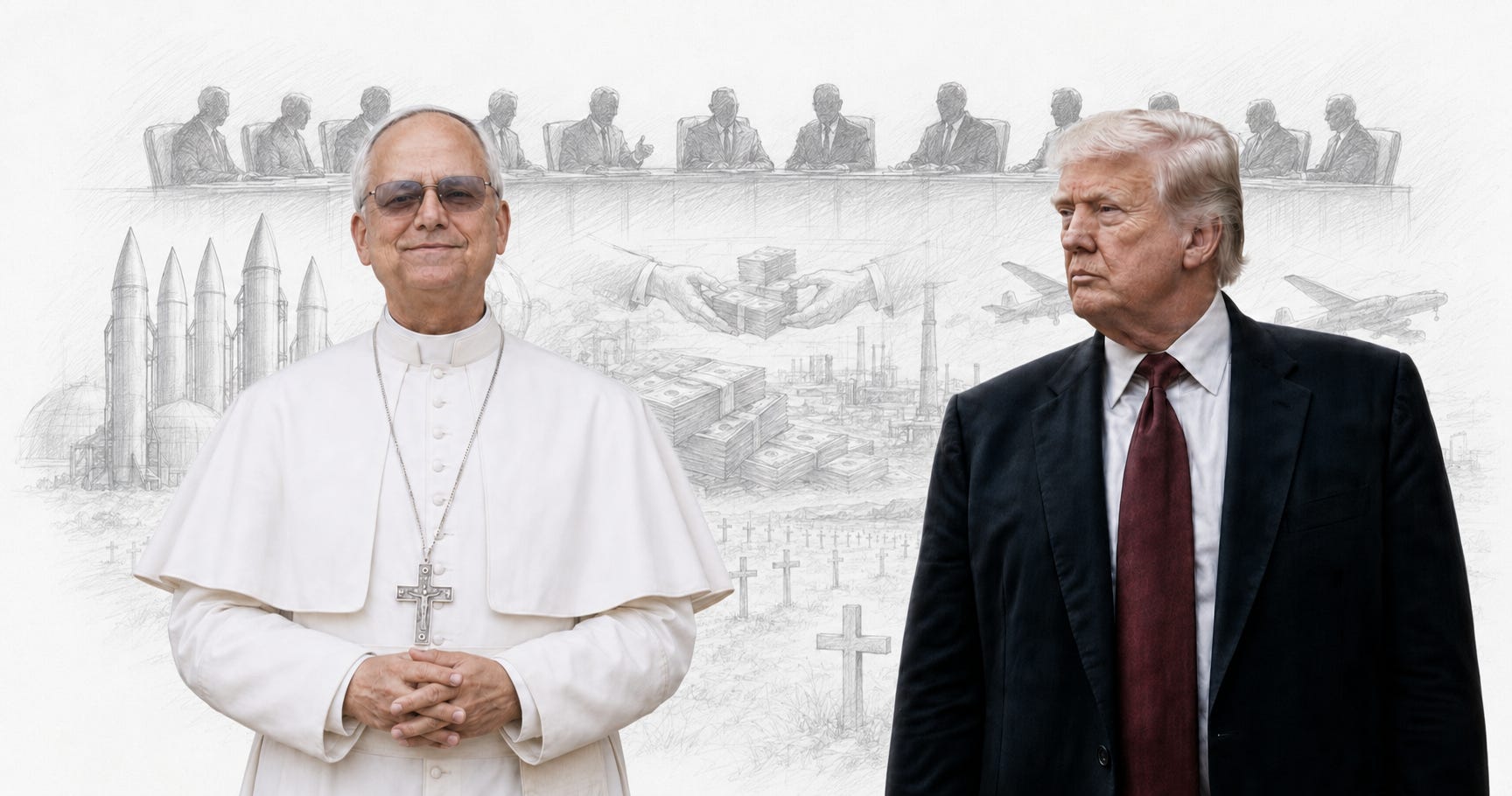
Quoting Bob Dylan, Pope Leo XIV Demands Nuclear Disarmament as Trump Reignites the Iran War
In a new Vatican book out today, the pope asks whether the human species may “continue to inhabit the Earth.” One month after Trump’s Versailles peace memorandum, American bombs fall on Iran nightly.

Pope Leo XIV called for nuclear disarmament on Tuesday in a new book from the Vatican’s own publishing house, writing that “it is not atomic weapons that generate peace, but disarmament.”
The book — Disarmed and Disarming: Peace Is a Gift, edited by the Italian journalist Alessandro Banfi and released today in Italian by the Libreria Editrice Vaticana — collects the pope’s addresses on peace since his election, opening with a foreword from Leo himself. An English edition is due out soon.
Among the authorities Leo summons is an American songwriter. “As singer-songwriter and poet Bob Dylan wrote, figuratively addressing the atomic bomb,” the pope writes, quoting “Go Away You Bomb,” the unreleased lyrics Dylan wrote against nuclear war in 1963: “I hate you cause yer man-made and man-owned an’ man-handled.”
The pope has seemingly reached for Dylan before. Preaching at St. Joseph’s Cathedral in Bamenda, Cameroon, in April, he declared that “the masters of war pretend not to know that it takes only a moment to destroy, yet often a lifetime is not enough to rebuild” — an apparent echo of “Masters of War,” the protest song Dylan released that same year, 1963.
He signed that foreword at the Vatican on June 19, one day after Donald Trump stood in the Palace of Versailles and signed a memorandum of understanding with Iran promising the “immediate and permanent termination of military operations on all fronts.”
The promise did not survive a month. American warplanes have bombed Iran through more than a week of consecutive nights, an Iranian attack on a U.S. base in Jordan killed two American service members late last week and left a third missing, and Iranian drones struck American facilities in Kuwait and Bahrain on Monday. The war has now killed sixteen Americans.
Peace was supposedly all but finished. Scott Jennings announced in late May that a senior administration official had told him the Iran deal was “95 percent” agreed. Donald Trump Jr. celebrated the framework the next day as “a HUGE win for America,” boasting that his father was achieving “exactly” what he promised on Iran.
A White House that was “95 percent” done with peace in May is bombing Iran’s coastline in July. Vice President JD Vance negotiated the framework now burning; Trump has taken to telling reporters the two men are “philosophically” different on the war — though the vice president has stood by him as the conflict grinds into its fifth month.

Leo’s foreword reads like a dispatch from a man watching all of it. “Today, a good 103 states are involved in some way in a war on Earth,” he writes. “Weapons boom and kill in Ukraine, in the Middle East, in Sudan, in Myanmar, in Yemen, in Congo, and in many other situations.”
He reaches back to John Paul II’s warning that the recourse to war has become “an adventure with no return.” He worries about autonomous weapons — “a world in which machines, albeit sophisticated and faster than us, are the ones to decide to bomb defenseless people would be truly frightening” — extending the argument of Magnifica Humanitas, his encyclical on artificial intelligence.
The fear is personal for him. On the first day of the renewed war, American missiles destroyed the Shajareh Tayyebeh elementary school in Minab, in southern Iran, killing more than a hundred children — and the parents of the dead wrote to Pope Leo, telling him they now press their children’s “burned bags and bloody notebooks” to their chests. As I reported in April, the letter moved him deeply. Questions about how, and by what, the school was targeted remain open.

Then he asks: “Must the human species continue to inhabit the Earth? The combination of the cyber domain and global rearmament impels one to seriously ask this question.”
The foreword closes with gratitude that God has placed us “among the present problems,” and with a charge: “It is no longer permitted to anyone to be mediocre.”
The pope against the war
The collection doubles as a record of Leo’s confrontation with this war.
He condemned the campaign within days of its renewal, pleading at his March 1 Angelus for the parties “to assume the moral responsibility to stop the spiral of violence before it becomes an irreparable abyss.” Stability and peace, he said that morning, are built “only through a reasonable, authentic, and responsible dialogue,” never with “weapons, which sow destruction, pain, and death.”
Through Lent, he implored Trump to find an off-ramp and end the war by Easter.
Trump answered on Truth Social. He branded Leo “Weak on Nuclear Weapons,” declared that “I don’t want a Pope who thinks it’s OK for Iran to have a Nuclear Weapon,” and boasted that “if I wasn’t in the White House, Leo wouldn’t be in the Vatican.”
The pope took the question aboard the papal plane to Algeria in April: “I am not afraid of the Trump administration. I speak about the Gospel, I am not a politician.”
He answered the nuclear smear directly, telling reporters outside Castel Gandolfo on May 5: “The Church has spoken for years against all nuclear weapons, so there is no doubt there.”
By June the judgment was formal. “There is no just war there,” he told reporters en route to Madrid, adding that just-war theory “comes from centuries past when we couldn’t imagine the weapons, human beings’ ability for destruction.”
A city-state of 800 souls
This month the administration tried a new argument. Brian Burch, Trump’s ambassador to the Holy See, told the New York Times on July 9 that Leo had issued his judgment “not as the leader of the Roman Catholic Church, the vicar of Christ, but only as the sovereign political leader of the Vatican City State.” The pope could not truly judge the war, Burch reasoned, because he holds only “a set of limited facts.”

Vatican City covers 121 acres and houses roughly 800 residents. By Burch’s arithmetic, the man who condemned this war speaks for a population smaller than a midsize parish festival.
The Vatican rejected the theory in writing. On July 13, Andrea Tornielli, editorial director of the Vatican’s communications dicastery, published a response approved at the Vatican’s higher levels: “The pope always speaks as a shepherd.” Even on war and peace, Tornielli wrote, “the Successor of Peter remains, above all, a spiritual leader” — a pastor to 1.4 billion Catholics whose temporal sovereignty Paul VI once called “tiny and practically symbolic.”
The making of a disarmed pope
Burch’s theory carries a further, fatal defect: Robert Prevost was preaching this peace decades before he acquired a state to speak for.
The cardinals who elected him knew exactly what they were choosing. In The Election of Pope Leo XIV, Gerard O’Connell and Elisabetta Piqué record Cardinal Charles Maung Bo of Yangon warning in the days before the conclave that “more than thirteen thousand nuclear weapons remain armed and ready to destroy human civilization several times over,” and that “a single spark of hatred could unleash a nuclear holocaust, turning cities to ash, rivers to poison, and the sky to darkness.”
Start with the first words of the papacy. On the evening of May 8, 2025, the new pope stepped onto the balcony of St. Peter’s Basilica and greeted the world: “Peace be with you all!” The peace of the risen Christ, he said that night, is “a disarmed peace and a disarming peace, humble and persevering.” Today’s title repeats the words he chose in his first hour as pope.
The lineage runs deeper still. In American Hope, his portrait of the pope, Christopher Lamb records that Prevost was ordained a deacon in 1981 by Bishop Thomas Gumbleton — a founding member of the peace group Pax Christi USA, arrested for civil disobedience protesting nuclear weapons. The bishop who first laid hands on the future pope spent his own life demanding the abolition of the bomb.
Two years later he marched himself. On October 22, 1983, roughly one million people filled Rome to protest NATO’s deployment of cruise missiles at Comiso, in Sicily, and among them walked Father Prevost, then a canon-law student in the city, carrying a sign that read “Agostiniani per la Pace” — “Augustinians for Peace.”
The photograph of that moment, taken by the Stigmatine priest Gianni Novelli, resurfaced after his election — and became a controversy, because the coalition that organized the march included the Italian Communist Party. The friars who walked beside him have answered the insinuation plainly. “He is not a politician but a pastor,” says Father Giuseppe Pagano, who has known the pope since that day.

Peru tested the conviction. Prevost arrived in 1985, as Sendero Luminoso’s terror spread through the north of the country that made him.
In Elise Ann Allen’s biography of the pope, Leo remembers a bomb placed at the door of the bishop’s house in Chulucanas, and three priests assassinated in the diocese of Chimbote, south of Trujillo. The peaceful marches of those years stayed with him as well — Catholics organized them, he says, “to protest against terrorism and to say, ‘We’re not going to run, and we are going to promote peace and look for other ways of solving problems that are not the choice of terrorism.’”
He also names his teacher. “I remember Gandhi and reading some of his stuff on a peaceful protest to promote the good of the people and not to use violence, but to authentically preach a message of peace and dialogue,” the pope told Allen, recalling his refusal of the armed currents then running through Peruvian church circles. “That was something that made a lot more sense to me.”
His seminarians in Trujillo marched under a sign reading “If you want peace, work for justice.” When Peruvian soldiers boarded a minibus in the mid-1990s to conscript those same young men into the army, the New York Times reported last year, Prevost stood up to them: “No, these young men are going to be priests; they cannot go to the barracks.” A seminarian who was on that bus, Father Ramiro Castillo, remembered it simply: “When he had to speak, he spoke.”
Offered a bodyguard amid death threats, Prevost declined — “I don’t think I want a bodyguard; it makes it too obvious who you are.” His own summary of those years, preserved in Allen’s pages, runs three words: “But we stayed.”
The Church against the bomb
When Leo tells Trump that “the Church has spoken for years against all nuclear weapons,” he is citing the record. John XXIII wrote in Pacem in Terris, at the height of the Cold War in 1963, that “nuclear weapons must be banned.” Two years later, Paul VI carried the plea to the United Nations floor: “Never again war!” The warning about war as “an adventure with no return” that Leo quotes in today’s foreword comes from John Paul II.

And it was Francis who flew to Hiroshima in 2019 to declare the use and the possession of atomic weapons alike “immoral,” under whose authority the Holy See became one of the first states to ratify the U.N. Treaty on the Prohibition of Nuclear Weapons. I wrote last August about how Leo carried that inheritance to the Hiroshima anniversary as the first American pope.

Today’s foreword compresses the whole tradition into one sentence — deterrence has the logic of peace backward, because “it is not atomic weapons that generate peace, but disarmament.”
The man Burch says holds “a set of limited facts” refused a bodyguard during a terror campaign, faced down soldiers to protect his seminarians, and has been preaching nonviolence since the Reagan administration. He asks in today’s book whether the human species may continue to inhabit the Earth. The government of his native country answers with another night of airstrikes and a press release calling it peace.
“It is no longer permitted to anyone to be mediocre.” The pope wrote that line for all of us.
At Letters from Leo, we stand with Pope Leo XIV and the millions of Catholics — joined by countless people of goodwill — who believe that human beings were not made to live under the shadow of their own extinction, and that a government which signs a peace at Versailles and breaks it within a month owes the world more than slogans.
We are the fastest-growing Catholic community in the country because people are hungry for moral clarity about war — for reporting that takes the Gospel seriously enough to test power against it, and for a faith that refuses to bow before the idols of fear and the bomb.
If you believe this movement matters — Catholics and people of goodwill standing for human dignity against a war machine that calls itself peace — I am asking you to join us.
If you’d like to invest in our mission, here are three ways you can help:
Subscribe as a paid member to receive exclusive posts about the life and formation of Pope Leo and help sustain this newsletter.
Donate with a one-time gift to fuel this project’s mission.
Share this post (and Letters from Leo) with a friend who might enjoy it.
Paid members receive our ongoing series on Pope Leo’s life and formation — including the Peru years that shaped the pope you met in this essay — along with the Epstein-Bannon investigation and Pope Leo Takes On AI.
And you can go deeper into the three books behind today’s reporting with our essays on Elise Ann Allen’s historic biography, Christopher Lamb’s revelatory portrait, and the inside story of the conclave that elected him.
Whether you give $0, $5, $50, $500, $1,000, or more, your presence here matters — no matter your faith or your politics.
Thank you for reading. I’ll see you on the road.


Thank you for the newsletter, Chris. A Nobel prize winner Bob Dylan is . I find this very inspiring. I will continue to pray for Pope Leo and this country. Most of all I will continue to pray for the parents whose sons and daughters have lost their lives.
Speaking of Bob Dylan, of whom I've been a faan for over 60 years. I think it's more appropriate for His Holiness to prepare us for "the hour that the ship comes in."
