
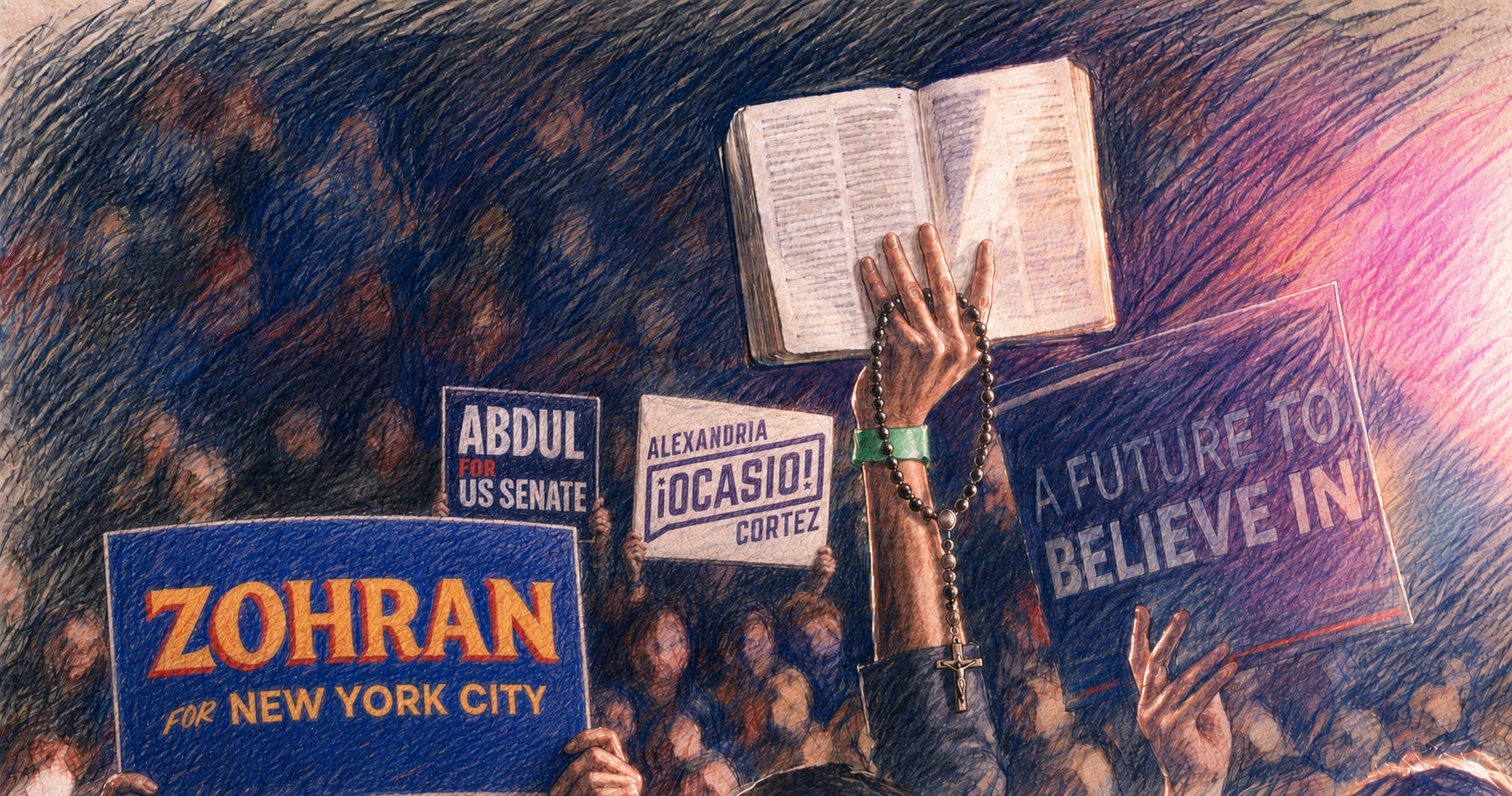
The DSA Was Born in the Catholic Church
Michael Harrington founded the DSA three decades after Dorothy Day put him to work on Chrystie Street. Bishop Barron has spent a year attacking a movement his own church helped raise.

Thank you for reading! Letters from Leo is a reader-supported publication and the fastest-growing Catholic community in the country. To receive new posts and support this movement, consider becoming a free or paid subscriber.
Chris Hayes asked Bernie Sanders on Thursday night about a man who died way back in 1989.
The Democratic Socialists of America were founded by Michael Harrington, Hayes reminded his MS NOW audience, and Harrington argued that socialists should work inside the Democratic Party as “the left wing of the possible.”
Sanders, in his younger years, wanted a clean break and new parties. The two, as Hayes put it, ran in the same circles and never settled the question between them.
Sanders conceded the argument, more or less. A successful third party is “very difficult to start,” he said.
“It just requires all kinds of money” and means “overcoming all kinds of state restrictions.”
As he pointed out, he ran for president twice inside the Democratic primary.
Before he touched strategy at all, though, he offered something closer to a eulogy for the late political activist.
“He was a wonderful, wonderful man,” Sanders said of Harrington, a man he admitted he never knew well. “He was involved with the Catholic Worker, as you may recall.”
Watch the exchange:
That aside points to a history most of the DSA’s admirers and nearly all of its enemies have forgotten — it was birthed in the heart of the Catholic Church.
American democratic socialism, as an organized force, grew up inside Dorothy Day’s Catholic Social Worker movement.
Michael Harrington was born in St. Louis in 1928, the only child of a wealthy Irish Catholic family, and was educated by the Jesuits first at St. Louis University High School, then at the College of the Holy Cross.

In 1951, at twenty-three, he walked into the Catholic Worker’s house of hospitality on Chrystie Street in Manhattan, where Dorothy Day and Peter Maurin had been practicing the works of mercy since founding the movement on May Day 1933.
He stayed roughly two years, helping edit the group’s penny newspaper and sleeping in the house, where he ladled soup for men off the Bowery. Day gave the rich, young Midwesterner his first in-person experience with American poverty, and the experience shaped everything he wrote afterward.

His faith, however, did not survive his time in New York.
Harrington described himself in later years as “a pious apostate, an atheist shocked by the faithlessness of the believers.”
The Other America, his 1962 study of the poverty that postwar prosperity had hidden, reached John F. Kennedy’s White House and is credited with helping push Kennedy and, after his death, Lyndon Johnson forward in fighting the War on Poverty.

Harrington founded the Democratic Socialist Organizing Committee in 1973. When it merged with the New American Movement in Detroit in 1982, the combined organization adopted the name Democratic Socialists of America.
Harrington co-chaired DSA alongside Barbara Ehrenreich until his death in 1989.
It now claims more than 100,000 members — by its own count, more than any socialist organization in American history — and its most visible member, Zohran Mamdani, governs New York City with an improbable friendship with Pope Leo XIV’s new archbishop, Ronald Hicks.

Day herself would have bristled at the label “democratic socialist.” She was a pacifist and a personalist who distrusted the state far too much to entrust the economy to it, and her radicalism ran deeper than any political or governmental program: voluntary poverty, houses of hospitality, and the corporal works of mercy.
However, she formed Harrington, who left the Church, alongside generations of Catholics who went deeper into it. The Worker asked only that you look at the poor and refuse to look away.
Bishop Robert Barron has spent much of the past year treating this lineage as an invading army. He answered Mayor Mamdani’s inaugural praise of “the warmth of collectivism” in January in hours with an essay claiming that collectivism “is responsible for the deaths of at least 100 million people in the last century.”
In May, he told Fox News that one of our two parties now offers “borderline communists” as serious candidates.
In a Fox column last month, he warned that “the success of radical socialists and communists in our electoral process is, for religious people, a real and present danger.”
None of this history obliges Barron to admire democratic socialists, and the Church has quarreled with some forms of socialism since the nineteenth century. However, history shows that the Church has had a unique friendship with this movement.
The organization he warns America about was founded by a man formed at Dorothy Day’s soup line — and Day is a Servant of God whose canonization cause the Church itself has opened, a woman Pope Leo XIV praised by name in St. Peter’s Square this past November.
“She had fire within. Dorothy Day took a stand,” the pope told pilgrims at a Jubilee audience, remembering a woman who involved herself “with workers, with migrants, those cast aside by an economy that kills.”
Father Thomas Reese, the Jesuit priest and veteran Vatican analyst, pushed this convergence to a unique question in Religion News Service last week: is Pope Leo a democratic socialist?
“When Leo speaks,” Reese observed, “he certainly sounds like a Democratic Socialist.”
The evidence he gathered comes mostly from Magnifica Humanitas: the pope’s warning that “the pursuit of greater profits cannot justify choices that systematically sacrifice jobs,” and his judgment that “it is no longer possible to rely solely on the ‘invisible hand’ of the market.”
I don’t believe the pope is a democratic socialist, and Reese lands in nearly the same place, concluding that “Pope Leo is not a card-carrying Democratic Socialist, but he certainly holds many of the same goals as they do, especially on economics and foreign policy.” Leo’s economics flow from an older source.
Neither am I, for the record.
He chose his name in honor of Leo XIII, whose Rerum Novarum demanded the living wage and defended the worker’s right to organize in 1891 — the same encyclical that condemned the socialism of its day for seeking to abolish private property.
The pope stands where the Church has stood for 135 years, on ground that predates both American parties and challenges both of them in kind.
Benedict XVI, no lefty, wrote in 2006 that “in many respects, democratic socialism was and is close to Catholic social doctrine,” and credited it with “a remarkable contribution to the formation of a social consciousness.”
Of course, there are differences. The modern DSA platform embraces abortion rights without apology, and the Church doesn’t.
The man who became Leo XIV has never been afraid of left-wing company, either. In October 1983, a young Augustinian friar named Robert Prevost joined a mass demonstration in Rome against NATO’s Euromissiles, holding a hand-lettered sign that read Agostiniani per la Pace — Augustinians for peace — in a crowd whose organizing coalition stretched from Pax Christi to, controversially, the Italian Communist Party.

I wrote about that photograph in July, when the pope renewed his demand for nuclear disarmament as American bombs fell on Iran. He has been marching, in one form or another, for more than four decades.
The Gospel, of course, is not a socialist program, and the Church has refused for over a century to serve as anyone’s party mouthpiece. Yet the same Church that educated Michael Harrington in the corporal works of mercy keeps producing people who cannot make their peace with an economy that in the words of late Pope Francis, “kills.”
One of them held a peace sign in Rome in 1983 wearing the black habit of the Augustinians, and he now teaches the world in a white cassock from the Chair of Peter.
Leo XIV’s argument is simple: profit can never justify the systematic sacrifice of jobs. Whatever name American politics gives that conviction, its roots are as old as the gospel.
So when Bernie Sanders paused on national television to remember that Michael Harrington “was involved with the Catholic Worker,” he was honoring more than an old rival. He was acknowledging, whether he meant to or not, where the whole project began: with young Catholics on Chrystie Street led by a young convert with a newspaper who believed the poor were worth everything.
Both the Church and the democratic socialists have kept her memory. And God-willing, when she becomes St. Dorothy, we will remember the movement she spawned — Harrington’s included.
Let’s remember this the next time a bishop mistakes the Catholic Worker’s children for the enemy.
At Letters from Leo, we stand inside a tradition that has never needed a party’s permission to defend the poor. Dorothy Day cooked for men the world had forgotten, and what Michael Harrington carried away from her ministry changed how a nation saw its hidden poor.
Pope Leo XIV carries the same fire today, against an economy that treats workers as cogs in the wheel and politics as entertainment through cruelty.
This is the fastest-growing Catholic community in the country because people are hungry for a faith that names what our economy does to human beings and then feeds them while the dictatorship of superficiality rages on all around us.
If you believe this movement matters — Catholics and people of goodwill standing for human dignity against an economy of discard — I am asking you to join us.
If you’d like to invest in our mission, here are three ways you can help during this critical time:
Subscribe as a paid member to receive exclusive posts about the life and formation of Pope Leo and help sustain this newsletter.
Donate with a one-time gift to fuel this project’s mission.
Share this post (and Letters from Leo) with a friend who might enjoy it.
Paid members receive the full biographical series on Pope Leo’s life and formation, along with the Epstein-Bannon investigation and the Sunday scripture reflections that anchor this community each week.
Whether you give $0, $5, $50, $500, $1,000, or more, your presence here matters — no matter your faith or your politics.
Thank you for reading. I’ll see you on the road.


Thank you for the history of the DSA. Very enlightening!! I had forgotten about Michael Harrington until Chris Hayes mentioned him on MS NOW.
Dorothy Day is one of mine!