


Thank you for reading! Letters from Leo is a reader-supported publication and the fastest-growing Catholic community in the country. To receive new posts and support this movement, consider becoming a free or paid subscriber.
Jean-Marie Delbos is 80 years old, and until Sunday he had not been to Mass in 60 years. He went to Lourdes that morning.
By evening he was sitting with Pope Leo XIV in the bishop’s residence, one of seven survivors of clerical sexual abuse the pope received privately on the third day of his apostolic journey to France.
“He took me with both arms,” Delbos told reporters afterward. “I never thought that it was the pope who was holding me.”
Delbos was sexually abused by a priest as a boy at Notre-Dame de Bétharram, a Catholic boarding school in southwest France a short drive from the shrine. His book about it sat on the table in front of him as he spoke.
“You can imagine, I lost my faith,” he said. When Leo gathered the survivors and offered to bless them, Delbos made the sign of the cross. “Even me, a notorious unbeliever,” he added. “This guy made me cross myself.”
The meeting was scheduled for 30 minutes, according to Colleen Dulle of America, and it ran nearly two hours. Leo met each of the four men and three women alone (two asked that their names be withheld), then sat with the whole group.
The Vatican said he thanked them “for their painful testimony” and reaffirmed his “commitment to ensuring that the evil they experienced is not repeated for others.” Before they left, he asked them to pray for him.
The survivors left hopeful and clear-eyed at once.
Jérôme Guillement said the pope grasped that abusers act as individuals while “the systemic dimension within the institution” lets the abuse go on.
Olivier Mardi, co-founder of Voix Libérées de Touraine, told reporters that Leo “is not fooled and knows that these events will continue and that we must remain vigilant.” Véronique Garnier, the author, allowed herself a little more: “I do indeed believe there is hope.”
France has earned the caution.
In 2021, an independent commission known as CIASE estimated that clergy abused 216,000 children between 1950 and 2020, and that the number reaches 330,000 once lay Church workers are counted.
Before Leo arrived, the sanctuary covered the mosaics Father Marko Rupnik made for the Basilica of Our Lady of the Rosary; the former Jesuit, accused of abuse by more than 20 women, now faces trial at the Vatican.
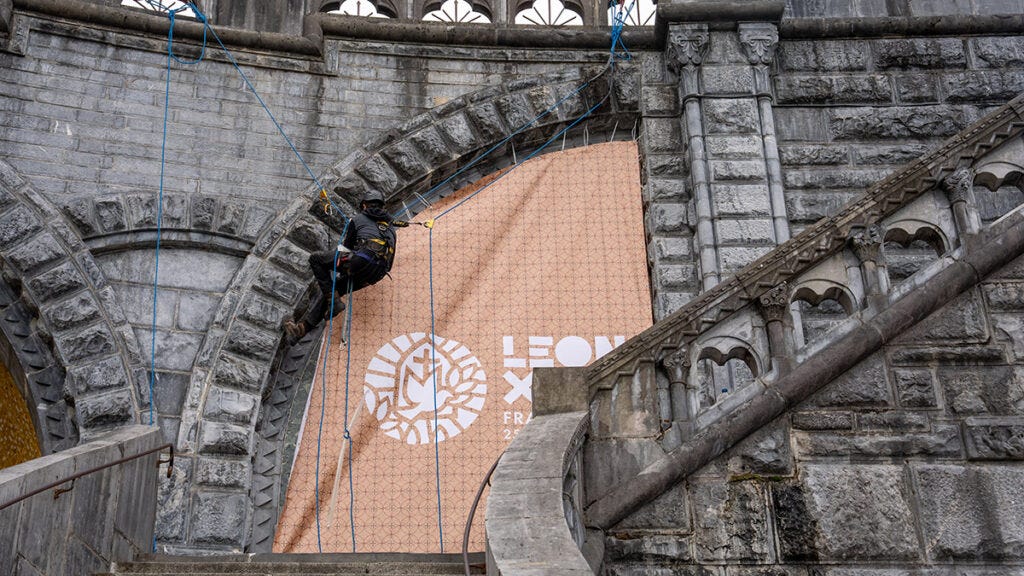
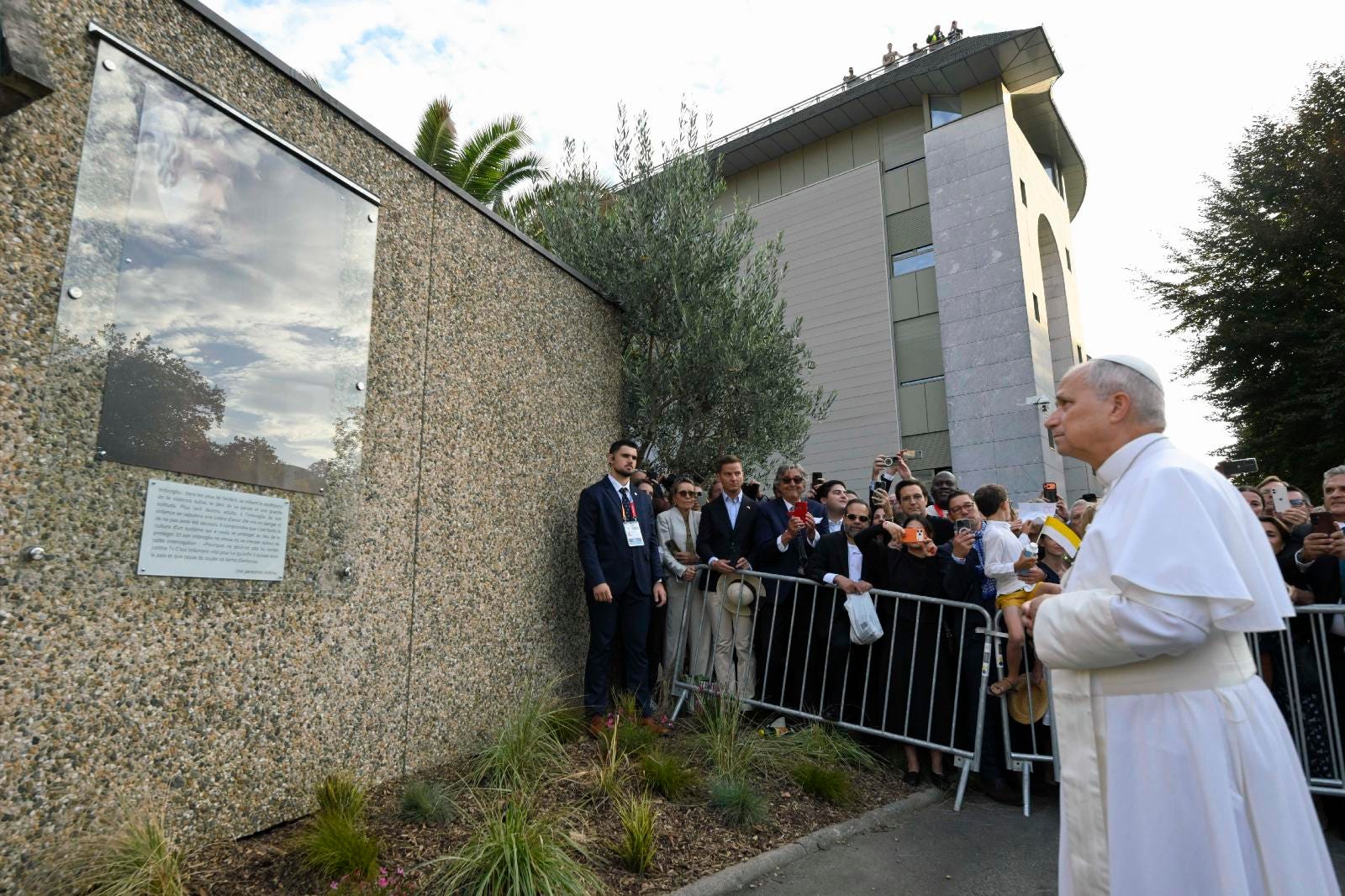
Leo built the whole day around the wound of sex abuse. He stopped at the shrine’s memorial to abuse victims on his way to France’s bishops, whom he told to “acknowledge failings with a love of the truth.”
At Mass before 150,000 pilgrims, he said the Church “must have the courage to begin with herself,” as I reported yesterday. Last October he became the first pope to meet with an organized group of abuse survivors and advocates, and on Sunday he brought that practice to France.
“A pilgrim among pilgrims”
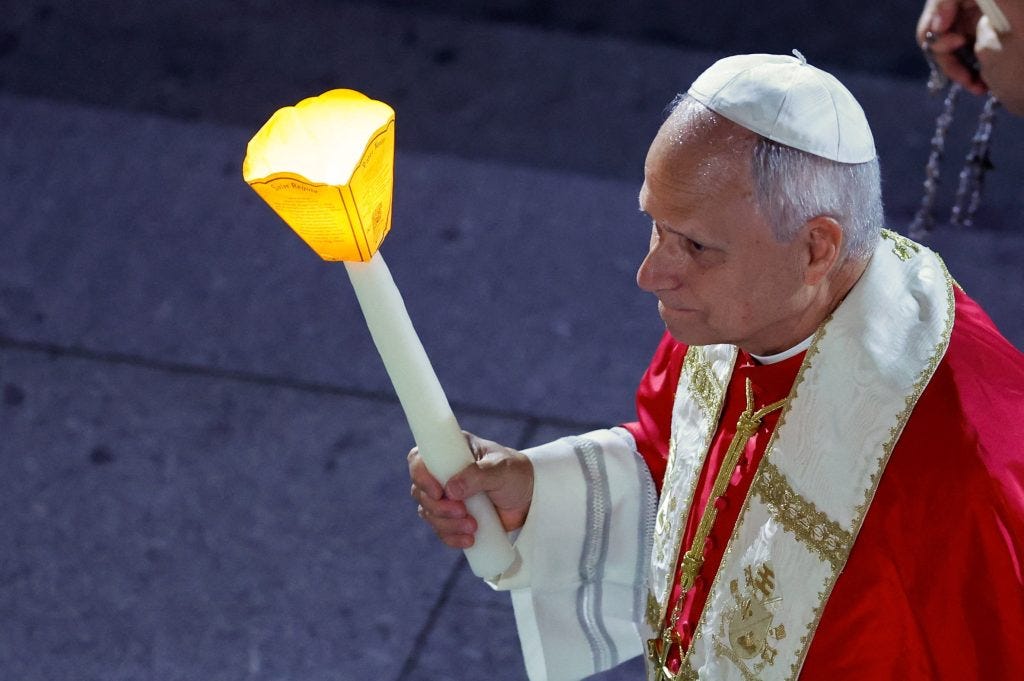
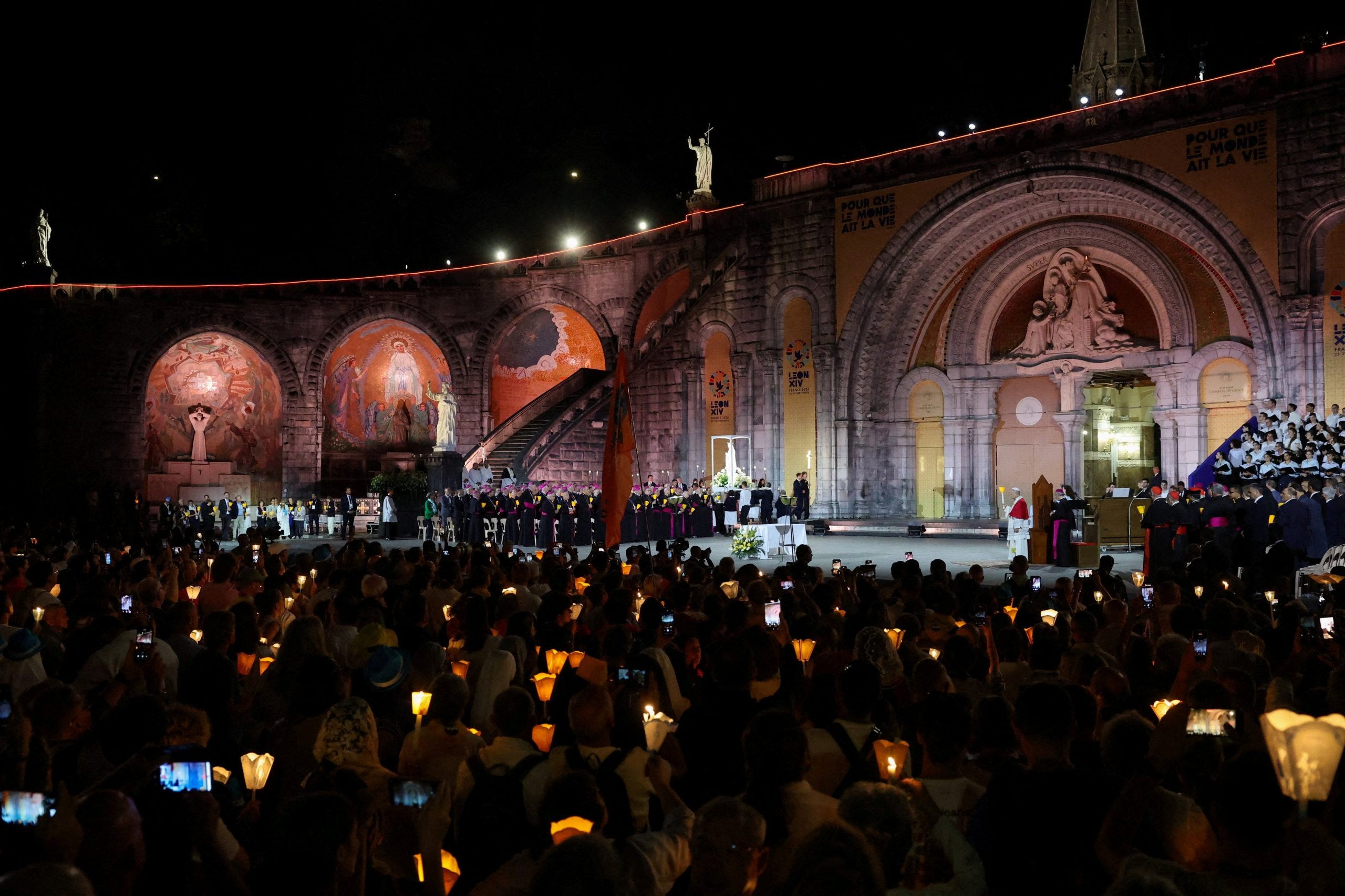
At nine o’clock that night, Leo carried a candle behind an illuminated statue of the Virgin in the sanctuary’s torchlight procession, a Lourdes custom that turns the esplanade into a field of small flames. Tens of thousands walked with him, many in wheelchairs, praying the Glorious Mysteries of the Rosary in several languages and lifting their candles between Mysteries.
He told them he had come as “a pilgrim among pilgrims,” and he spoke to the sick directly. They are, he said, “privileged witnesses” to what faith and love can make of a suffering life.
He quoted Pius XII’s 1957 encyclical on Lourdes, Le Pèlerinage de Lourdes: “No one has ever seen such a procession of suffering in one spot on earth, never such radiance of peace, serenity, and joy.”
That afternoon he had told some 5,000 sick pilgrims and caregivers at the Accueil Notre-Dame that “killing the sick is neither compassionate nor normal, and being legal does not make it moral,” an answer to France’s new assisted-dying legislation.
Leo keeps locating the Church’s credibility in the people it is most tempted to hide, whether they lie in a hospice bed or still carry the wounds of what a priest did to them sixty years ago.
Metz: “To profane that name”
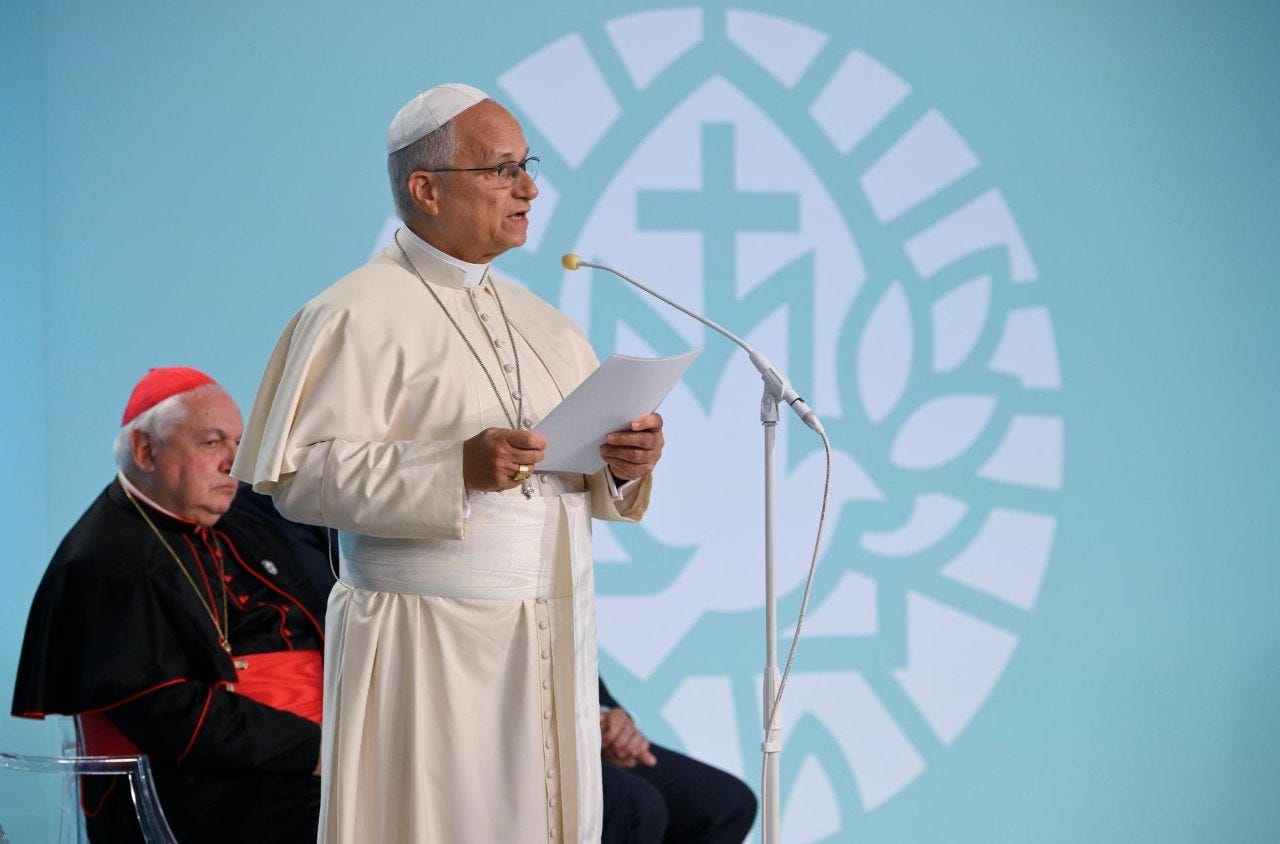
On Monday morning Leo reached Metz, the first pope to visit the city since John Paul II in 1988. He sat at the Robert Schuman Congress Center, named for the statesman whose 1950 declaration bound French and German coal and steel together so that war between the two nations would become impossible.
Around him, the Associated Press reported, were France’s Chief Rabbi Haïm Korsia, Chems-eddine Hafiz of the Grand Mosque of Paris, Protestant Federation president Christian Krieger, Greek Orthodox Metropolitan Dimitrios and Anthony Boussemart, representing France’s Buddhists.
Schuman, the pope told them, “knew how to transform old dividing lines into bridges of hope for all of Europe.” Then he turned to the faiths in the room.
“Indeed, to invoke God’s name in order to justify violence or oppression is to profane that name. Nothing that disfigures human dignity can claim to be inspired by God. Religious discourse must constantly call for the disarmament of hearts and words.”
Three days after he called war “the most terrible of human works” in Paris, Leo carried the argument into the one arena where believers can’t blame someone else. He closed by quoting Magnifica Humanitas, his encyclical on artificial intelligence: the Church regards all who sincerely seek “truth, goodness and beauty” as companions on the journey.
Less than two weeks ago, the Vatican marked sixty years of Nostra Aetate with a note calling dialogue essential to the Catholic faith, and right-wing Bishop Joseph Strickland, who was removed from his diocese by Pope Francis, told Catholics to “reject and repudiate” it.
The address in Metz proves that the pope has no intention of doing so.
To the roots of Europe
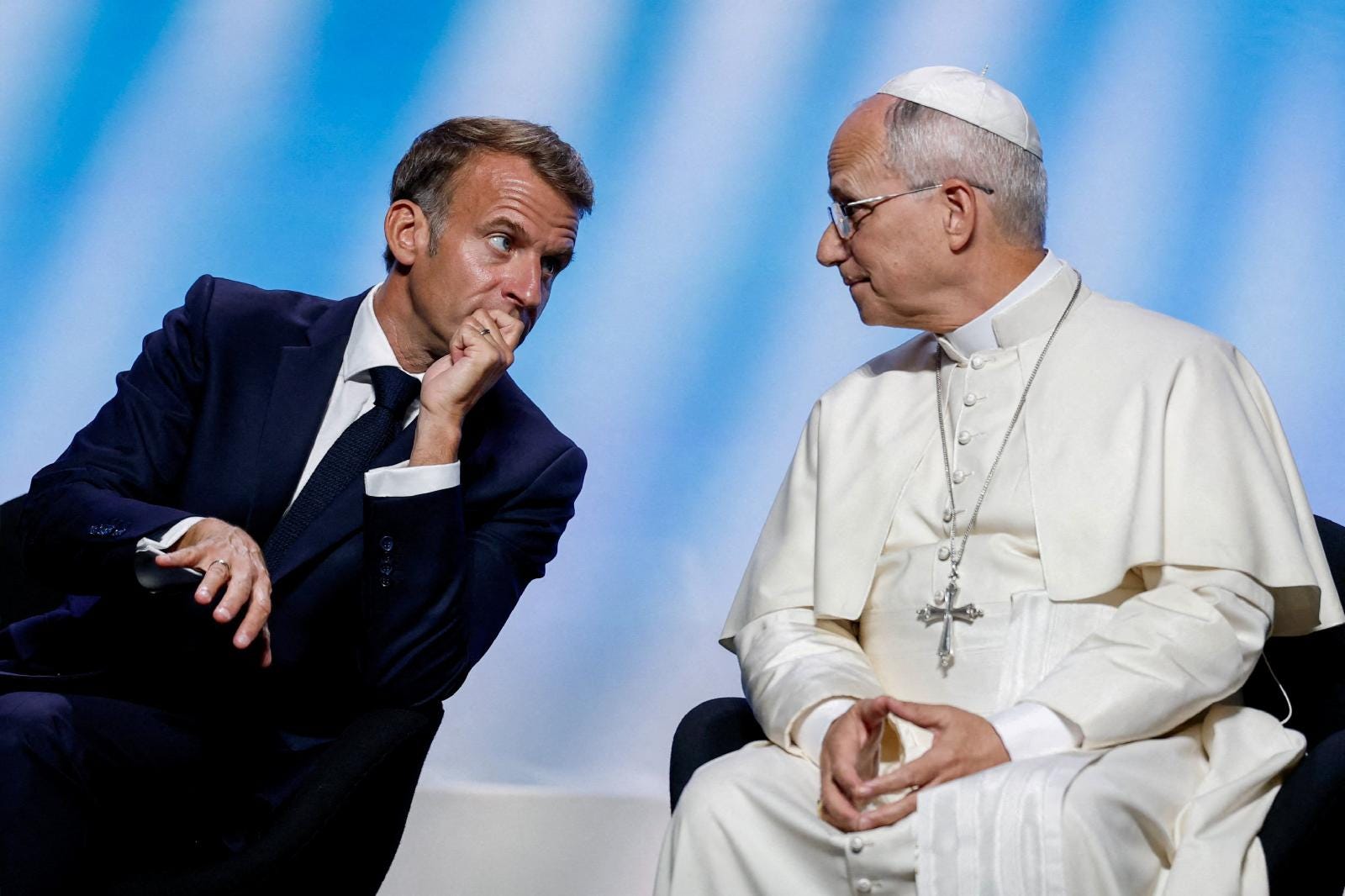
The journey’s last meeting followed in the same hall, under the title “To the Roots of Europe for Peace and Unity,” with President Emmanuel Macron seated beside the pope. Leo traced Europe’s roots through Saint Benedict and Robert Schuman before he turned to the case for rearmament.
“We must also guard against the illusion that rearmament is the answer,” he said, and he quoted his own World Day of Peace message:
“It is no coincidence that repeated calls to increase military spending, and the choices that follow, are presented by many government leaders as a justified response to external threats.”
He described public life in terms any American reader will recognize. “Today, relations between individuals and States are becoming increasingly uncivilized,” Leo said. “The value of keeping one’s word is dismissed; instead, people boast of lies and deceit.” On migration, he told the hall that to welcome a person “means to integrate them as if they were part of one’s own family.”
Leo celebrates a final Mass at St. Stephen’s Cathedral, beneath its Marc Chagall windows, before flying back to Rome this evening.
The survivors in Lourdes will judge this journey by what Leo does once he is back in Rome, and several of them said as much. Delbos has already reached his verdict on the man. On Sunday morning, for the first time in six decades, he went to Mass.
At Letters from Leo, we stand with Jean-Marie Delbos, Véronique Garnier and every survivor who has refused to let the Church look away, and with a pope who says her conversion has to begin at home.
We believe, with Leo, that a civilization is measured “by the way it cares for, protects and upholds the human person.” In an age when powerful men keep borrowing God’s name to bless cruelty, we hold to a faith that sits with the abused and refuses to call violence holy.
This is the fastest-growing Catholic community in the country because people are hungry for a Church that tells the truth about itself and still believes in mercy.
Letters from Leo exists to write about that Church, the one Leo is building in real time, to the people who need to hear about it most.
If you believe this movement matters — Catholics and people of goodwill standing with survivors and the sick against a culture that discards them — I am asking you to join us.
If you’d like to invest in our mission, here are three ways you can help:
Subscribe as a paid member to receive exclusive posts about the life and formation of Pope Leo and help sustain this newsletter.
Donate with a one-time gift to fuel this project’s mission.
Share this post (and Letters from Leo) with a friend who might enjoy it.
Paid members receive our series on Pope Leo’s Life & Formation, our exclusive investigations, including the Epstein-Bannon Investigation, and the Sunday Scripture Reflection Series.
Whether you give $0, $5, $50, $500, $1,000, or more, your presence here matters — no matter your faith or your politics.
Thank you for reading. I’ll see you on the road.

I appreciate Pope Leo speaking with a few of the survivors of priest sexual assault: and I celebrate Jean-Marie Delbos' return to mass.
I think many American Catholics these days are magas. They tend to love hating others, so if that is violence...then violence is inside the Church, imo. :(