


Thank you for reading! Letters from Leo is a reader-supported publication and the fastest-growing Catholic community in the country. To receive new posts and support this movement, consider becoming a free or paid subscriber.
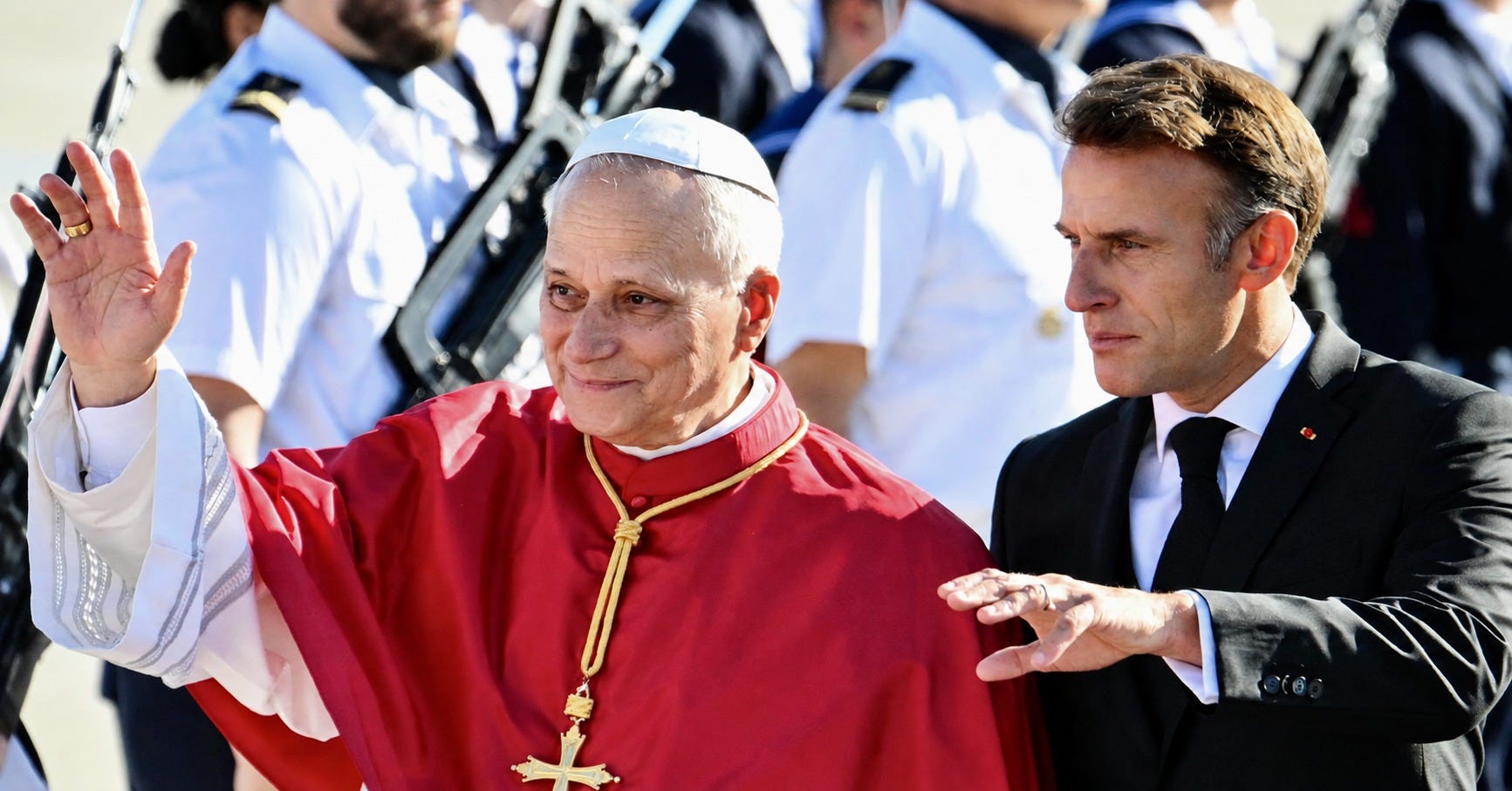
Pope Leo XIV landed at Paris-Orly on Friday morning to begin four days in France, the first papal visit to Paris since Benedict XVI in 2008. Emmanuel Macron met him on the tarmac, and by evening he had addressed the French state at the Élysée and the nations of the world at UNESCO. The day started, though, in the aisle of an airplane.
Pope Leo XIV answered the question about the White House shortly after the plane left Rome.
Christopher Lamb, CNN’s Vatican correspondent and the author of American Hope: What Pope Leo XIV Means for the Church and the World, one of the best books yet on this pontificate, stood in the aisle of the ITA Airways charter on Friday morning, thanked the pope for having reporters on board, and noted that some of his colleagues were “having difficulties in the White House.”
The pope smiled and answered in English.
“I am very happy that here you are all welcome,” he said. “Good coverage, I think, is very important, and we have it all the way around for everybody. Thank you.”
A note for readers: our four book offers are all extended through Sunday, September 27, at 11:59 PM PT.
Anyone who purchases a yearly subscription or gives $80 or more from one of the review essays receives a free copy of that book: Lamb’s American Hope, Elise Ann Allen’s Pope Leo XIV: The Biography, Gerard O’Connell and Elisabetta Piqué’s The Election of Pope Leo XIV, and the pope’s own first book, Freedom Under Grace.
Click through to the book’s review to claim it.
He never said Donald Trump’s name, which was unnecessary.
The White House confiscated the press badges of CNN, MS NOW, and Politico last weekend, and the president explained the decision himself: the outlets “purposely write negative things” about him.
On Thursday, the day before the papal flight, U.S. District Judge Timothy Kelly ordered the badges restored, ruling that the ban likely violated the reporters’ due-process rights (Trump’s own remarks, the judge noted, had been about negativity rather than the national-security rationale his lawyers argued in court). That same evening CNN and MS NOW were still turned away from the arrival of Xi Jinping for a state dinner.
More than 80 journalists from more than 10 countries were aboard.
He opened by apologizing to the ones who had flown with him to Spain in June, when a mechanical failure in the Canary Islands stranded the press corps and cancelled the customary return-flight news conference, “an incident that I had nothing to do with but which, I know, left a number of you unhappy.”
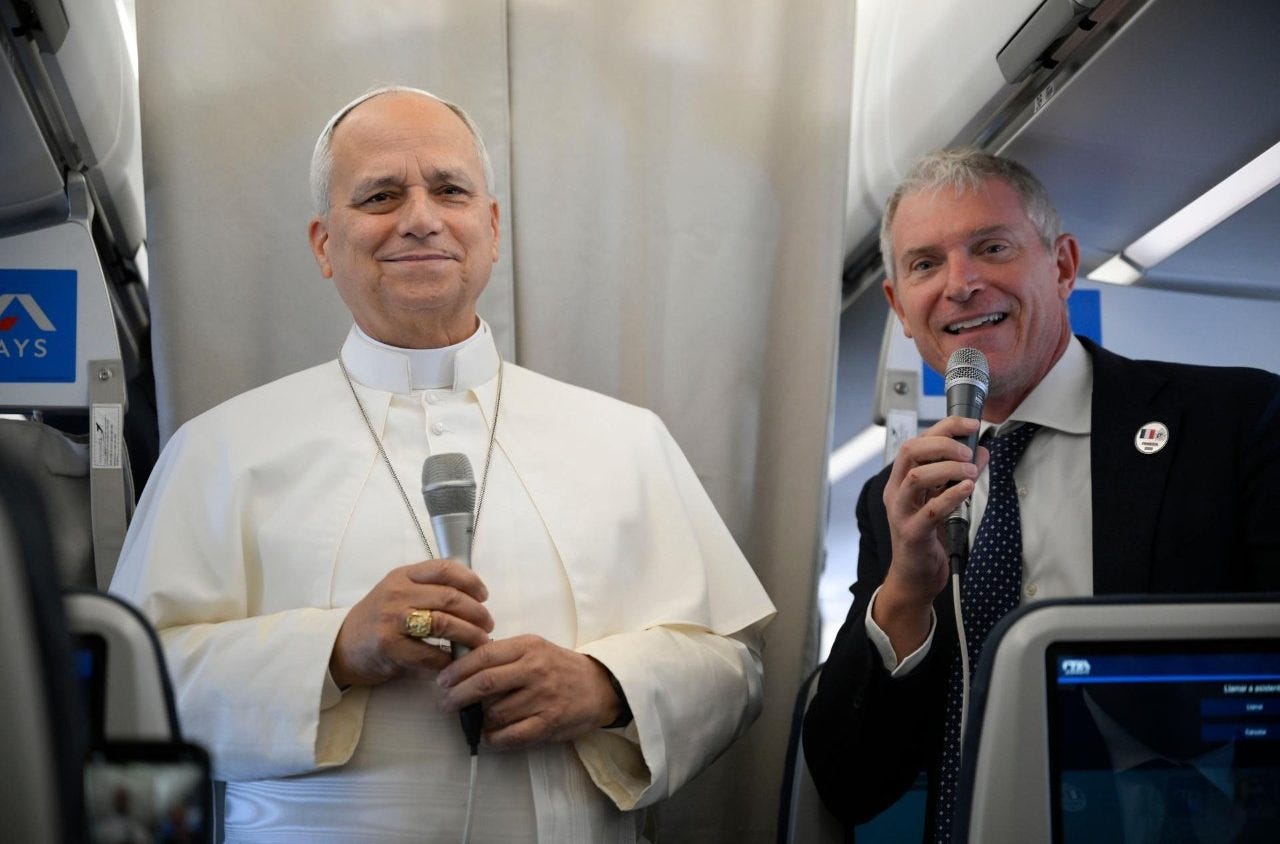
A reporter then reminded him that the Chicago White Sox had clinched a playoff berth the night before, two seasons after posting the worst record in modern baseball history, and asked whether the pope had anything to do with the miracle. “No comment,” Leo said, grinning. “Great things happen in Chicago.”
He was less coy about basketball. Villanova, his alma mater, opens its season against Notre Dame in Rome on Nov. 1, with a papal audience on the schedule, and the pope predicted the crowd would be “90% Villanova and 10% Notre Dame.”
We are splitting today in two. This is the civic half: the flight, the Élysée, and UNESCO. A second update tonight will cover the ecclesial side of the day, the pope with the Church of France.
The Élysée
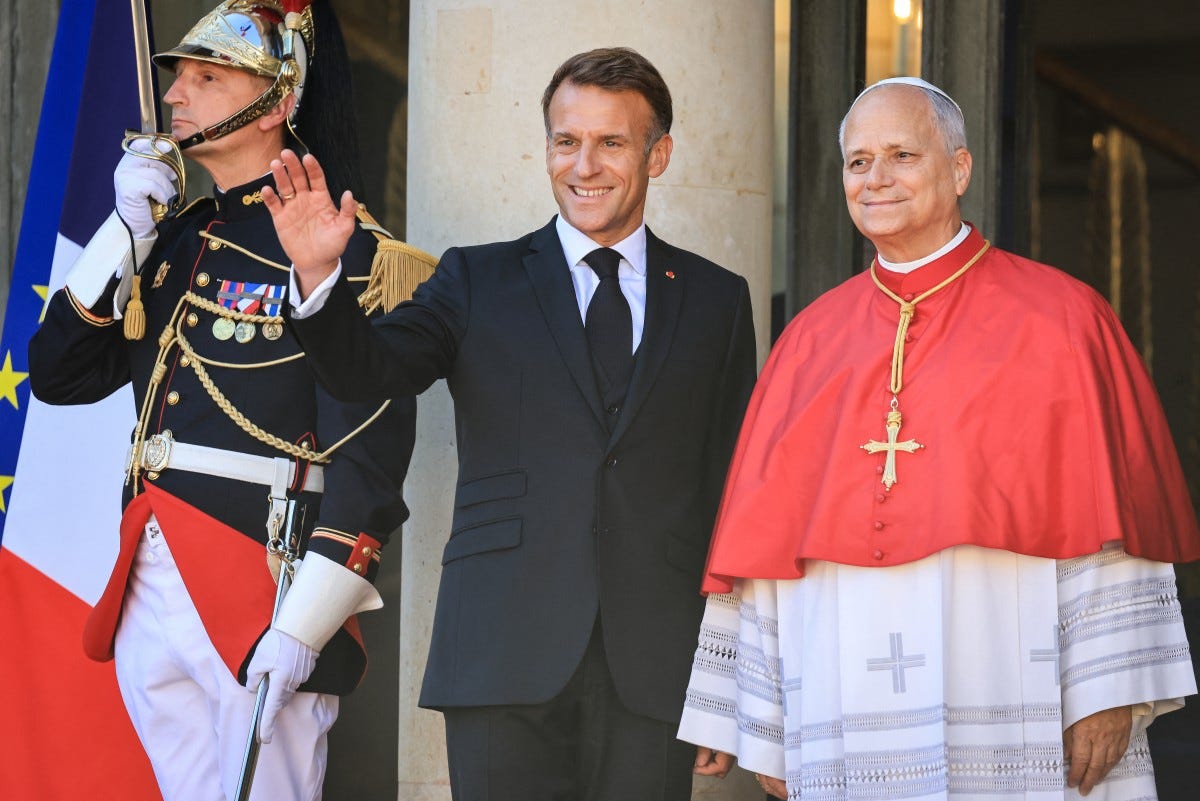
Leo spoke French at the Élysée Palace, and Emmanuel Macron smiled as he did. The speech was built around a warning borrowed from Georges Bernanos, the Catholic novelist who wrote La France contre les robots in exile in Brazil during the Second World War. Bernanos feared that blind obedience would deliver Europe into a “Paradise of Machines.”
Leo told the diplomatic corps that avoiding that paradise now requires “an urgent need for education in ethical discernment,” and he tied the argument to Magnifica Humanitas, the encyclical on artificial intelligence he published in May.
Here is the Bernanos passage in his own French, with our subtitles.
The rest of the address named, with courtesy, the places where the Church and the Republic part ways.
He said that “the mistaken belief that the possession of nuclear weapons is a guarantee of security is spreading and fueling a new arms race,” standing in the capital of a nuclear power, and he asked France to work for “a peace that is unarmed and disarming.”
He listed surrogacy, genetic manipulation, the organ trade, and “the possibility of arranging one’s own death” as profit-driven ventures dressed up as science. On laïcité, the French doctrine of secularism, he was patient and plain: “authentic secularity does not exclude religion but is capable of valuing it as an educational resource.”
He closed by quoting Macron’s own 2018 line to the French bishops, that a president “who claims to be uninterested in the Church and in Catholics would be failing in his duty.”
The passage on laïcité came a few minutes later.
Macron answered with a speech of his own. “Every life is worth the same, and all peoples must be defended,” he said, placing France “on the side of peace, active multilateralism, respect for international law and the United Nations Charter.”
Whatever divides Macron’s government from Leo’s Church, on bioethics above all, the two men plainly enjoy each other’s company.
They stated their differences kindly and spent more of the morning on the ground they share: Ukraine, Gaza, the Christians of the Middle East, and the defense of multilateralism. The grace ran both ways, with the president smiling through the pope’s French and the pope closing on the president’s own words.
Two other moments from the Élysée deserve to be seen rather than summarized.
He told his hosts that the “diverse origins” of the French people “have enlivened and enriched the nation and its democracy,” and he read their motto back to them: liberty, equality and fraternity, he said, “find in the Gospel message an inexhaustible source of inspiration and fulfillment.”
Then the motto.
UNESCO
The speech that will outlast the trip came at UNESCO’s headquarters on the Place de Fontenoy, where Director-General Khaled El-Enany welcomed the pope to a standing ovation. The address ran about half an hour and more than 3,500 words.
What made it fascinating was the language. Leo opened and closed in French, then switched to English for the heart of it, roughly 18 minutes, in Paris, at an institution France has hosted for eighty years.
He wanted the address heard across the globe, and it is the longest English-language speech of his pontificate. I expect it to serve as one of the magna cartas of how Leo understands the Church’s role in the world.
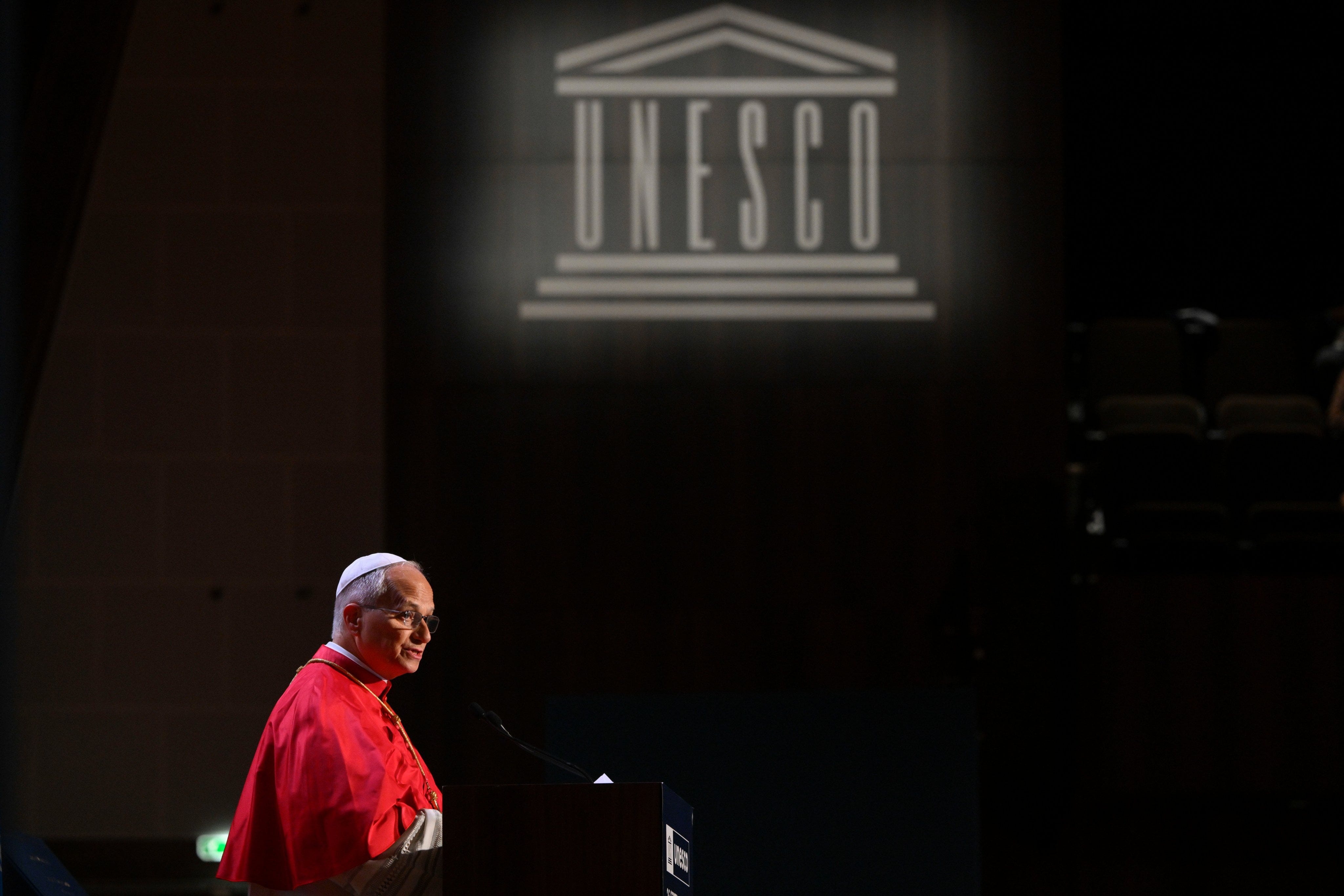
He began where Saint John Paul II began in the same building on June 2, 1980, with genus humanum arte et ratione vivit, and he defended the institution itself.
The United States announced in July 2025 that it is leaving UNESCO, effective at the end of this year. Leo told the room that international bodies face “a crisis of effectiveness, especially in situations where dialogue is seen as an obstacle to action rather than a resource for peace, a charade rather than an opportunity to seek the common good together,” and that the Holy See “wishes to increase this trust in UNESCO, as well as other international organizations.”
The English portion carried his answer to the question at the center of the address: what does it mean to be human?
Every person, he said, arrives as a child, and so all of us are brothers and sisters. We also arrive naked and in need. The third claim, that we arrive free and therefore answerable for what we do, is where he turned to war.
“To be human, then, implies a responsibility before history,” he said.
“The human being is one who grows, learns and works with both hands and mind. By that labor, we may cultivate the earth or disfigure it, create works of art or destroy them. At this particular juncture, we must recognize that the most terrible of ‘human works’ is war, for then science itself is placed at the service of an inhumane will to destroy and to kill.”
His defense of diversity ran through two biblical images, the tower of Babel and the square of Pentecost. Babel, he said, is “a unity imposed through domination,” and its modern forms are “a globalization pursued without fraternity,” “rapacious forms of neocolonialism,” and “ideological impositions.”
Pentecost is the square where each person hears the message “in his own native language,” and communion there “in no way suppresses diversity.” Readers of his address on human diversity last week will recognize the argument, aimed here at the nations themselves.
“Indeed, without truth, language becomes subject to the logic of violence and to the arbitrary will of the powerful,” he said.
“Others are then excluded in the name of profit, and the innocent are killed in the name of freedom. Instead of respecting the law, those in power invoke it when it serves their interests and disregard it when it restrains them, treating even justice itself as though it were a commodity to be bought and sold. If we realize that the corruption of the law begins with the corruption of the heart, we can recognize how every science risks losing its proper meaning when pursued without ethics.”
He did not say which powerful men he had in mind. There’s no doubt more than one who fit the bill.
The passage closed on children.
He asked the international community to give “particular attention to the protection of children and young people,” in the theaters of war and online, and warned that “in the digital age, their vulnerability must never become an opportunity for exploitation.” Artificial intelligence, he said, “can correlate data” but cannot answer the question of meaning, because “meaning is the oxygen of the mind.”
Consider the day as a whole.
Between takeoff and the end of the afternoon he took the side of reporters banned from the White House, asked a nuclear power to disarm, told a secular republic that faith belongs in its schools, and assured a United Nations agency that Washington is abandoning of the Holy See’s trust.
Those positions share a single root, the conviction he named at UNESCO: the inalienable dignity of every person, whatever a government or an algorithm decides that person is worth.
At Letters from Leo, we stand with the reporters who were turned away from the White House this week and with the pope who welcomed them aboard, because a Church that believes the truth sets us free cannot be indifferent to who is allowed to report it.
Leo told UNESCO that “the corruption of the law begins with the corruption of the heart.”
This is the fastest-growing Catholic community in the country because people are hungry for something deeper than rage and propaganda. They are looking for courage, for truth, for love made visible in action, and a day like this one in Paris shows what that looks like when a pope carries it into the halls of power.
That sentence is about Paris, Washington, and capitals across the globe at once, and it is the reason this community exists. People are hungry for a faith that speaks in every native language and refuses the unity that domination imposes.
If you believe this movement matters — Catholics and people of goodwill standing for human dignity against the arbitrary will of the powerful — I am asking you to join us.
If you’d like to invest in our mission, here are three ways you can help:
Subscribe as a paid member to receive exclusive posts about the life and formation of Pope Leo and help sustain this newsletter.
Donate with a one-time gift to fuel this project’s mission.
Share this post (and Letters from Leo) with a friend who might enjoy it.
Paid members receive the full biographical series on Pope Leo’s life and formation, our running coverage of Pope Leo’s fight over artificial intelligence, and the Sunday Scripture Reflection Series.
Whether you give $0, $5, $50, $500, $1,000, or more, your presence here matters — no matter your faith or your politics.
Thank you for reading. I’ll see you on the road.
