


Thank you for reading! Letters from Leo is a reader-supported publication and the fastest-growing Catholic community in the country. To receive new posts and support this movement, consider becoming a free or paid subscriber.
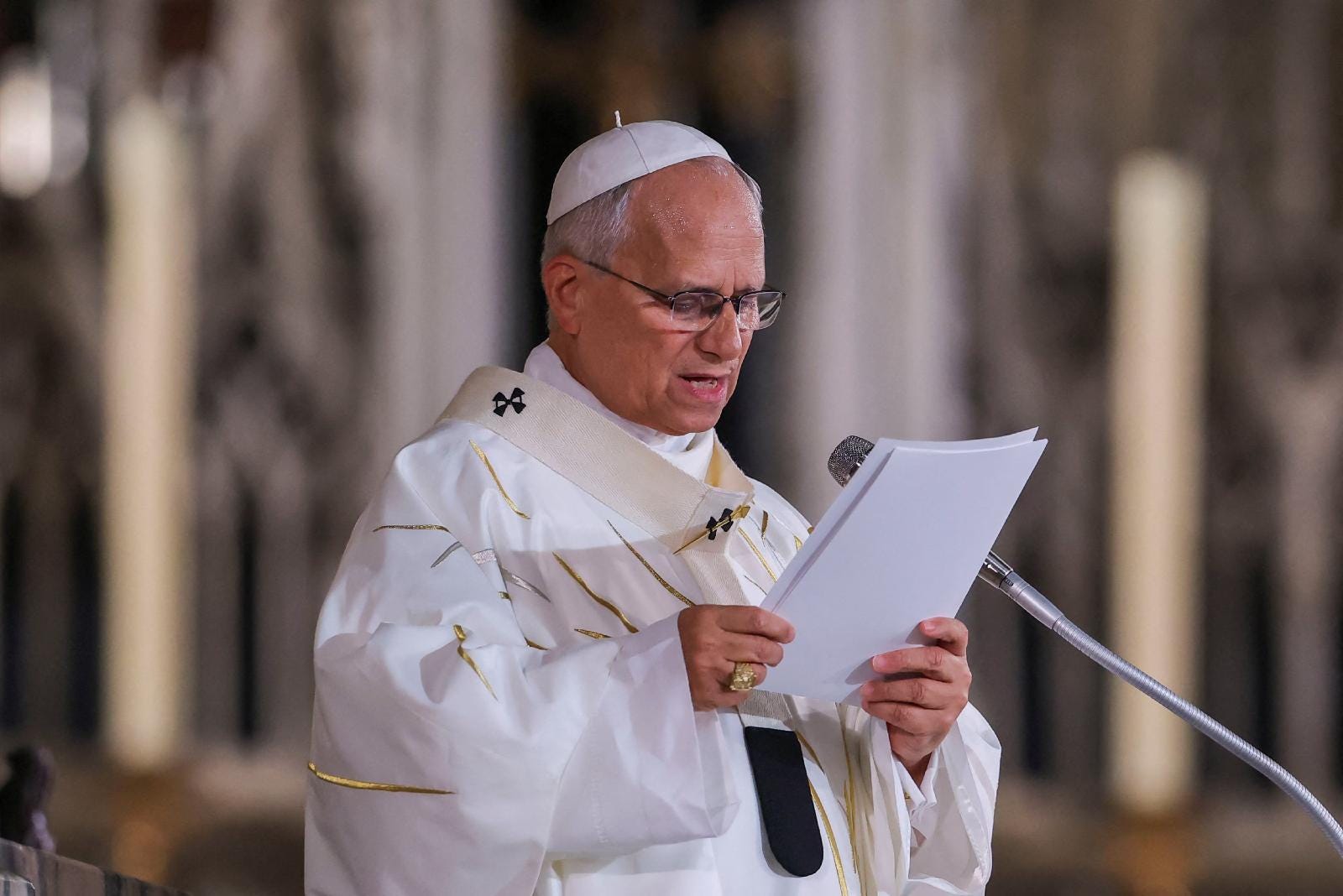
Pope Leo XIV ended his journey to France on Monday afternoon beneath the stained glass of St. Stephen’s Cathedral in Metz, and he used his last homily on French soil to preach forgiveness to a city that spent much of the last 150 years on the front line between France and Germany.
Metz has changed flags four times since 1871 (German after the Franco-Prussian War, French in 1918, annexed by the Nazis in 1940, liberated in 1944), and Leo spoke to that history directly.
“Those of you, who are the children of this land torn apart in the past by fratricidal conflicts, know full well that it is not true that those who seek revenge are stronger than those who forgive. It is not true that those who refuse to yield are stronger than those who seek reconciliation. It is not true that those who walk away are stronger than those who face the challenge of walking together.”
Some 35,000 people filled the cathedral and the streets around it, where large screens carried the liturgy, CNA reported. President Emmanuel Macron and his wife, Brigitte, sat in the front row. The Élysée said Macron had rearranged his schedule to attend, citing “his wish to continue his productive dialogue with the Pope.”
“The courage to break the chains of resentment”
The Gospel was Matthew 5, where Jesus tells his disciples to turn the other cheek and walk the second mile. Leo saw the objection coming. “To some, these words might seem like a sign of weakness, or a concession to evil, but that is not the case,” he said, and he asked the congregation to look honestly at what “vengeance, retaliation, and rejection” bring about, in the world and inside themselves.
His answer was the city itself. “Metz and Moselle bear witness to the whole world that reconciliation is only possible when one has the courage to break the chains of resentment,” he said. Robert Schuman, whose 1950 declaration pooled French and German coal and steel so that war between the two nations would become “materially impossible,” lived and is buried in Scy-Chazelles, just outside the city.
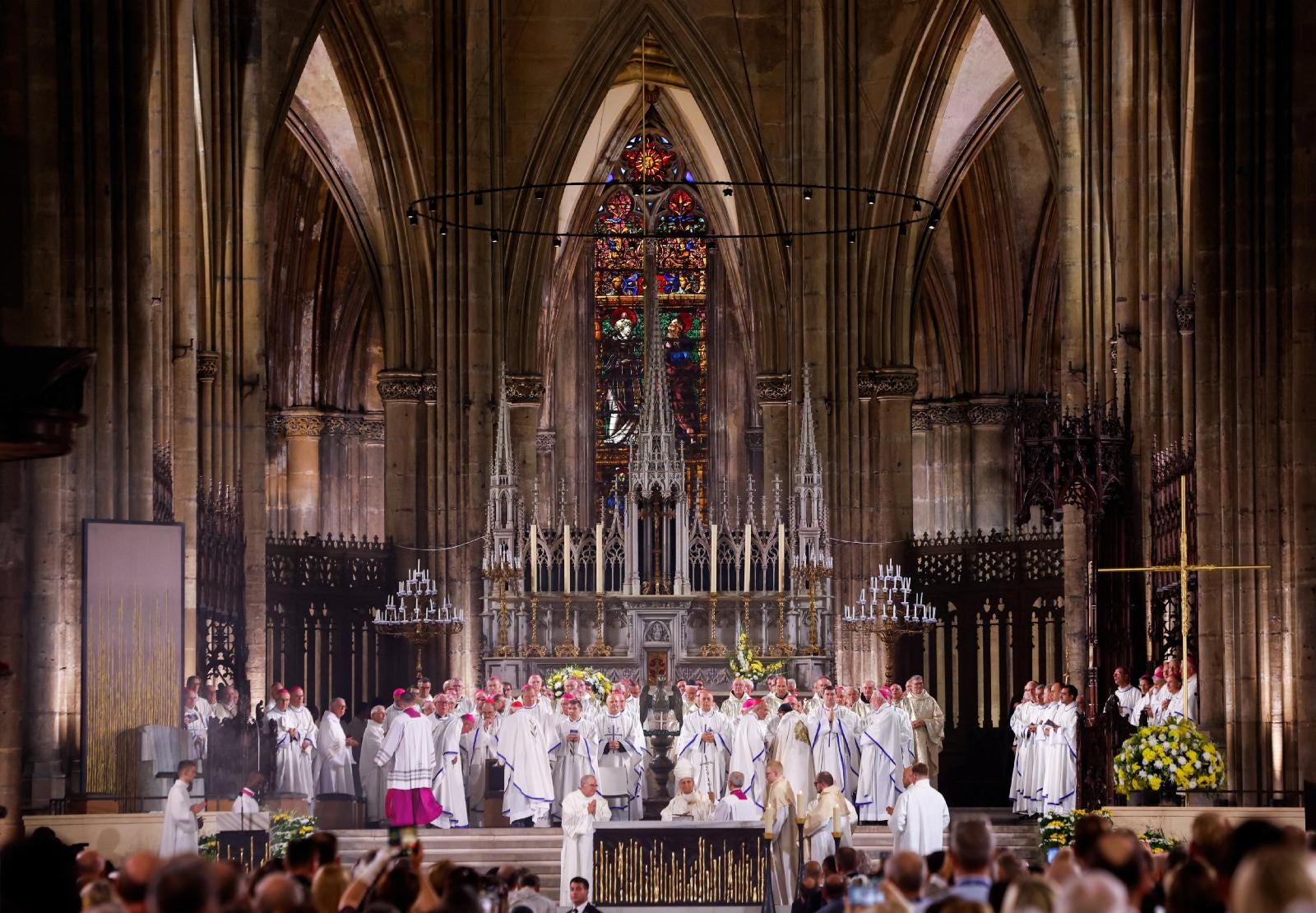
The pope found his image for the continent in the windows above him. The cathedral is known as the “Lanterne du Bon Dieu,” the Good Lord’s Lantern, for its 6,500 square meters of glass, some of it the work of Marc Chagall, whom Leo called “this great Jewish painter.” God’s light, he said, “does not erase our unique identities but rather unites different histories and cultures into a single marvelous mosaic of peace.”
“Europe’s future does not lie in uniformity, but in the harmony of differences,” Leo said, “where the wounds of the past become openings through which light shines.”
He then named what Europe inherited from the Gospel: the sacred nature of human life “at all stages and under all circumstances,” the family, care for the poor, respect for the elderly, and “welcoming the stranger.”
Americans have heard a different creed from their president. “I am your warrior. I am your justice,” Donald Trump told CPAC in March 2023, early in his comeback campaign. “And for those who have been wronged and betrayed, I am your retribution.” On Monday, the first American pope stood in a city that has paid dearly for the politics of revenge and preached the Sermon on the Mount instead.
A morning on Europe and war
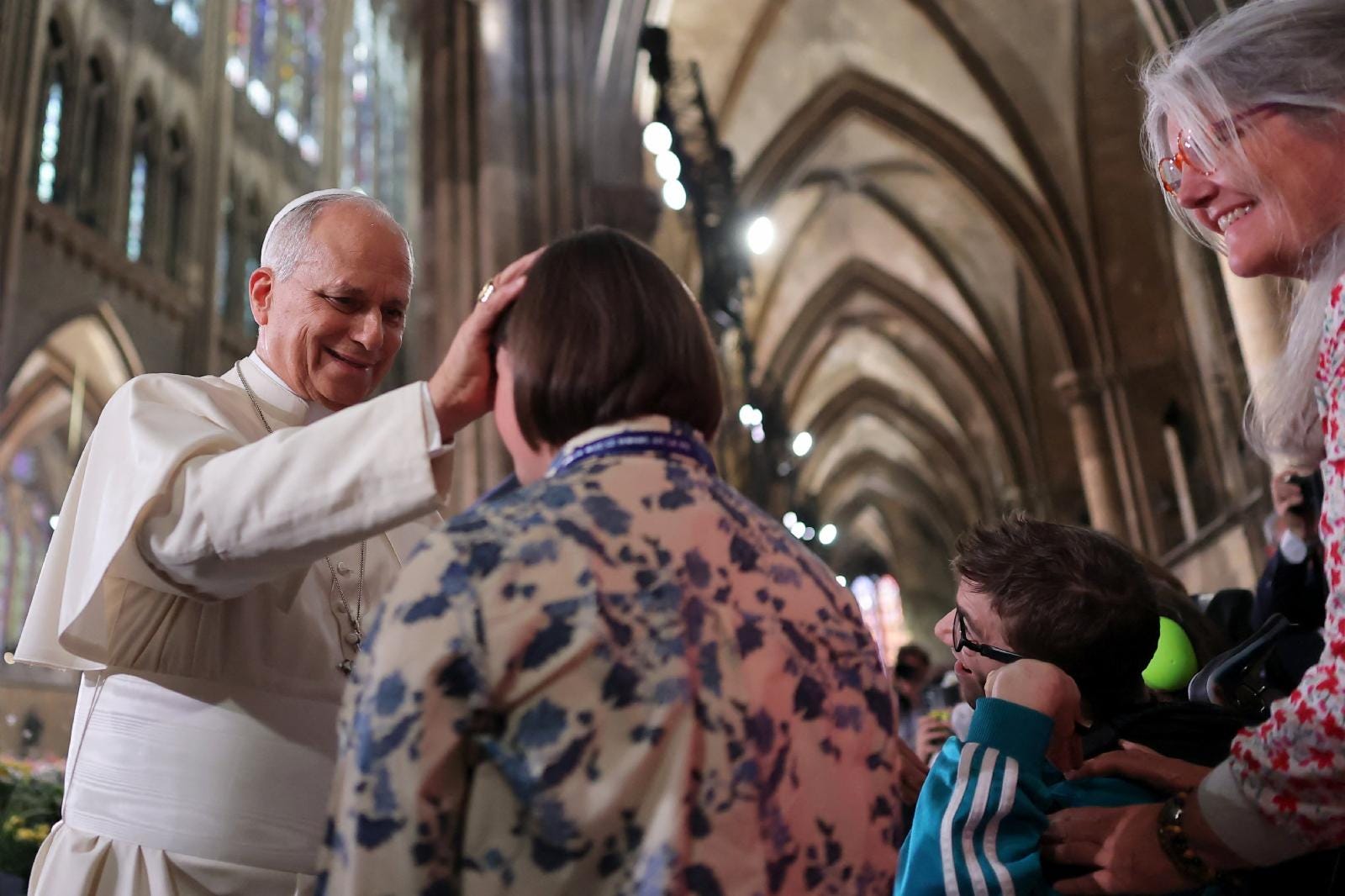
The homily closed a day Leo gave over to peace. At the Robert Schuman Congress Center that morning, he told France’s religious leaders that invoking God’s name to justify violence “is to profane that name.” Then, with Macron seated beside him, he warned Europe “against the illusion that rearmament is the answer,” as I reported earlier today.
“Today, sadly, war has returned, even to Europe: a new ‘senseless slaughter,’ claiming countless civilian lives every day,” he said, borrowing Benedict XV’s name for the First World War. He asked for “patient dialogue” and for leaders willing “to give up some positions for the greater good of peace.”
“Sad that he is leaving”
After Mass, Leo signed the guestbook with a single line, “May the peace of God reign always in the city of Metz,” and Mayor François Grosdidier handed him a wooden tennis racket, OSV News reported. Macron then accompanied him to Metz-Nancy-Lorraine Airport, where the two met privately before a farewell ceremony with military honors and both national anthems.
“We are sad that he is leaving, but happy that it went well,” the president said at the foot of the stairs, according to Agence France-Presse.
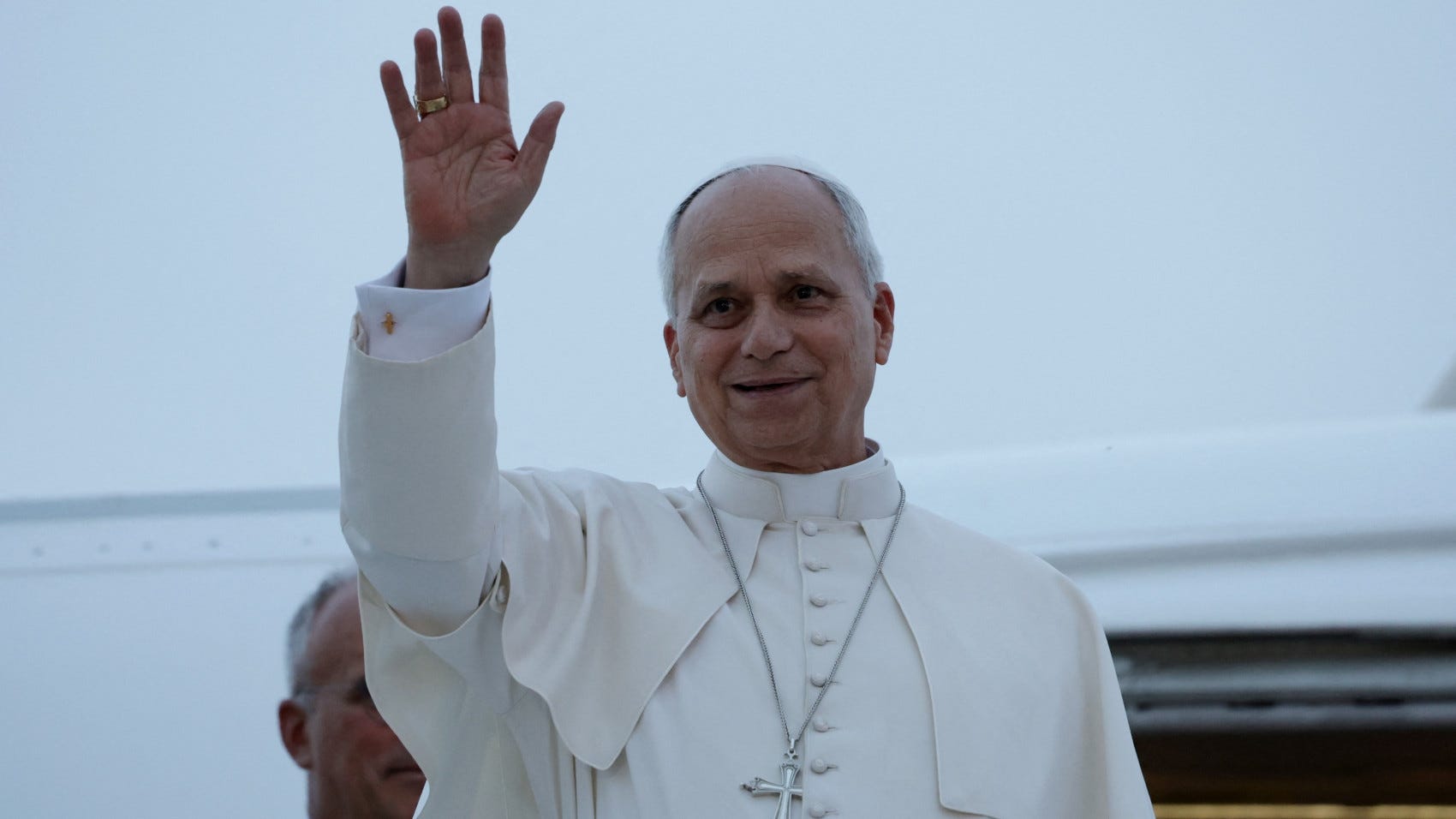
The Air France flight took off shortly after 7:30 p.m. and was due at Rome’s Fiumicino airport a little after 9, with the customary press conference for the reporters on board.
“We’re applying the Gospel to people’s lives”
On the flight to Rome, Leo took questions from the roughly 80 journalists on board. Xavier Le Normand of Le Pèlerin asked whether his repeated criticism of France’s new euthanasia law had crossed the line of laïcité, the French separation of religion and politics. Leo said he had not.
“When the Church speaks about defending life, when it speaks about questions of Social Doctrine, we’re not entering into politics, we’re applying the Gospel to people’s lives,” he said, and he sent the reporter back to the opening chapters of Magnifica Humanitas.
Cyriac Zeller of I.Media asked whether he considers sexual abuse in the Church systemic, as the survivors he met in Lourdes had told reporters he did. Leo preferred other words, but he conceded that “some organizations within the Church” have, “at times, if you will, as a system, been abusive.”
He named none of them, but the question of Opus Dei is already in front of him. In February he received the prelature’s leader, Msgr. Fernando Ocáriz, and Opus Dei said afterward that no publication date for its revised statutes “can yet be foreseen.”
A month later he gave a private audience in the Apostolic Palace to Gareth Gore, whose book Opus alleges that the movement recruited teenage girls from poor families to cook and clean for it without pay, as I reported at the time. Gore asked Leo for a formal, independent investigation, OSV News reported; Opus Dei denies the allegations.
Justin McLellan of the National Catholic Reporter asked about artificial intelligence, and Leo said he still sleeps at night. Then, without naming him, he turned to Nvidia’s chief executive, Jensen Huang, who says he has found a way to build guardrails into AI.
“He’s the same one, however, that says there should be no limits placed and no government regulation,” Leo said, seemingly rejecting that view. “This is a problem that I think we need to sit down and talk about.” Huang told a Dreamforce audience this month, “We don’t need any new laws.”
The last question came from Ludwig Ring-Eifel of Germany’s KNA news agency, about the rise of the far right across the border. Leo did not name a party. He said that the mixture of far-right politics “with a certain kind of religion” is, in his view and in the view of Germany’s Catholic and Protestant leaders, “not an authentic expression of Christianity,” and that the values of the Gospel “are not about hatred and division.”
Four days in France took him from 800,000 people at the Place de la Concorde to a Church he told to repent at Lourdes, and finally to a cathedral on the old frontier, where he asked a continent to stop mistaking vengeance for strength. Washington could stand to hear the same homily.
At Letters from Leo, we stand with Pope Leo XIV and with the people of Metz, who learned across two world wars that reconciliation asks more courage of a person than revenge ever will.
We believe, with Leo, that “it is not true that those who seek revenge are stronger than those who forgive.” In a season when an American president has promised his followers retribution, we hold to the Gospel of the other cheek and the second mile, and we refuse to call cruelty strength.
This is the fastest-growing Catholic community in the country because people are hungry for a faith brave enough to forgive, and for a Church that still believes the stranger has a place at the table.
If you believe this movement matters — Catholics and people of goodwill choosing reconciliation over the politics of revenge — I am asking you to join us.
If you’d like to invest in our mission, here are three ways you can help:
Subscribe as a paid member to receive exclusive posts about the life and formation of Pope Leo and help sustain this newsletter.
Donate with a one-time gift to fuel this project’s mission.
Share this post (and Letters from Leo) with a friend who might enjoy it.
Paid members receive our series on Pope Leo’s Life & Formation, our exclusive investigations, including the Epstein-Bannon Investigation, and the Sunday Scripture Reflection Series.
Whether you give $0, $5, $50, $500, $1,000, or more, your presence here matters — no matter your faith or your politics.
Thank you for reading. I’ll see you on the road.

Mr Hale, I look forward to your posts about Pope Leo every day.
I am an American Lutheran ( we call ourselves “Catholic Lite”).
The more I read about the pope, the more I find that he is a comunist!