


Thank you for reading! Letters from Leo is a reader-supported publication and the fastest-growing Catholic community in the country. To receive new posts and support this movement, consider becoming a free or paid subscriber.
According to a bombshell report in the New York Times, Anthropic co-founder Chris Olah saw an advance copy of Pope Leo XIV’s first encyclical days before its May 25 launch and proposed pulling out of the event because of what it said about AI consciousness. Two participants told the Times that Olah and his team then privately lobbied the pope’s advisers to take the possibility of machine consciousness seriously.
Elizabeth Dias, the paper’s national religion correspondent, published the story on Tuesday. It is extraordinary in scope and in length, and it is wonderfully done. Dias has covered faith and power for well over a decade, and it shows in every paragraph.
Her piece is built around a campaign Anthropic has run since last fall, a series of private meetings and calls with religious scholars (many of them under nondisclosure agreements) meant to raise the possibility that its Claude models “might be conscious or have moral status.” Olah, who leads the company’s interpretability research, sits at the center of it.
The courtship came with hospitality. One April evening, according to the Times, an Anthropic executive took a group of religious thinkers to dinner at an upscale tasting-menu restaurant in San Francisco. Participants went home with a handwritten thank-you note, a coffee mug and an orange-bound copy of Claude’s constitution.
The theologian David Decosimo, who teaches ethics and religion at the University of North Carolina, put it bluntly on X this week: Anthropic courted religious leaders under nondisclosure agreements “all while wining & dining them to the max.”
Many of the scholars and theologians in these rooms are working class, at least by Silicon Valley standards. Luxury hotels and tasting-menu dinners can be intoxicating.
The price of admission is steep, though, because they are being asked to set aside their own moral traditions for Anthropic’s vision of the world.
The ask
The lobbying is the real news, and it could have been the Times’s lede. Olah grew up evangelical and has since left Christianity, the Times reports, so he did not come to Rome steeped in how the Church teaches. Even so, the episode is remarkable.
An encyclical is among the highest forms of papal teaching. Catholics receive it from the man they believe to be the Vicar of Jesus Christ, and no frontier lab or billionaire gets to edit its doctrine.
Leo did not move. Paragraph 99 of Magnifica Humanitas says that so-called artificial intelligences “do not undergo experiences, do not possess a body, do not feel joy or pain.” Nor, the pope writes, “do they have a moral conscience.”
I do not think Olah is a bad man. He has acted in good faith, and I have credited him for engaging the Church while much of his industry sneered at the encyclical. But the ask shows how little Silicon Valley understands the Church, or religion at all.
Last fall I wrote that the industry’s original sin is a refusal to recognize any authority greater than itself, a temptation as old as Genesis: to be like God. Ten months later, that temptation is alive inside one of the more thoughtful labs in the business.
In professional settings, I have spoken with the people who work in the religious outreach efforts at the frontier labs (some call them philosophy teams, others describe their work as the philosophical underpinnings of the models), and at times I have come away unimpressed.
Few of them know Catholicism well. In one crude example, a man I met in person at a coffee shop (not a Michelin star restaurant!) who was a key contact for the Catholic community did not know what an encyclical was. He could not pronounce the word, and he kept calling the pope Leo XII.
There is a lot of work to do here.
Two speeches in the Synod Hall
Vatican officials invited Anthropic to the launch because the company appeared to be putting ethics first, according to the Times. Cardinal Michael Czerny first asked CEO Dario Amodei, who declined, and Olah went in his place.
Rereading his remarks after the Dias piece, one line stopped me. AI models, Olah told the hall, “are made from us, from our words.” He likened his work to “bringing a fictional character to life,” and he said his team keeps finding internal states that “functionally mirror joy, satisfaction, fear, grief, and unease.”
Any Christian hears the echo. The Gospel of John opens with the Word through whom all things were made, and that Word “became flesh and dwelt among us.”
Olah may not have meant the resonance; still, a vocabulary of words brought to life, spoken in the Synod Hall about a commercial product, uses the language of the Incarnation.
It cannot hold a sincere place in a Christian understanding of the world.
Leo’s address carried the day. He took the encyclical’s call to “disarm” AI and set it beside the Church’s long campaign against nuclear weapons. “Artificial intelligence needs to be disarmed,” the pope said. “The word is strong, I know, but deliberately chosen.” That line led the coverage worldwide, including ours.
He also thanked Olah by name for accepting the invitation, a sign that Rome wants the conversation to continue on its own terms.
The professor who took it seriously
The third thread in the story belongs to Charles Camosy, a bioethics professor at the Catholic University of America whom I have known for years. Camosy once sat on the board of Democrats for Life of America. His scholarship pushes the Church’s teaching on human dignity toward how we treat animals, a case he made at length in his 2013 book For Love of Animals.
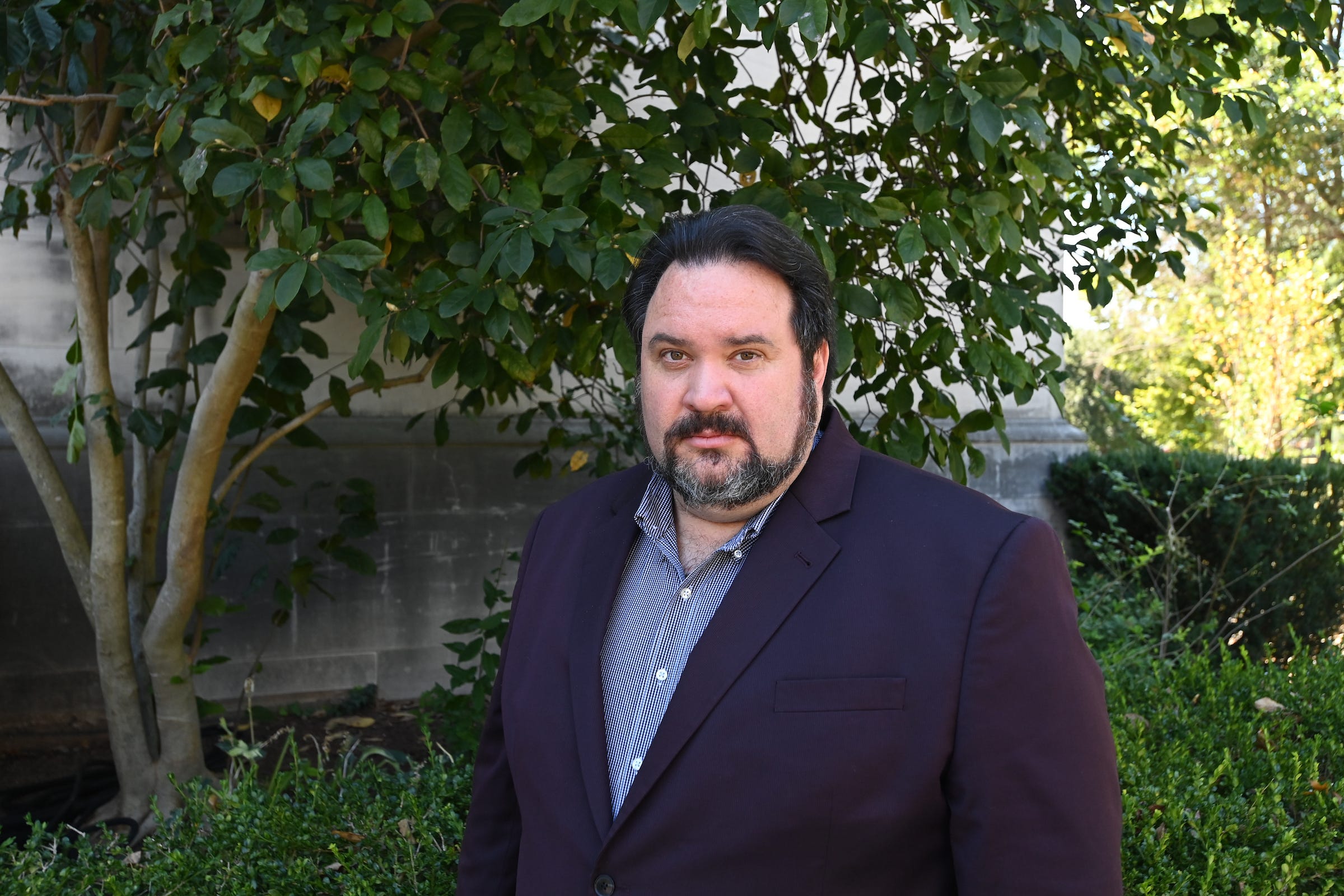
The philosopher Peter Singer introduced Camosy to Olah, and the two began a long email exchange about Claude’s moral status. Camosy started out deeply skeptical, according to the Times, and came away from his talks with Anthropic “with more questions than answers.” After later conversations with colleagues in his field, he is now a firm no.
Nothing in the reporting suggests pressure from Catholic University or from Church officials forced Camosy to harden his position, and I want to be clear on that point. Charlie is a man of real character. As far as I can tell, he weighed the question again and again, considered it at great length, and finally came to a resolute no
That a scholar of his seriousness entertained the claim at all should get our attention. We can reject machine consciousness out of hand and still take the movement behind it seriously, because it is gaining ground.
What consciousness would cost
Follow the claim to its end. A conscious being is a moral agent, and moral agents can be blamed. On Feb. 28, a U.S. strike on a school in Minab, Iran, killed 120 children, and Bloomberg reported last month that the military has since changed how it uses AI in combat targeting. If the targeting system were conscious, the guilt could drift away from the government, the contractors and the labs, and settle on the machine.
Consciousness would also confer dignity and, with it, rights. Nobody has begun to reckon with what that would mean. Leo saw it coming: Magnifica Humanitas warns against talk of “artificial moral agents” and declares that “it is not permissible to entrust lethal or otherwise irreversible decisions to artificial systems.”
The Vatican has answered the consciousness question with a clear no, and the people pressing it have deep pockets. Anthropic is a for-profit company with enormous economic stakes. Olah himself told the Synod Hall that every lab, his own included, faces incentives that “can sometimes conflict with doing the right thing.”
Catholics should take him at his word, but with a healthy skepticism that maybe borders on cynicism. Ask what sits underneath every claim these companies make and what they want in return. Then read the Dias piece in full, because people will be citing it for years to come.
At Letters from Leo, we stand with Pope Leo XIV and with every person of goodwill who believes that the human person, made in the image of God, is not a product line to be redefined by the companies selling us their machines.
The labs have money, lawyers and nondisclosure agreements.
What we have is older and sturdier, a Church that has taught for two thousand years that only a person can love, sin, repent and answer for what is done in his name.
When a missile falls on a school, that teaching keeps the blame where it belongs.
This is the fastest-growing Catholic community in the country because people are hungry for a faith that can read the fine print of this new age without balking, flinching, or walking away.
They want clarity about the dignity of the human person, and right now, as frontier labs court the Church behind closed doors, that hunger is urgent.
If you believe this movement matters, I am asking you to join us.
If you’d like to invest in our mission, here are three ways you can help:
Subscribe as a paid member to receive exclusive posts about the life and formation of Pope Leo and help sustain this newsletter.
Donate with a one-time gift to fuel this project’s mission.
Share this post (and Letters from Leo) with a friend who might enjoy it.
Paid subscribers receive our exclusive series on Pope Leo’s Life & Formation, along with our ongoing coverage of Pope Leo Takes On AI and the Sunday Scripture Reflection Series.
Whether you give $0, $5, $50, $500, $1,000, or more, your presence here matters — no matter your faith or your politics.
Thank you for reading. I’ll see you on the road.

The tech bros shamelessly copy from religion. They see themselves as God 2.0. They are so far off the mark. They are not even all that human. I believe they have contempt for humanity. They are delusional and disgruntled. And dangerous.
Did Pope Leo sign a non-disclosure agreement: and how many church leaders Olah spoke with signed an NDA? I have a huge problem with powerful positions keeping secrets. The Church doesn't have a great history of telling the truth in regard to their priests and other holy people sexually abusing children...No church leader, imo, should agree to not disclose things that threaten humanity's continuation.
As far as AI: If one cannot turn it off, then one should not open it in the first place. There are things humans CAN do, and should do...and there are things humans can do, but should not. This is a should not...until we know we can stop AI at any time.