


Thank you for reading! Letters from Leo is a reader-supported publication and the fastest-growing Catholic community in the country. To receive new posts and support this movement, consider becoming a free or paid subscriber.
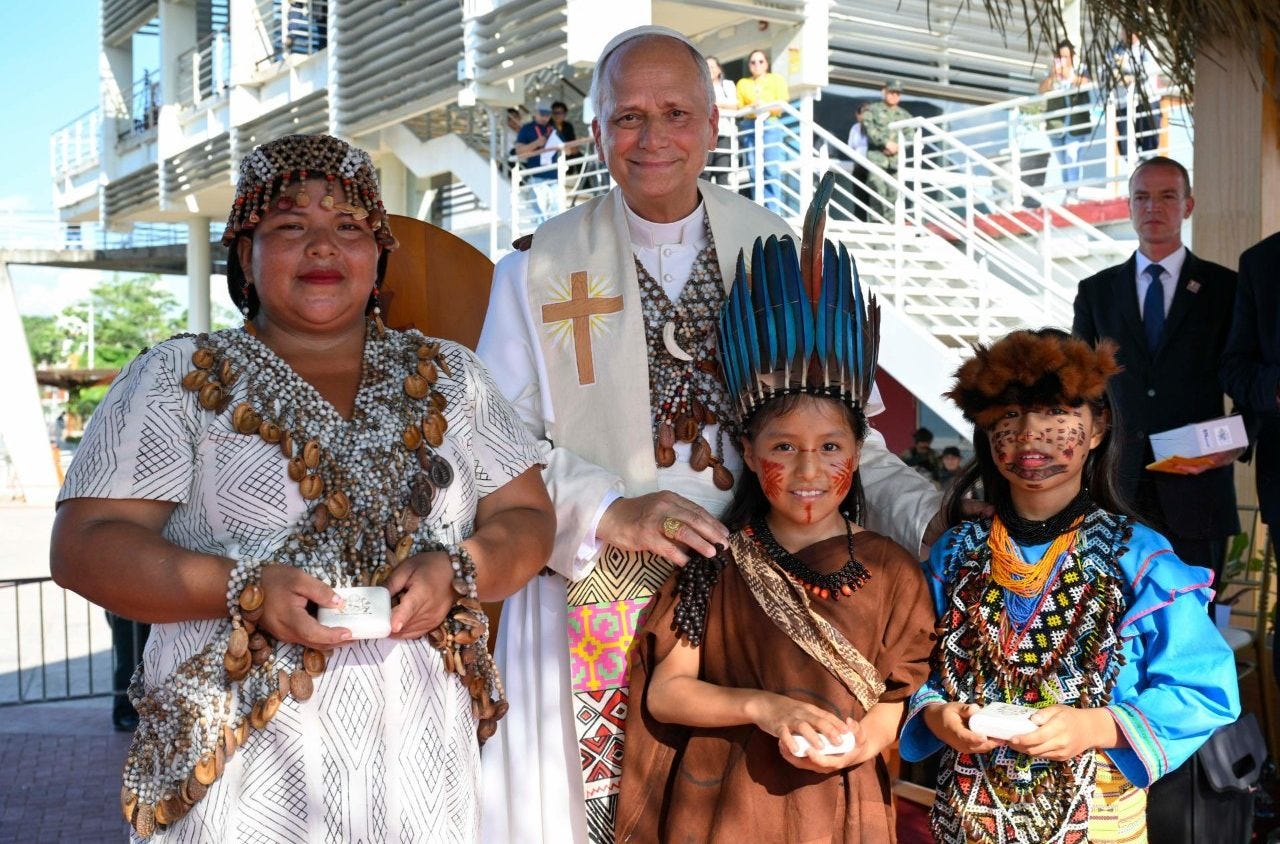
Pope Leo XIV flew into the Peruvian Amazon on Sunday afternoon and told the Indigenous peoples gathered on the Pucallpa waterfront that the men and women killed defending their forests have not been forgotten in Rome.
“The blood of these brothers cries out to God and demands justice!” he said at the Malecón Puerto Callao, where some 5,000 Indigenous people, missionaries, and their supporters had waited for him in the wet afternoon heat.
It was Leo’s final full day in Peru, the country where he spent two decades as a missionary and bishop. He gave it to the cause Pope Francis carried for twelve years, which is the care of God’s creation and of the people who live closest to it.
The day began in Cusco, where Leo prayed the Angelus before an estimated 60,000 people in the Plaza de Armas. By mid-afternoon he had crossed the Andes to Pucallpa, a river city on the Ucayali whose name means “red earth” (its forests are home to the Shipibo-Konibo people).
Before the pope spoke, a young Indigenous woman named Susi Díaz told him that 37 Indigenous leaders have been killed, and many more threatened, since Francis came to the Peruvian Amazon in 2018. She described oil spills, illegal logging, extractive mining, and drug trafficking. Defending one’s home here, she said, can cost a life.
Leo responded to her. “In recent years, many Indigenous leaders have been murdered for defending their territories,” he said.
He also talked about environmental destruction. “You know well the damage caused by indiscriminate deforestation and the pollution of rivers and other waters through illegal mining and oil spills,” he told the crowd. He spoke of drug traffickers who prey on the region’s young people, and of women and girls who suffer violence and sexual abuse that “leaves deep wounds, often compounded by complicity and impunity.”
Francis’s unfinished work
Nearly every line of the Pucallpa speech traced back to Francis. Leo opened by quoting Querida Amazonia, the exhortation Francis wrote after the 2019 Synod for the Amazon: “I dream of an Amazon region that fights for the rights of the poor, the original peoples and the least of our brothers and sisters, where their voices can be heard, and their dignity advanced.”
He borrowed the language of Laudato Si’, the 2015 encyclical whose tenth anniversary Leo marked last year by calling care for creation a Christian duty, and told the crowd that “the cry of the earth and the cry of the poor are inseparable.” Then came the line his own account posted that evening: “Protecting the Amazon rainforest cannot be separated from concern for the people who live there. Indeed, integral ecology, social justice, and the spiritual life go hand in hand.”
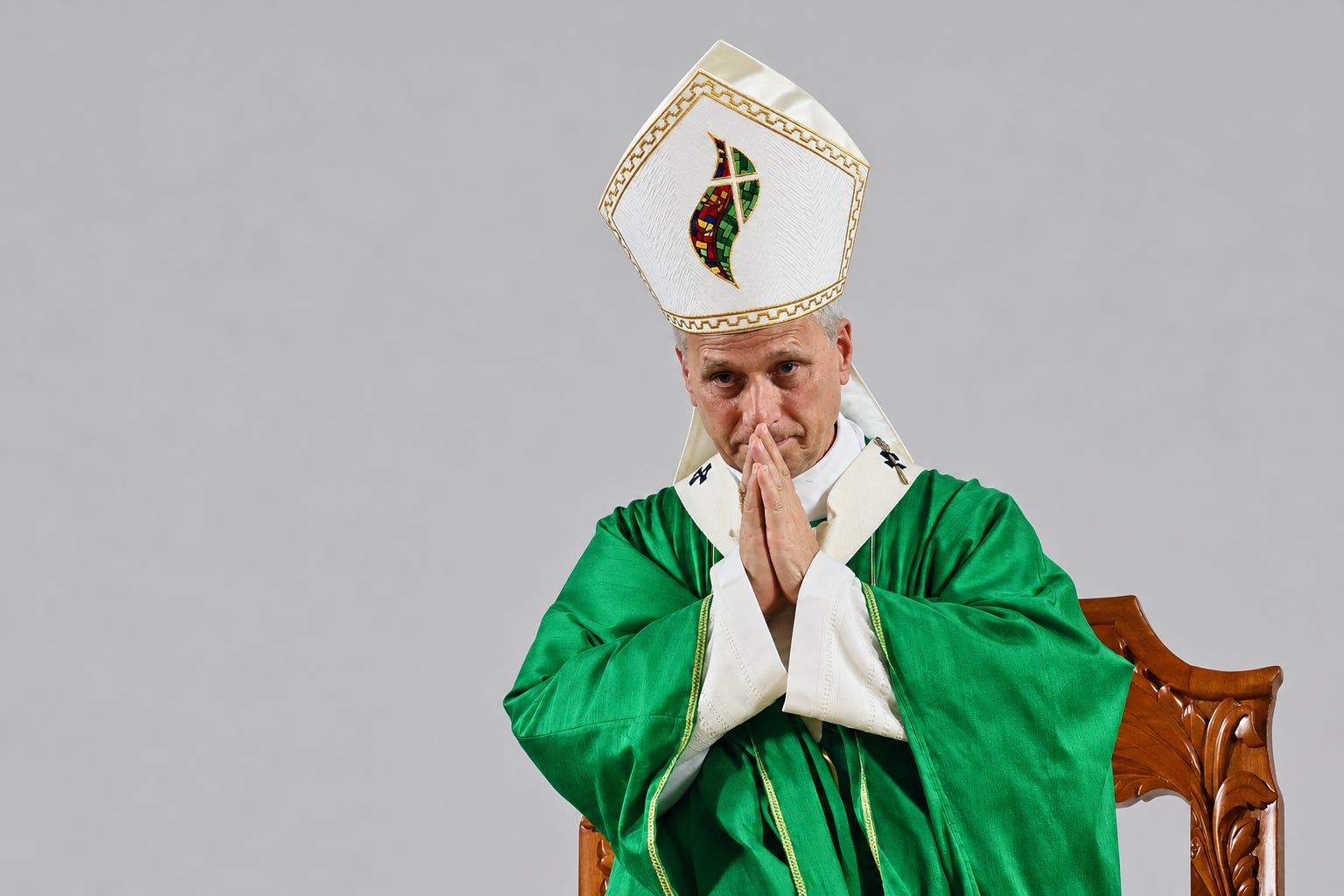
Even his vestments carried the message. For the Mass that followed, Leo wore a mitre embroidered with the leaf-shaped emblem of Francis’s Amazon synod.
Francis made his own trip into this jungle in January 2018, to Puerto Maldonado, near the Bolivian border. Bishop David Martínez de Aguirre, who welcomed him there, recalled in August that Francis began that visit by saying, “Here the Synod for the Amazon begins.” Eight years later, his successor stood on another riverbank and picked up the thread.
Mass on the Ucayali
Leo then celebrated Mass for about 100,000 people at the Villa Deportiva Regional Ucayali, a sports complex on the edge of the city. The entrance procession moved to drums and to “Los hijos de la selva,” an Amazonian hymn whose refrain the crowd sang back to him: “We, the children of the jungle, praise you, Lord.”
His homily turned on the Gospel parable of the talents, and on what we do with the gifts God entrusts to us, beginning with life and the land. “Social peace and ecological equilibrium go hand in hand,” he said, “so violence against people is violence against the earth, and violence against the earth is violence against human beings.”
Then he placed himself in a line of succession. Joining his voice to those of Benedict XVI and Francis, Leo said that “very little has been done — and very slowly at that — while the means to exploit and pollute creation have accelerated.” He urged the faithful not to bury the Lord’s talents in the ground, since God gives the strength “to repair and heal the suffering caused by an insatiable thirst for domination.”
The moral pollution
Francis spent his pontificate insisting that the ecological crisis is a moral crisis first, and Leo pressed the point in the same homily. “The culture of charity alleviates moral pollution,” he said in a line his account shared Sunday night, calling it “the cause of every wound inflicted on creation, our common home.”

Those words travel north. The Trump administration spent August paying $1.2 billion to cancel wind farms and opening 44 million acres of forest to roads, as I reported in September, while Leo insisted it is “not yet too late” to save creation.
Weeks later, a Vatican commission whose document he approved named environmental destruction a “sin against creation.” On Sunday, Leo carried that teaching to a place where the sin has victims with names.
His speech called for schools that teach in Indigenous languages and for health care in isolated villages, and it noted that the local vicariate, a territory as large as entire countries, has only 25 priests.
Francis did not live to see an American pope stand in the Amazon and finish the sentence he began in Puerto Maldonado. On Sunday, Leo finished it, and then told the people of Pucallpa what Francis would have told them. “You are not alone on your journey,” he said. “May God bless the Amazon.”
Leo closed the night the way he has closed nearly every night of this trip.
Back in Lima, he walked onto the balcony of the Apostolic Nunciature for one last balconazo. When the microphone failed, he tested it himself, drawing out “¡Uno, dos, treeees!” and sending the street below into a frenzy. Then, mic in one hand and the other raised to the crowd, he belted out “¡Que viva Cristo! ¡Que viva la Virgen María! ¡Que viva la Iglesia católica!” like a performer working an encore.
The habit began in Montevideo and followed him to Buenos Aires and Lima, and I hope he packs it for every trip from here on.
On Monday, Leo visits a home for abandoned elderly people in Lima, celebrates a farewell Mass at Las Palmas Air Base, and flies home to Rome.
At Letters from Leo, we stand with Pope Leo XIV and with the Indigenous peoples of the Amazon, who keep burying leaders killed for defending their land — and with the millions of Catholics and people of goodwill who believe the earth is a gift from God, not a mine to be emptied.
Pope Francis taught the whole Church to hear the cry of the earth and the cry of the poor as one cry. On Sunday, his successor carried that teaching to the banks of the Ucayali and gave it the names of the dead.
This is the fastest-growing Catholic community in the country because people are hungry for a faith that tells the truth about the world as it is. They want courage and a hope that has been tested by suffering — and right now, as Washington opens forests to the bulldozer, that hunger has never been more urgent.
If you believe this movement matters — Catholics and people of goodwill standing for human dignity and for God’s creation — I am asking you to join us.
If you’d like to invest in our mission, here are three ways you can help:
Subscribe as a paid member to receive exclusive posts about the life and formation of Pope Leo and help sustain this newsletter.
Donate with a one-time gift to fuel this project’s mission.
Share this post (and Letters from Leo) with a friend who might enjoy it.
Paid members get our series on Pope Leo’s life and formation — including the two decades in Peru that brought him back to the Amazon on Sunday — along with our Sunday Scripture Reflection Series and exclusive investigations.
Whether you give $0, $5, $50, $500, $1,000, or more, your presence here matters — no matter your faith or your politics.
Thank you for reading. I’ll see you on the road.

Amazing at how the thread of faith and concern for the people and the ecosystems of the world through the past pontiffs is now ablaze with Pope Leo. His message of hope, love and especially social justice speak to the challenges that people of the Amazon encounter. He looks very happy, engage and also sad at what he has seen in the Amazon. Thank you, Chris, for a thorough report.
¡Que viva el Papa Leon XIV! ¡Viva!