

“Communion Is Not Built by Clinging Rigidly” — Pope Leo XIV Defends Diversity at the Pallium Mass
The pope’s homily for 35 new archbishops was a defense of unity that makes room for difference. It came days before he marks America’s 250th from Rome and offers Mass for migrants on Lampedusa.

Thank you for reading! Letters from Leo is a reader-supported publication. To receive new posts and support my work, consider becoming a free or paid subscriber.
A note before we begin: for the first time in this newsletter’s life, I am writing to you from Rome. I’ll be here and across Italy through July 11. Tell me what I should see — and write to me if you’d like to meet up while I’m here.
Some of what I’ll be covering while I’m here:
Pope Leo XIV’s consistory of cardinals, where they took up the future of the just-war doctrine, among other questions.
Today’s pallium Mass, where the new archbishop of New York, Ronald Hicks, was received by Leo XIV.
The possible July 1 excommunication of SSPX, a schismatic right-wing group.
Leo’s July 3 remote address to the American people at the Liberty Medal ceremony in Philadelphia.
His July 4 Mass on the migrant island of Lampedusa, which some read as counter-programming to President Trump’s partisan 250th-anniversary rally.
Interviews with some of the people who know Leo best — cardinals, priests, nuns, and, most important, his favorite Roman pizza chef.
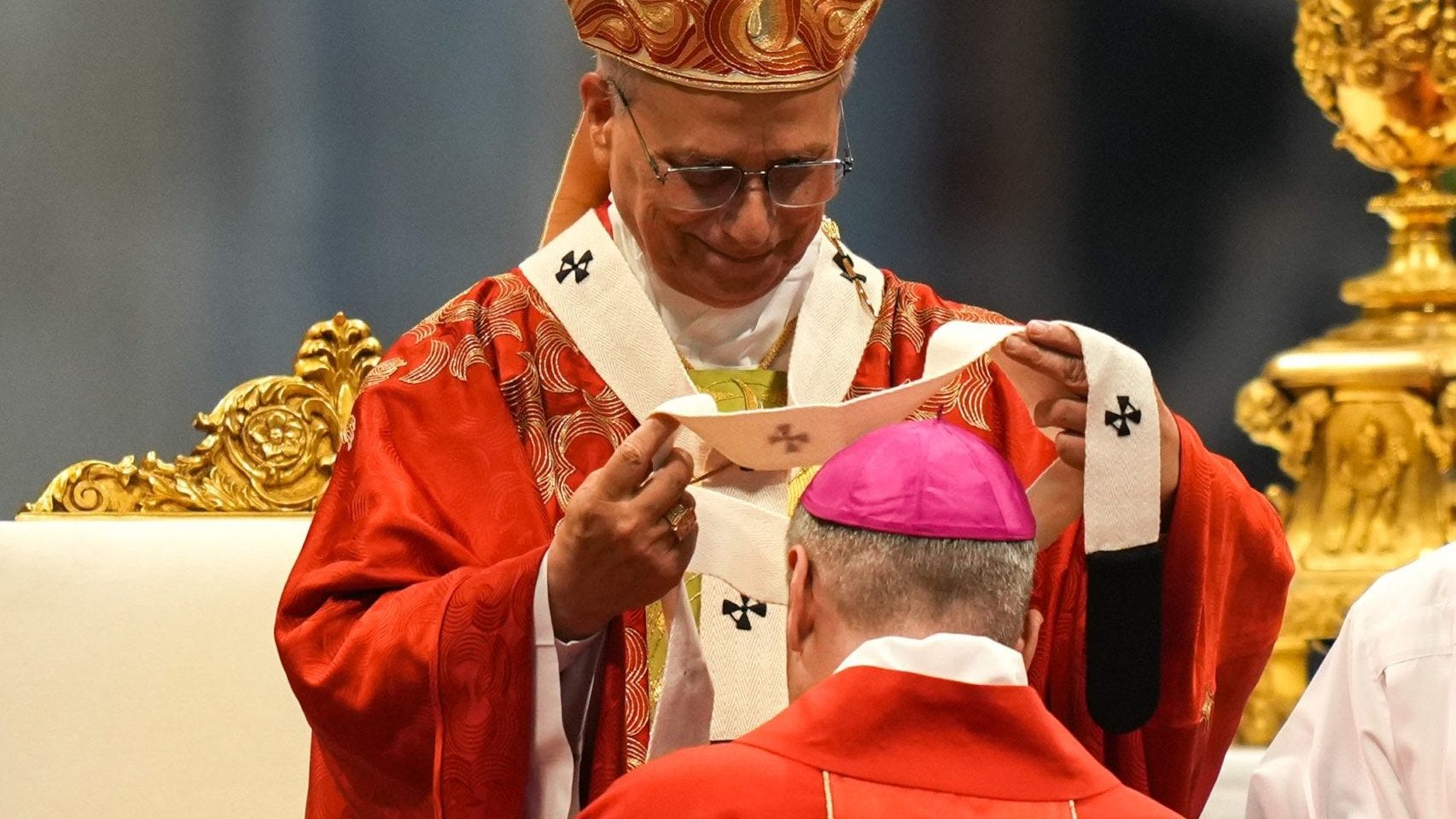
On Monday morning, beneath Bernini’s bronze canopy in St. Peter’s Basilica, Pope Leo XIV laid a band of white wool across the shoulders of each new archbishop who knelt before him, and used the moment to say what he believes holds the Church together.
The vestment is called the pallium. Woven from the wool of lambs blessed each year on the feast of St. Agnes and marked with six black crosses, it is the sign that a metropolitan archbishop shepherds his people in communion with Rome. Leo conferred it on the Solemnity of Saints Peter and Paul, the patrons of the city, on thirty-five new metropolitan archbishops gathered from around the world.
Four of them were American: Ronald Hicks of New York, James Checchio of New Orleans, James Golka of Denver, and Mark Rivituso of Mobile. When Leo revived the old custom of placing the pallium on each archbishop’s shoulders with his own hands — a practice Francis had returned to the local nuncios — he made the gesture personal again.
Of the four, Hicks is the one to watch. He is, in a way, Leo’s man in the country’s most visible see — Chicago-born like the pope, and formed by the same instincts. After his ordination, he left for El Salvador, where he spent five years running a home for orphaned and abandoned children.
He came back to serve as Cardinal Blase Cupich’s vicar general in Chicago, then as bishop of Joliet, and in February, Leo sent him to New York to succeed Cardinal Dolan. More than a hundred and fifty pilgrims followed him to Rome to watch the wool go on.
The homily Leo preached before the conferral was, in its quiet way, beautiful. He turned to the keys of Peter, the symbol stamped on every image of the first pope, and refused the obvious reading of them.
“A key does not break down doors,” he said. “Rather, it opens and closes them by finding the proper levers within and guiding their movements, so that locks may release, bolts withdraw, and doors turn freely on their hinges, thereby joining rooms together and transforming many isolated spaces into one welcoming home.”
From that image he drew a claim about the Church itself. “Communion within the Church is not built by clinging rigidly to one’s own position,” Leo said, “but by seeking, in all hearts, points of encounter in the Truth, in whose light alone each person becomes a means of growth for another.”
He described the office handed to Peter and his successors as something other than command. It is a charge “to listen ... to the voice of each person; to discern inspirations; to guide the way; to correct errors; to instruct, encourage, exhort and accompany our brothers and sisters.” Every Christian, he added, is called “to become a builder of unity.”
We have heard this music from Leo before. Last autumn he stood before the synodal teams and their staff, gathered in Rome for their Jubilee, and called for a Church that listens, and that kneels to wash the feet of others — the address I called, at the time, the Magna Carta of this pontificate. This morning’s homily is cut from the same cloth.
It is the theme Leo keeps returning to, and he returned to it again only days ago. At the extraordinary consistory he convened this week, he asked the world’s cardinals to become builders of Christ’s communion and told them to learn synodality by practicing it — and, behind closed doors, to weigh retiring the old language of “just war” for a stricter doctrine of proportional defense.
In his encyclical on artificial intelligence, Magnifica Humanitas, he read the tower of Babel as a parable of false unity — a homogenization that flattened difference and then called the flattening peace.
The phrase his readers keep fastening onto is unity, not uniformity. I wrote about it last fall, when Leo first pressed it on a divided American Church, and some Catholic conservatives heard a threat in it.
For a certain narrow temperament, communion means conformity — a single permitted set of opinions, policed and enforced, the magisterium shrunk to a loyalty test. Leo’s homily answers that temperament without naming it. A key that forces a door is a crowbar. The Church he describes does not break locks; it works the levers until the house opens.
Leo gave the point a living illustration inside the basilica.
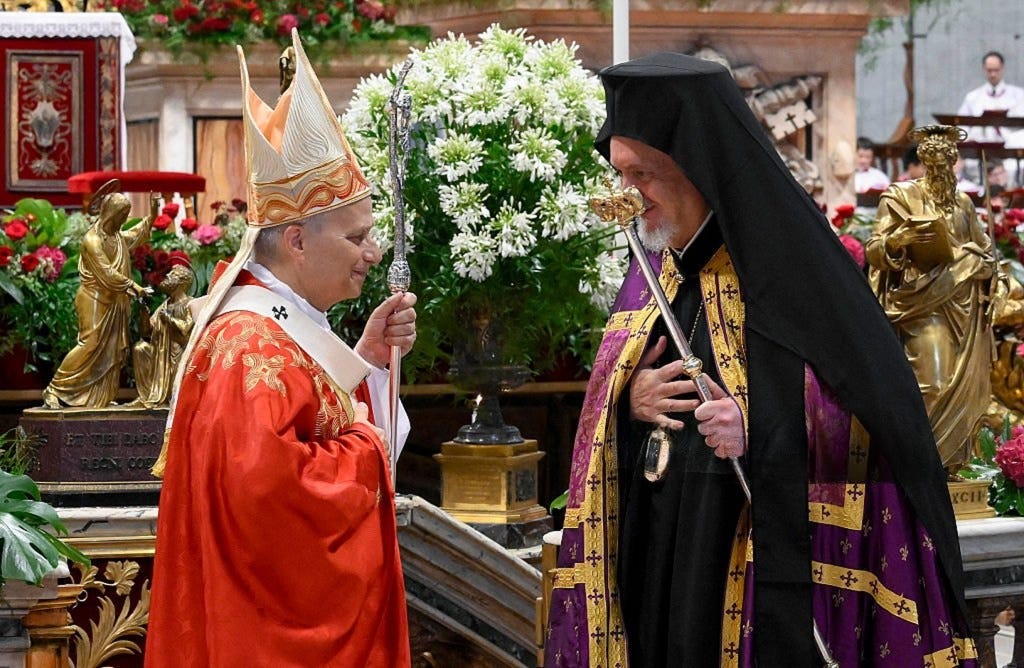
Among those he greeted from the altar was a delegation from the Ecumenical Patriarchate of Constantinople, sent by Patriarch Bartholomew. Rome and the Orthodox churches have not shared full communion for nearly a thousand years, and each still sends envoys to honor the other’s great feasts. There is a unity that has made its peace with difference, and this morning it was standing in the room.
Hicks understands the wool he was given. “I am going to receive a collar made of wool from the Holy Father,” he said before leaving for Rome, “that symbolizes that I, as the archbishop of New York, am united with Pope Leo, with the apostolic succession, with all the popes who have come along the way.”
He has already shown what that communion costs. In March, as the Trump-Vance administration’s ICE raids moved through immigrant neighborhoods, Hicks stood in St. Patrick’s Cathedral on the feast of New York’s Irish patron and defended the migrants the state was hunting.
That is the unity Leo blessed this morning, and it is not a fragile thing. It is wool laid on the shoulders like a yoke, heavy enough to carry the people entrusted to a shepherd “like so many lambs of the Lord’s flock.” Leo asked his archbishops to spend their energy, their time, and if it came to it their lives for the ones in their care. He called them apostles and “generous servants of the truth in charity.”
Truth and charity sit together in that phrase, and Leo will not let his critics pry them apart.
A Church confident in the truth has nothing to fear from drawing close to the people who do not yet hold it. Saint Augustine, Leo reminded the basilica, said that God “took the persecutor of the Church and made him a messenger of peace” — the whole drama of Paul compressed into a single sentence about a man who began with a sword and ended with a letter.
All of this lands in a particular American moment.
As the country approaches its two hundred and fiftieth birthday, the Trump administration is dismantling diversity programs across the federal government, stripping money from universities that keep them and opening investigations into the academic centers that defend them — the sharpest official retreat from the work of inclusion since the civil rights era.
A Church that lays wool on a man’s shoulders and tells him to go gather the stranger is saying something this moment can hear.
Leo will say it himself in the days ahead. On July 3, he will accept the National Constitution Center’s Liberty Medal and address the American people by video from Rome, marking the nation’s 250th as its first native-born pope.
The next morning he travels to Lampedusa — the Sicilian island where migrants come ashore after the crossing, and where Francis made his first journey as pope — to offer Mass for the people the sea did not take. Some read it as counter-programming to the partisan rally President Trump has planned for the same anniversary.
I will be there to cover it in the flesh, because you deserve to know what’s happening on the ground of this historic event.
This comes at a time when diversity itself is under siege in the United States.
The Trump-Vance administration has moved to dismantle diversity programs across the federal government and to punish universities that keep them, the sharpest official assault on the idea since the civil rights era. Leo’s defense of a unity that holds difference, rather than erasing it, lands all the harder against that backdrop.
The pope who last fall called the Church to kneel and wash the feet of humanity stood this morning and laid a collar of lambswool on four American shepherds, and asked them to carry it the way Peter did — opening doors rather than breaking them, gathering the house rather than guarding a single room.
At Letters from Leo, we stand with the shepherds who understand that the Gospel gathers rather than divides — the bishops and priests and ordinary Catholics who believe that the unity Christ prayed for at the Last Supper is wide enough to hold the stranger, the migrant, and the neighbor who votes the other way.
In a Church some would shrink to a loyalty test, we remain rooted in a faith that bends low to wash feet and refuses to mistake conformity for communion.
This is the fastest-growing Catholic community in the country because people are hungry for a Church that opens doors instead of barring them — for truth and charity held together, the way Leo held them this morning in St. Peter’s.
If you believe this movement matters — Catholics and people of goodwill standing for a Church of communion against the narrowing of the faith into a weapon — I am asking you to join us.
If you’d like to invest in our mission, here are three ways you can help during this critical time:
Subscribe as a paid member to receive exclusive posts about the life and formation of Pope Leo and help sustain this newsletter.
Donate with a one-time gift to fuel this project’s mission.
Share this post (and Letters from Leo) with a friend who might enjoy it.
Paid members make this work possible. Your support funds the biographical series on Pope Leo’s life and formation, the ongoing coverage of how Pope Leo is taking on AI and the technologists who would homogenize the world, and the Sunday Scripture Reflection Series. It also underwrites our Epstein-Bannon investigation.
Whether you give $0, $5, $50, $500, $1,000, or more, your presence here matters — no matter your faith or your politics.
Thank you for reading. I’ll see you on the road.

Clinging is the source of suffering. This Hope Pope is the source of much joy and inspiration.
Wonderful thoughts here!! ❤️