


Thank you for reading! Letters from Leo is a reader-supported publication and the fastest-growing Catholic community in the country. To receive new posts and support this movement, consider becoming a free or paid subscriber.
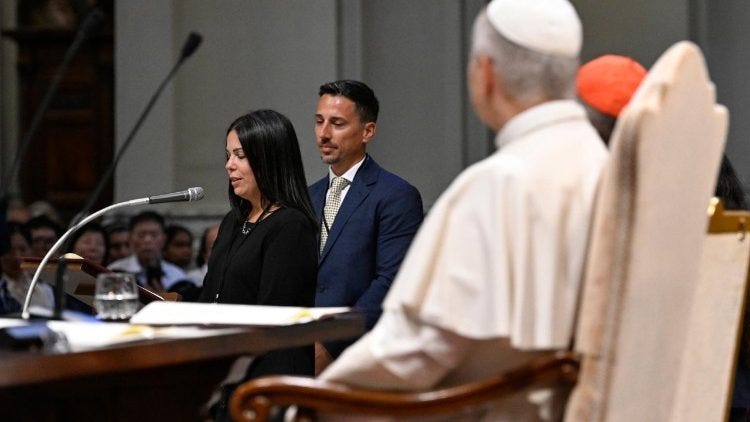
Pope Leo XIV opened the Diocese of Rome’s pastoral year on Friday evening at the Basilica of St. John Lateran, his own cathedral, and spent more than twenty-two minutes telling the priests and lay leaders of his diocese that the synodal Church Pope Francis built is the ground they will keep walking on.
It was one of the longest speeches of his pontificate, and it came sixteen months after he first stood on the loggia of St. Peter’s.
He began where Francis so often did, inside a Gospel scene.
Mary Magdalene stands at the empty tomb before dawn, a man she takes for the gardener asks her two questions, “Why are you weeping? Whom are you seeking?” (John 20:15), and the pope asked Rome to let those two questions govern its coming year.
Then he said the sentence that answers a fight Catholics have been having since Francis’s synod closed in October 2024.
“I am not handing you a new pastoral program today,” Leo said.
“We are not starting from zero, and nothing we have lived is to be filed away.”
The diocese’s recent work on “spiritual illnesses,” he said, taught it to recognize what needs healing, and “the Synodal Path taught us how to listen and discern together, co-responsible for the one mission.”
Building on both, he proposed “a third dimension: that of pastoral verification.”
He defined it carefully.
“To verify, in the light of the Holy Spirit, means to stop, to reread what has happened, to recognize what bore fruit, to understand what did not work, and to search together for the reasons. It means, in a word, making truth.” (The Italian is fare verità.)
The whole community should take part, he said, including “people who do not attend and who see things, so to speak, ‘from the outside.’”
I raised this point in July, in “Just Say Nothing,” my dispatch after two weeks of Roman conversations about how this pope governs: a synodal process can end up favoring the insiders, the people who already know how to work a listening session and who hold the invitation. Leo’s answer on Friday sends the parish out to the people who never come, and it puts an obligation on the rest of us. If the Church is going to make room for outsiders, those of us who drifted away, or who only ever comment from a distance, have to walk in and be those voices.

The method rests on one word. “The heart of the method I am proposing to you is a very simple question: ‘why?’” For every parish activity, the pope wants two rounds of it.
First, why do we do this at all, and to what real need does it answer? “Then the second step: why do we obtain these results and not others? Why do some initiatives generate paths and others remain isolated? Why do some people take part and others remain at the margins?”
From the meeting of those two sets of reasons, he said, comes a discernment that tells a community what to keep and what to let go.
Anyone who has read Francis will recognize the parentage. In Evangelii Gaudium, the 2013 exhortation that became the charter of his pontificate, Francis wrote that “realities are more important than ideas” and warned against ideas that lose contact with the people they were meant to serve.
Leo has turned that principle into a diocesan discipline: reexamine your priors against what actually happened.
He gave the diocese a face to go with it, approving the opening of the beatification inquiry for Msgr. Luigi Di Liegro, the first director of Caritas Rome, who died in 1997.
Before building anything, Leo said, Di Liegro “wanted to see,” commissioning a 1969 survey of the religious life of Romans “because he had learned that there is no incarnation of the message without listening to reality.”
He also asked for time. “I ask you therefore to give yourselves the time to walk together, not a year but a journey, so that it may be a true discernment and not one more initiative added to the others.”
The Greek behind “synod” means a road walked together, and Leo pointed that road at the Jubilee of the Redemption in 2033. He told his priests that the work “gives you permission to do less and to do it better,” and that “a community in which everything depends on the pastor is a fragile community.”
This is the part of the speech that should be read in Winona-Rochester.
On January 6, the day before Leo convened his first extraordinary consistory of cardinals, Bishop Robert Barron posted on X that synods are “good and useful tools for the determination of practical pastoral strategies” but should “not be a defining and permanent feature of the Church’s life, lest we lose our verve and focus.”
One sighs with relief, he wrote, when a council ends.

Barron was not alone.
After the second consistory in June, Cardinal Raymond Burke said “this whole synodality business” has to be stopped and studied, and Cardinal Gerhard Müller complained that the small-table format was “manipulated and controlled beforehand.”
None of that is happening.
Leo answered the cardinals in June — keeping the Latin Mass off the table and putting listening and the laity at the center, as I reported at the time.
The synod’s next stage is already scheduled through an ecclesial assembly in October 2028, and Leo met the synod’s members on June 25 to close a conference on how to carry it out. On Friday he told his own diocese that the synodal method is the assumed foundation, and that the next thing to build on it is a habit of honest self-examination.
Remember how this pontificate began.
On the evening of May 8, 2025, little more than an hour after the white smoke, Leo told the crowd in St. Peter’s Square, “We want to be a synodal Church, a Church that moves forward, a Church that always seeks peace, that always seeks charity, that always seeks to be close above all to those who are suffering.”
Sixteen months later, from the chair of the Bishop of Rome, he asked his diocese for a Church honest enough to say which of its programs failed and why.
That request is harder than it sounds — for a parish or for a country. Institutions that never ask why they got the results they got tend to keep getting them.
The pope’s critics wanted the listening to stop so the Church could return to what Barron called its essential work; Leo just told Rome that the listening is the essential work, and that the next step is to check whether anyone heard.
At Letters from Leo, we stand with the American pope who asked his own diocese on Friday to reread what happened and tell the truth about what did not work. A Church willing to examine itself in the light of the Gospel is a Church that can still be corrected, and a Church that can be corrected is one the poor and the stranger can still trust.
In an era when the powerful never ask why their policies produce the results they produce, we remain rooted in a faith that puts realities ahead of ideas, the faith Francis preached and Leo is now building into the ordinary life of parishes.
This is the fastest-growing Catholic community in the country because people are hungry for a Church that listens before it answers, and for a faith honest enough to ask why it gets the results it gets.
If you believe this movement matters, Catholics and people of goodwill walking together toward human dignity and the common good, I am asking you to join us.
If you’d like to invest in our mission, here are three ways you can help:
Subscribe as a paid member to receive exclusive posts about the life and formation of Pope Leo and help sustain this newsletter.
Donate with a one-time gift to fuel this project’s mission.
Share this post (and Letters from Leo) with a friend who might enjoy it.
Paid subscribers receive our biographical series on Pope Leo’s life and formation, our Sunday Scripture Reflection Series, and the investigations, including the Epstein-Bannon files, that you will not find anywhere else.
Whether you give $0, $5, $50, $500, $1,000, or more, your presence here matters — no matter your faith or your politics.
Thank you for reading. I’ll see you on the road.

Bless you, Pope Leo. Listen to the people and the movement of the Holy Spirit amongst us. A Church that refuses to take stock risks becoming cemented in "tradition" for the sake of tradition, and not for the sake of the Gospel. Take time to do this, so that we don't throw out the baby with the bathwater, but so that we acknowledge ways in which the Church needs to move forward on our journey. Keeping old ways just because they are old risks spilling into idolatry, refusing to hear what the Spirit is currently saying to the Church. We don't have to heedlessly adopt trendy or flashy new liturgy or interpretations of the Catechism, but we should be open to considering why some of our ways of doing church no longer apply or appeal.
The first American Pope couldn't have come at a BETTER time!
Instead of DWELLING on what WE DON'T have...
Let's DWELL on what WE DO HAVE!