
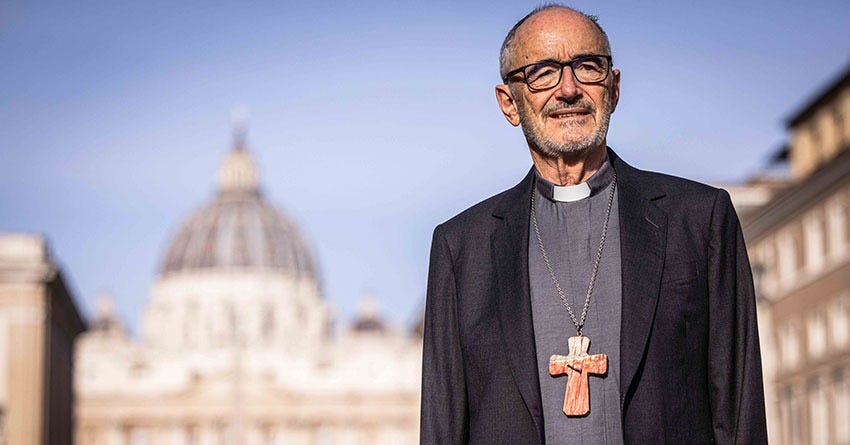
Sent by Pope Leo XIV, Cardinal Czerny Rebukes Trump’s Threats to “Take Cuba”
Eight days after Marco Rubio’s Vatican audience, Cardinal Czerny answered from the altar of St. Ignatius in Rome. The Church will not be conscripted into Trump’s war on Havana.
Thank you for reading! Letters from Leo is a reader-supported publication. To receive new posts and support my work, consider becoming a free or paid subscriber.
On the evening of May 15, Cardinal Michael Czerny celebrated a Mass for Peace and Social Development in Cuba at the Church of St. Ignatius of Loyola in Rome — and from the altar, delivered the Vatican’s answer to the Trump administration’s escalating campaign against Cuba.
Eight days earlier, Secretary of State Marco Rubio had crossed the Tiber to meet Pope Leo XIV in the Apostolic Palace. The U.S. statement on the meeting stayed vague, describing “cordial discussions.”
The Vatican’s readout was more specific, naming the disagreements the Holy See had pressed with the secretary of state. Cardinal Pietro Parolin, the Vatican secretary of state, had told reporters the day before that Trump’s recent attacks on Leo struck him as “a bit strange.”
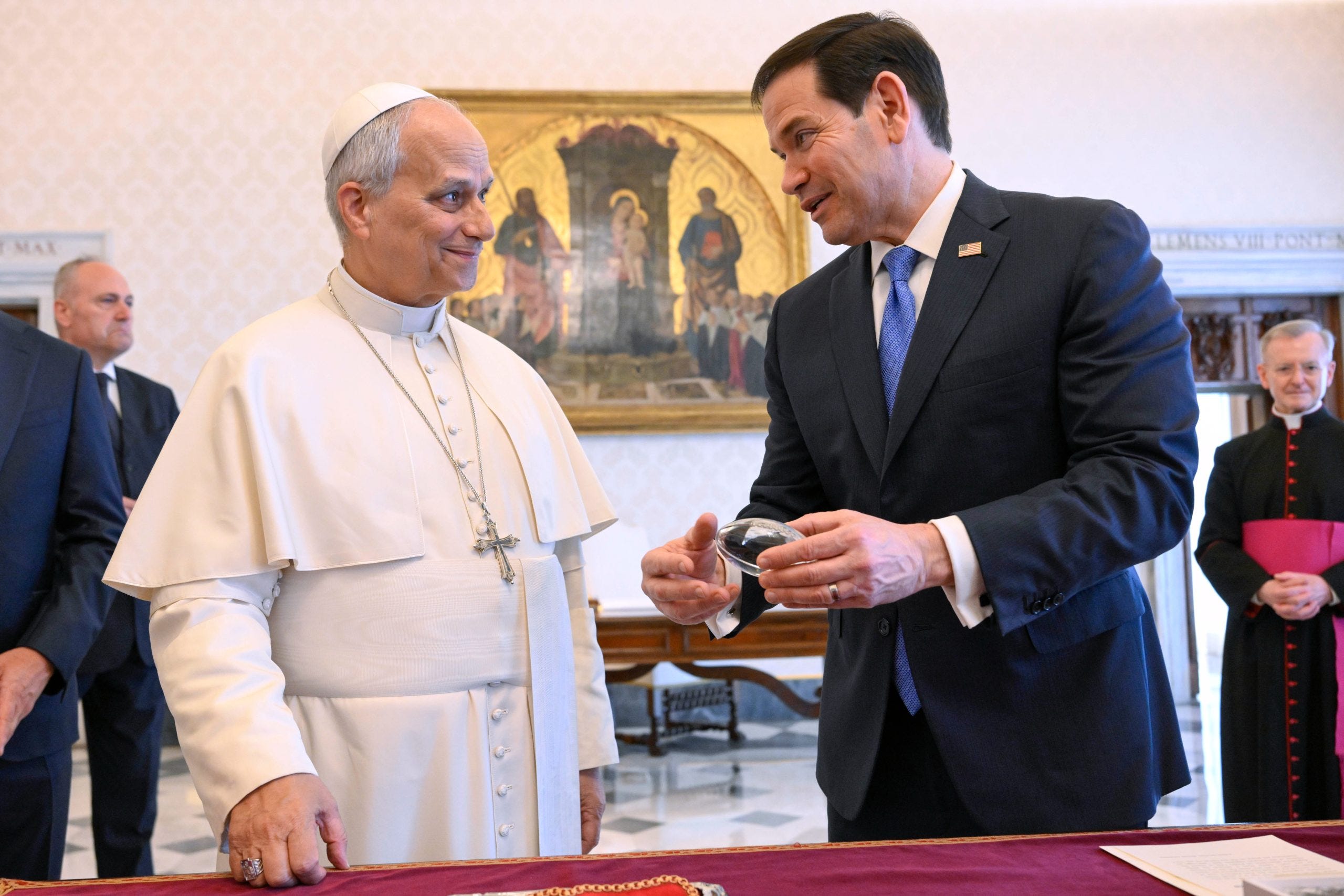
On the same day as his audience with the pope, Rubio announced a fresh round of sanctions targeting GAESA — the military-controlled conglomerate that anchors Cuba’s economy. He wrapped the move in humanitarian language, pointing to $6 million already routed through Caritas Cuba and promising more if Havana cooperated.
Trump was less restrained. From the Oval Office earlier this month, the president suggested that a U.S. aircraft carrier returning from Iran could stop “about 100 yards offshore” of Cuba, where “they’ll say ‘thank you very much, we give up.’” In March he predicted he would soon have “the honor of taking Cuba.”
According to a CNN review of flight data, surveillance flights off the island’s coast have surged since February. Havana’s foreign ministry called the new sanctions “collective punishment of a genocidal nature.”
This was the diplomatic terrain Czerny stepped onto when he approached the ambo on Friday night.
The Mass for Peace and Social Development in Cuba was organized by the Cuban Embassy to the Holy See, and Czerny — the Jesuit prefect of the Dicastery for Promoting Integral Human Development and the pope’s senior voice on migration and global justice — chose his words knowing every line would be parsed by the State Department, by Havana, and by the Vatican’s own diplomats.
The homily opened with the people:
This evening we bring before the Lord’s altar the sufferings, hopes and expectations of the Cuban people. We do so with respect, with sincerity, with deep affection for a land that cherishes a history rich in dignity, culture, sacrifice, faith and resilience.
From there, Czerny moved through the four pillars of John XXIII’s Pacem in Terris — truth, justice, freedom, love — and rendered each as a specific demand. Justice, he said, “demands concrete attention to those who suffer most.”
Freedom “calls for real opportunities for participation, listening and shared responsibility.” Truth “becomes a form of sincere dialogue, capable of overcoming propaganda, hardening attitudes and mutual mistrust.” Love “opens the way to solidarity, to the sharing of material, cultural and spiritual goods amongst peoples.”
Then he named the current pope. Pope Leo XIV, Czerny said, in his recent appeals to the international community, “has reminded us that no stable order can arise from the force of arms or from pressure that humiliates peoples; human development, on the other hand, grows through dialogue, international law, cooperation between nations and the safeguarding of the dignity of every human being.”
And then the verdict:
Any logic of constant confrontation risks exacerbating the burden already weighing on ordinary people, especially the poorest, the elderly, the sick and children. … Humanitarian aid should arrive in sufficient quantities and without hindrance and must never be exploited for political or geopolitical ends.
That last clause carried the homily’s verdict. In the days around his Vatican audience, Rubio had publicly tied the Cuba sanctions package to a $100 million U.S. humanitarian aid offer — aid the secretary of state has since said Havana refused — with the Catholic Church positioned as a possible conduit.
From the high altar of St. Ignatius, in the heart of a city where the secretary of state had stood eight days before, Czerny refused that role. The Vatican will not allow its charitable infrastructure to be conscripted into a regime-change strategy.
Czerny then invoked St. John Paul II’s 1998 plea in Havana — “May the world open up to Cuba, and may Cuba open up to the world” — and recalled Pope Francis’s 2015 homily at the Plaza de la Revolución, where Francis insisted that service “is never ideological” because “we do not need ideas, but people.”
The lineage was strategic. American Catholic apologists for Trump have spent months suggesting Leo XIV’s social teaching belongs to a single, idiosyncratic pontiff. Czerny placed it inside the long arc of Catholic social teaching without ever acknowledging the smear.
The Holy See’s objection to the U.S. embargo runs back to John Paul II, who decried it as cruelty inflicted on the poor. Francis renewed that condemnation in 2015 and helped negotiate the diplomatic groundwork for the Obama-era thaw the following year. Parolin has said repeatedly that economic strangulation is punishment of the wrong people.

What changed on Friday was the venue. Eight days after Rubio left the Apostolic Palace, the Vatican’s position was delivered again — this time from the altar of a Roman church rather than the State Department briefing room.
The Cuban ambassador to the Holy See had come up from the embassy for the occasion. At the altar, vested in white, a Jesuit cardinal carried the rite. Both knew Czerny had been sent by the pope to deliver the homily.
Czerny closed with the prayer the homily had been building toward. He asked that “the beloved land of Cuba may know days of greater serenity, of authentic human and social development, of harmony and hope.” He entrusted Cuba’s children to the Virgin of Charity of El Cobre, the patroness of the island.
The Catholic teaching here carries no ambiguity. Sanctions engineered to break a population’s will are an assault on human dignity, and the magisterium has named them so for decades. Threatening a Caribbean nation with an aircraft carrier offshore — even rhetorically — falls outside any version of the just war tradition the Church has ever taught.
The moment humanitarian aid arrives with a regime-change rider attached, it stops being humanitarian and becomes what the cardinal called by its right word on Friday: exploitation.
The pope commands no armies. His authority is moral and sacramental, and on Friday night, in a Jesuit church a mile from the Vatican walls, his cardinal used both to tell the Trump administration that the Catholic Church will not be conscripted into its war on Cuba.
At Letters from Leo, we stand with Cardinal Czerny and the millions of American Catholics — and countless others of goodwill — who refuse to let humanitarian charity be conscripted into a regime-change strategy or watch sanctions tighten around the bodies of the elderly, the sick, and the children of an island the United States is supposed to call a neighbor.
In a moment when an American secretary of state can stand in the Apostolic Palace and ask the pope to bless an economic siege, we remain rooted in a faith that refuses to flinch before injustice or bow to the idols of fear and authoritarianism.
This is the fastest-growing Catholic community in the country because people are hungry for something deeper than rage and propaganda. They’re looking for courage, for truth, for love made visible in action — and right now, as the United States threatens a Caribbean nation with aircraft carriers and rhetorical conquest, that hunger has never been more urgent.
If you believe this movement matters — Catholics and people of goodwill standing for human dignity against the cynicism of empire — I am asking you to join us.
If you’d like to invest in our mission, here are three ways you can help:
Subscribe as a paid member to receive exclusive posts about the life and formation of Pope Leo and help sustain this newsletter.
Donate with a one-time gift to fuel this project’s mission.
Share this post (and Letters from Leo) with a friend who might enjoy it.
Paid subscribers get access to the full biographical series on Pope Leo’s Life & Formation, the ongoing Epstein-Bannon Investigation, and the Sunday Scripture Reflection Series.
Whether you give $0, $5, $25, $250, $5,000, or more, your presence here matters — no matter your faith or your politics.
Thank you for reading. I’ll see you on the road.


Hopefully, he continues to the small, rural Minnesota town where the disgraced Bishop Barron lives jerking it to his false orange idol. And before you get upset at the word ‘jerking’, Barron was recently busted searching gay dating sites.