


Thank you for reading! Letters from Leo is a reader-supported publication and the fastest-growing Catholic community in the country. To receive new posts and support this movement, consider becoming a free or paid subscriber.
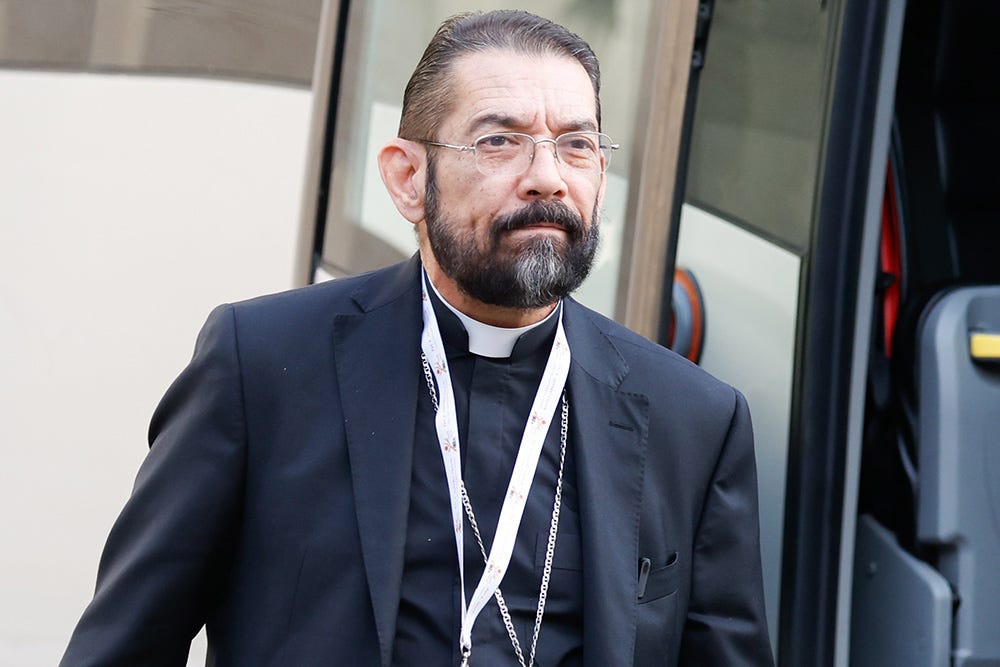
Bishop Daniel Flores of Brownsville, Texas, the vice president of the U.S. Conference of Catholic Bishops, told the National Catholic Reporter last week that his brother bishops should lower the temperature of American politics before the November midterms, and that “revving up the anger” helps no one.
“The general demeanor of the bishops in the country, I think, should be one that exemplifies before it preaches to,” Flores told NCR’s Vatican correspondent, Justin McLellan, in Rome. “We need to exemplify a certain generosity of spirit that is not necessarily immediately jumping to the condemnatory or the immediately critical.”
He asked the same of every Catholic. “We need to restore a certain self-restraint,” he said. “Particularly when it comes to the contentious issues because we aren’t helping the situation by revving up the anger thing.”
Asked about Bishop Robert Barron of Winona-Rochester, whose collaboration with the Trump administration and attacks on prominent Democrats I have chronicled in these pages since last fall, Flores declined the invitation.
“I think the Church is robust enough to be able to handle when somebody speaks in that way,” he said, adding that Catholics are “spending a little bit too much time trying to decide which bishop is on the right side of things and which one is not.” Disagreeing with a bishop, he said, is “perfectly alright.”
I have been deeply impressed with Flores’s leadership since the bishops elected him vice president last November, and this interview is the reason.
Two weeks ago I argued here that partisan politics belongs to the laity, and that a bishop who picks up a party’s weapons forfeits the ability to preach to the whole flock. Flores has now said the episcopal half of that on the record, without naming an enemy, in the city of a pope who watches the American Church more closely than most Americans realize.
Flores is 65 and has led the Diocese of Brownsville since 2010.
It covers four counties at the bottom of the Rio Grande Valley, where more than 1.2 million Catholics make up 85 percent of the population, and the Census counts it as one of the poorest regions in the country.
He led the American phase of the Synod on Synodality, served as one of the pope’s president delegates at the 2023 and 2024 assemblies (the second alongside then-Cardinal Robert Prevost), and in October 2024 the synod elected him to the council that now oversees how its conclusions are carried out.
After the first assembly he told NCR that the synod had felt “a certain amount of sorrow” over how the Church has treated women, and that its leadership had not “appreciated the sacrifice” of the women whose work “continues to make the church viable.”
His September began in Cuernavaca, Mexico, where from August 30 to September 4 the bishops’ conferences of Mexico, the United States, and Canada held what their host, Bishop Ramón Castro Castro, called the first meeting of its kind in their history.
After the opening Mass in the cathedral, Flores told the congregation that “it will become increasingly important — indeed, urgent — for the Catholic Church in the Americas to speak with one voice, defending the honor of Our Lord and the dignity of the human person — especially the poor and immigrants, who often have nowhere to lay their heads, just like the Lord Jesus himself.”
The three conferences’ joint statement, “Three Nations, One Church, One People Walking in Communion,” called the migrant’s road “two shores of one same journey.”
From Mexico, he flew to Rome for the fourth Fratelli Tutti encounter, where, from September 10 to 12, the Pontifical Commission for Latin America put bishops in a room with the AFL-CIO’s Liz Shuler and Microsoft’s Fred Humphries to argue about work and technology across the hemisphere. Pope Leo XIV received the participants on September 12 and asked them for a “culture of negotiation.”
Flores gave America’s Gerard O’Connell as compact a summary of Catholic social teaching as I have read this year: “This kind of gathering reminds us that from the Catholic point of view, history is not always a matter of what the powerful decide, that there are other things that move history. One of them is social friendship and a sense of justice and a sense of what is right.”
That sentence is characteristic. Flores thinks in short, load-bearing sentences, and he posts them on X under the handle @bpdflores and the display name “Amigo de Frodo.” On Sunday evening he published three numbered lines that do more work than most pastoral letters: ecclesiology is an extension of Christology; the Church’s social doctrine, as the popes teach it, is rooted in the Council of Chalcedon and the Nicene Creed; so is the whole of the Second Vatican Council.

Read that as an answer to everyone who treats the Church’s teaching on migrants and the poor as a program a clever pundit can argue away.
If the social doctrine rests on the same creed as the Incarnation, then a bishop who trades it for a party platform has touched the creed. He showed the same instinct in May, days before the release of Magnifica Humanitas, the pope’s encyclical on artificial intelligence, when he warned Catholics in America against letting a chatbot read the pope for them:
“Read carefully, think deeply and then pray from that place within where the WORD himself dwells.”
Don’t confuse what Flores means by restraint for silence.
In the same NCR interview, he called deporting a working father a “rupture in what is a basic good of society” and said an expired visa ought to be handled “within the context of the least disruption possible,” hardly the language of a man hedging on immigration.
He spoke about migrants in Cuernavaca and again in Rome, as he has for fifteen years along his own stretch of the border.
What he refuses to do is enlist, because a bishop who fights for one party can no longer be heard by the half of his people who belong to the other. His name for the alternative is “Catholic realism,” and he set it against ideology: “you really do have to listen to what the other person is saying … and to address the person and not just the idea.”
By the conference’s custom, the vice president is usually elected president when his term ends, which would hand Flores the presidency in November 2028, the same month the country chooses its next president.
He closed the NCR interview with Genesis: “We’re the ones for whom it rings when Cain asks the voice of God, ‘Am I my brother’s keeper?’ and the silence of God [says]: ‘What would ever make you think you weren’t?’”
Six weeks before the country votes, that is the sermon, and the man delivering it is showing the rest of the bench how to preach it without becoming a precinct captain.
At Letters from Leo, we stand with Bishop Flores and the bishops of three nations who met in Cuernavaca and pledged to speak with one voice for the poor and the immigrant, under a pope who asks his shepherds to listen before they condemn.
In an era when anger is the most profitable product in American politics, we remain rooted in a faith that keeps families together and refuses to let its bishops be drafted into the party trenches.
This is the fastest-growing Catholic community in the country because people are hungry for something deeper than rage and propaganda.
They are looking for courage, for truth, for love made visible in action — and right now, with the midterms six weeks away and the temperature climbing, that hunger has never been more urgent.
If you believe this movement matters — Catholics and people of goodwill standing for human dignity against a politics that separates families and recruits bishops as combatants — I am asking you to join us.
If you’d like to invest in our mission, here are three ways you can help:
Subscribe as a paid member to receive exclusive posts about the life and formation of Pope Leo and help sustain this newsletter.
Donate with a one-time gift to fuel this project’s mission.
Share this post (and Letters from Leo) with a friend who might enjoy it.
Paid subscribers receive the full series on Pope Leo’s life and formation, including his years as a migrant bishop in Peru, along with our investigations and the Sunday Scripture Reflection Series.
Whether you give $0, $5, $50, $500, $1,000, or more, your presence here matters — no matter your faith or your politics.
Thank you for reading. I’ll see you on the road.

History is not always a matter of what the powerful decide…a message that resonates from earliest days
Respectfully, even Jesus cleared the temple…