Thank you for reading! Letters from Leo is a reader-supported publication and the fastest-growing Catholic community in the country. To receive new posts and support this movement, consider becoming a free or paid subscriber.
Pope Leo XIV became the first pope to carry the statue of the Madonna del Lago across Lake Albano by boat on Saturday evening, and he used the homily before the crossing to warn that “hatred and violence bring nothing good, only destruction and death, always, even when they are a response to injustices suffered.”
The 25-minute crossing, aboard a park-service boat from the Tropicana beach to Giorgio’s Beach below the Apostolic Palace at Castel Gandolfo, closed a feast this lakeside parish has kept for seven decades. In the four centuries popes have summered here, none had gone out on the water for it.
The homily took aim at those who, in the pope’s words, say that “to turn the other cheek is for losers.” The retort reminded me of Donald Trump, who has spent decades reaching for “loser” whenever he wants to brand someone as weak, and who called Leo himself “WEAK on Crime, and terrible for Foreign Policy” on Truth Social in April. An American pope who grew up in that vocabulary knows exactly how the word lands.
To be clear, no politician was named, and Leo meant the words more universally than the smallness of our politics allows; he was preaching about the human heart, which turns to hatred in a kitchen as readily as in a capital.
The pictures from the shore told the rest of the story. Twenty minutes after the boat put in, Leo walked past a beach bar: the kiosk at Giorgio’s Beach still had its beer signs lit and its refrigerators humming when the pope came up the steps from the water in a white cassock and red mozzetta, his security detail in dark suits around him, a man in a black t-shirt watching from behind the counter. Vatican Media had the shot.

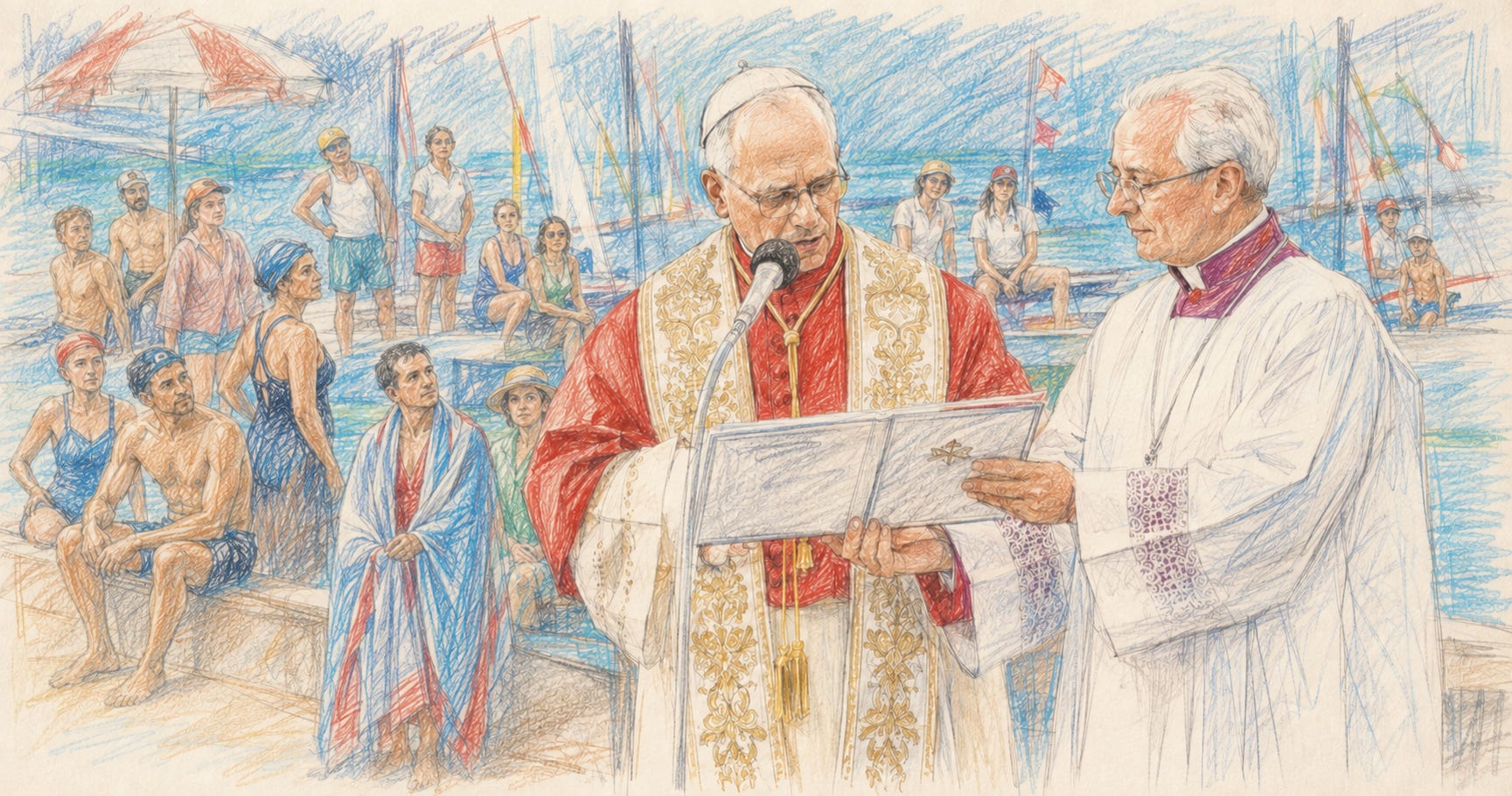
On the water he had stood at the bow of the boat, a park vessel called the Falco, with the bronze statue of the Madonna beside him while families in bathing suits stood up in their dinghies to film him with their phones. A man in a white t-shirt waded into the lake to get closer. A sailboat strung with lights drifted behind him, its crew in shorts and tank tops, and a girl in a swimsuit leaned on the gunwale of a rowboat to watch.

Rome sat under a red heat alert all day, the only city in central Italy at the Health Ministry’s highest warning level, and the air over the crater lake had not cooled with the sunset.
None of it was an accident. The feast of the Madonna del Lago has been celebrated on the last Saturday of August since 1954, when a Salesian parish priest named Don Dino Sella founded it during Pius XII’s Marian Year.

Paul VI commissioned the sail-shaped church on the shore in 1966 and consecrated it on the feast of the Assumption in 1977, telling the parish, “Who knows if I, being old, shall have the good of celebrating this feast with you again.” He died the following August. John Paul II said Mass there on September 2, 1979. Neither man got in the boat.
Leo did. Federico Bronzi, the man who has steered the Falco for two decades, told the local paper what that meant to him before the pope ever stepped aboard: “This is the first time ever that a pope has boarded a boat. It’s enormous emotion, it’s an honor.”
“Let us not deceive ourselves”
The evening began at six o’clock in the Church of Maria Santissima del Lago, a building its pastor, Don Tadeusz Rozmus, says was designed to “breathe the lake.” It seats about six hundred in summer. The pope had driven out from the Vatican that afternoon, according to the Holy See Press Office, and he celebrated Mass in simple white vestments in front of a congregation in a town that had banned glass bottles for the night and closed the lakefront road at five.
The homily was short, and it centered on a warning. Leo took the day’s readings (Jeremiah’s complaint that God had “seduced” him, and Peter’s refusal to accept a Messiah who would suffer) and turned them on the cynicism of the present moment. “Unfortunately, not everyone understands the beauty, the goodness, and the concreteness of this dream of the Creator,” he said. “Indeed, many think it is a utopia. To turn the other cheek, they say, is for losers; to give in the face of refusal is for the naive; to forgive without limit is for the weak.”
Then he answered them. “Let us not deceive ourselves,” he said. “Hatred and violence bring nothing good, only destruction and death, always, even when they are a response to injustices suffered. We see it every day, from the small scale of our home life to the great stage of the world.”
No country and no war was named, and none had to be. This is the pope who called hatred “increasing” from this same town in March, at the height of the Iran war, and who walked out of the palace at Castel Gandolfo a week later to ask Donald Trump for an off-ramp. Saturday’s sentence was built to survive the specifics. Whatever the wound, he told the congregation, “whatever the offense, let us not allow evil to disfigure our humanity and corrupt our hearts.” Jesus, he said, “remains categorical: only the way of love is the way of life.”
Two weeks ago, in this same parish, he preached on the Assumption that love is humanity’s most beautiful adornment. Saturday he took that argument to the shore and made it a rule for a world at war with itself.
The crossing
Leo told the people in the pews what the boat ride would mean before it happened. The procession on the lake, he said, evokes the night on the Sea of Galilee when Jesus reached the frightened disciples by walking on the water and “led them to shore by calming the storm.” The lesson he drew from it was the one he has been repeating all summer: “Precisely when they were most afraid, at the mercy of contrary winds, he urged them to have faith, to pray, to find peace again and, together with him, to keep sailing toward the desired destination.”

After Mass, the statue went out the door on the shoulders of the parish association and down the lakefront road to the Tropicana beach, where the Saroli rowing club keeps its pier. The pope boarded the Falco there at about a quarter past seven. The boat is a twenty-four-seat vessel the Castelli Romani Regional Park bought for the 2000 Jubilee, and its first working voyage, in 2006, was the same one it made on Saturday.

Roughly ten civilian boats followed, two of them canoes, plus the police launches and a gray rigid-hull inflatable marked Med Defense that idled off the pope’s stern. In an ordinary year swimmers accompany the statue. This year the diocese’s liturgical director, Don Adriano Gibellini, ruled them out for safety, and the lake was closed to navigation and bathing from six o’clock on. The crossing to Giorgio’s Beach took about twenty-five minutes.

The lake he crossed is shrinking. A citizens’ monitoring group, Grottaferrata Sostenibile, measured the water at 130 centimeters below its reference mark this week, thirteen centimeters lower than at the end of July and the lowest reading on record; over the last several decades Albano has lost more than seven and a half meters of depth. The pope whose predecessor founded Borgo Laudato Si’ on the papal farm up the hill, and who ate lunch there with two hundred of Rome’s poor in July, spent Saturday evening blessing a lake that is visibly draining away.
“As one of us”
Castel Gandolfo’s mayor, Alberto De Angelis, thanked the pope at a press conference this week for placing “the small Lazio village at the center of the world.” He was talking about pilgrims and hotel bookings, and he was also, without quite meaning to, describing the method.
Leo is the pope who told those two hundred guests at Borgo Laudato Si’ that he had come “without a speech, because I’m hungry. I’m hungry for justice.” He accepted a pair of hand-painted Nikes from a Kentucky priest in May, and earlier this month 40,000 White Sox fans in mitres exchanged the sign of peace in his honor on the South Side. Don Rozmus, who has now hosted him twice in two weeks, describes a man who is “open to encounters, not formalistic” and who “always seeks to be available to people after celebrations.”
Populism is the wrong word for it. A pope who stands in a boat in the heat and lets a girl in a swimsuit watch him from a rowboat is refusing to let the office wall him off from the people it exists to serve, and the image says something a hundred documents cannot say on their own, which is that the Church has no reason to fear the world it is trying to love.
Leo said as much himself, in the homily’s final paragraph, and he borrowed the words from the man who built the church. Quoting Paul VI’s homily at the consecration in 1977, he described the little lakeside sanctuary as “a symbol of the love with which the Lord, through his Most Holy Mother, wished to draw near to us as one of us, to the point of blending into the great crowd of our humanity.”
That is the theology behind the Vicar of Christ walking by the beach bar. The Word became flesh and walked past the beer coolers, and on Saturday his vicar let himself be filmed from a dinghy by people in bathing suits, on a red-alert heat night, as if to prove that the incarnation was never a metaphor.
Paul VI gave this parish its Stations of the Cross, its tabernacle, its Madonna, and a Pietà. He gave it a building shaped like a sail, and he never lived to sail. Forty-nine years later an Augustinian from Chicago did, with the lake at a record low and the day’s heat still hanging over the water after dark, and he told the people on the water why: to be, “not only on the lake, but in all the nights of the world, a calming reflection of God’s presence, and an irresistible echo of his love that invites us to love.”
At Letters from Leo, we stand with the families in the dinghies and the man wading in to get closer, and with the parish that keeps a lakeside church open all year so that once a summer the whole people of God can fill it.
We stand with a pope who answers the gospel of the strongman by saying, in front of the beer signs, that hatred and violence bring nothing good.
In an age that calls turning the other cheek a loser’s game, we remain rooted in a faith that treats it as the only way of life there is.
This is the fastest-growing Catholic community in the country because people are hungry for exactly what Leo offered on the water Saturday night, which is a Church unafraid of the crowd and a God who draws near as one of us. If you believe that movement matters, I am asking you to join us.
If you’d like to invest in our mission, here are three ways you can help:
Subscribe as a paid member to receive exclusive posts about the life and formation of Pope Leo and help sustain this newsletter.
Donate with a one-time gift to fuel this project’s mission.
Share this post (and Letters from Leo) with a friend who might enjoy it.
Paid subscribers receive the full biographical series on Pope Leo’s life and formation, the Sunday Scripture Reflection Series, and our reporting on Pope Leo’s confrontation with the AI industry.
Whether you give $0, $5, $50, $500, $1,000, or more, your presence here matters — no matter your faith or your politics.
Thank you for reading. I’ll see you on the road.


To me ‘turning the other cheek’ means not falling for being offended when someone insults you. I have found that it makes for a freer and uncomplicated life by refusing to get embroiled in unnecessary unpleasantness.
Your ego can be turned into your enemy if you rise to the bait.
Thank you for sharing this beautiful message and celebration with us.
