Thank you for reading! Letters from Leo is a reader-supported publication and the fastest-growing Catholic community in the country. To receive new posts and support this movement, consider becoming a free or paid subscriber.
Donald Trump presented the Presidential Medal of Freedom to the family of Welles Crowther on Tuesday, standing on the Ellipse beside a 21-foot steel beam pulled from the South Tower, with Welles’s mother, Alison, and his sister Paige accepting on his behalf.
Then the president measured the dead man against himself. “The man in the red bandana has become more famous than me,” he told the crowd. “I don’t like it. Very unhappy. But he’s become much more famous than me.”
He is right about the fame. Welles Crowther is beloved because he gave his life for strangers, and in the faith I was raised in, a man who does that is called a saint.
Yesterday I promised to name the Catholic players and heroes of September 11 between now and Friday’s anniversary. Welles comes first, along with a correction. In that essay, and in a piece last year, I called him a Catholic. He was not.
Welles was a communicant at Grace Episcopal Church in Nyack, where his family held a liturgy of thanksgiving for his life on September 29, 2001.
His formation belonged to the Jesuits at Boston College and to Pedro Arrupe’s charge to become “men and women for others.” The Church has never pretended holiness stops at its own doors, and I will not spend a sentence apologizing for using the word saint to describe him.
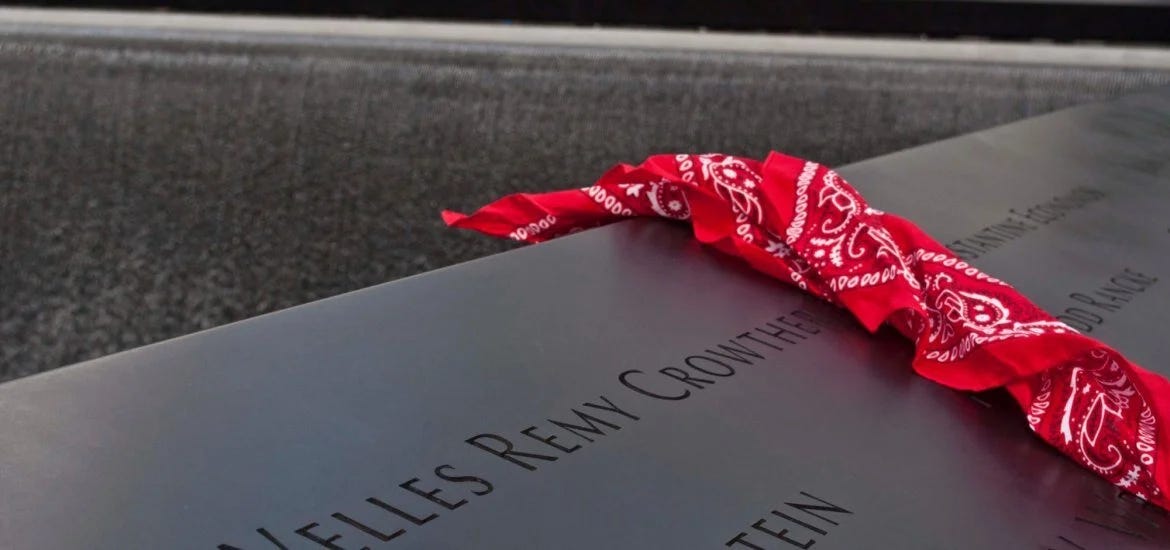
The bandana came from his father when Welles was six. Jefferson Crowther folded a white handkerchief into the boy’s pocket and handed him a red one for the other pocket, and explained: “This white handkerchief, that’s for show. Here’s a bandana, that’s for blow.”

Welles carried a red bandana for the rest of his life, under his helmet at Boston College, where he wore No. 19 on the lacrosse field. At 16 he had joined Empire Hook and Ladder Company No. 1 in Upper Nyack as a junior firefighter. By 2001 he was an equities trader at Sandler O’Neill on the 104th floor of the South Tower, and he had already told his father he wanted to leave Wall Street for the FDNY.

United Flight 175 cut into the South Tower at 9:03 on the morning of September 11, tearing through the floors between the 78th and the 84th. Nine minutes later, Welles left a voicemail for his mother: “Mom, this is Welles. I want you to know that I’m okay.”
Roughly 200 people had been waiting for elevators in the 78th-floor sky lobby when the plane hit. Ling Young came to on the floor with blood on her glasses, surrounded by the dead and the badly burned. Then a young man’s voice came through the smoke. “I found the stairs,” he said. “Follow me. Only help the one that you can help.”
He led the group down to the 61st floor, carrying one woman for 17 flights, handed them to firefighters, and turned around. Judy Wein, who was still up in the sky lobby, repeated his words to her husband from a hospital bed that afternoon: “Everyone who can stand, stand now. If you can help others, do so.” The South Tower fell at 9:59.
Alison Crowther watched it from her home in Nyack and dropped to her knees. “I said, dear God, take me now. Leave him here.”
His body was recovered on March 19, 2002, in what had been the lobby of the South Tower, beside uniformed firefighters. The family did not learn what he had done until that May, when the New York Times published survivors’ accounts of the 78th floor, and Judy Wein described a man in a red kerchief running a triage station. Alison read the line and knew.
She mailed a photograph of her son to Wein and to Young, and both women told her yes, that was him. By the survivors’ count, Welles saved somewhere between a dozen and 18 people, and the FDNY made him an honorary member of the department in December 2006.
His sisters, Honor Crowther Fagan and Paige Crowther, sat down with KFC Radio on the 24th anniversary last year, and the host asked whether they were religious. “We are Episcopalian, baptized,” one of them answered.
Her first words to her future husband when he picked her up that day were “take me to church,” and she prayed alone inside Grace Church that afternoon. “Maybe this was some grand plan after all,” she said of the families her brother put back together, and she calls him a guardian angel “in flesh and blood.”
The word for what moved Welles back up those stairs is empathy, and empathy has become a target — even among Catholic leaders.
Pope Leo XIV, speaking to Christians and Muslims at the Vatican in May, taught the opposite. Compassion and empathy, he said, “are not something additional or optional, but are a call from God,” and both, he warned, “are sadly in danger of disappearing today.”
Welles felt the terror on the 78th floor as if it were his own, and the feeling turned into a stairwell and a voice people could follow. Feeling alone would have left him on the 61st floor with everyone else.
The Church’s word for empathy once it starts climbing is charity, and no higher form of it exists.
Jesus set the ceiling himself in the Gospel of John: “No one has greater love than this, to lay down one’s life for one’s friends.”

In 2017, Pope Francis opened a new path to beatification under that verse’s Latin title, Maiorem hac dilectionem, for those who freely offer their lives for others. The Church built a category for what Welles did.
Father Mychal Judge is still waiting on his country. The Franciscan chaplain of the FDNY walked into the North Tower lobby with his firefighters and was killed there while praying over the dying, the first certified death of the day, Victim 0001.
Chuck Schumer asked the White House to give him the Medal of Freedom in 2011, and fifteen years later the request sits where he left it. We will get to Father Judge later this week. Welles Crowther’s medal is deserved, and the priest who died a few hundred feet away from him is owed the same.
At Letters from Leo, we stand with Welles Crowther and with every person who felt a stranger’s fear on September 11 and moved toward it, Father Mychal Judge among them.
We stand with Pope Leo XIV, who calls empathy a summons from God at the very moment powerful men are teaching Christians to sneer at it.
This is the fastest-growing Catholic community in the country because people are hungry for a faith that climbs the stairs.
They are tired of being told that mercy is weakness and that a priest’s sacrifice is a footnote, and they want a Church, and a country, that knows a saint when it sees one.
If you believe this movement matters — Catholics and people of goodwill standing for human dignity against the gospel of contempt — I am asking you to join us.
If you’d like to invest in our mission, here are three ways you can help:
Subscribe as a paid member to receive exclusive posts about the life and formation of Pope Leo and help sustain this newsletter.
Donate with a one-time gift to fuel this project’s mission.
Share this post (and Letters from Leo) with a friend who might enjoy it.
Paid subscribers receive the full series on Pope Leo’s life and formation, along with the Sunday Scripture Reflection Series and every investigation we publish.
Whether you give $0, $5, $50, $500, $1,000, or more, your presence here matters — no matter your faith or your politics.
Thank you for reading. I’ll see you on the road.


THIS IS an ELECTION about RESTORING things...
NOT DESTROYING things..
In AMERICA!
WE ARE STRONGER TOGETHER and WE CAN DO THIS TOGETHER!!
No greater love than this, that a man would give his life for others.
