
Why I’m Spending America’s 250th on Lampedusa Island
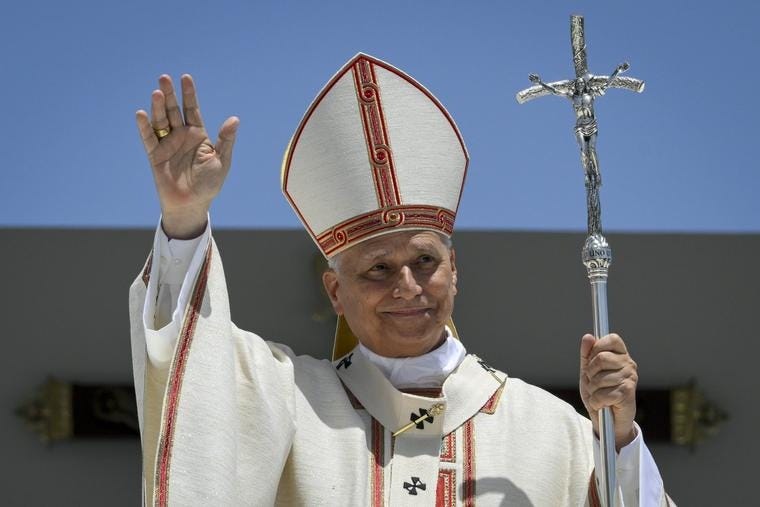
For the first time, I'm spending the Fourth of July abroad — at Mass on Lampedusa, where Pope Leo XIV stood today and children are buried under crosses cut from shipwrecks.
Letters from Leo is the fastest-growing Catholic community in the country — a movement for human dignity against authoritarianism. This Fourth of July, I am asking you to join us.
For the first time in my life, I am spending the Fourth of July outside the United States. I am writing from Lampedusa, a speck of rock in the Mediterranean that sits closer to Tunisia than to Rome — the place where Africa reaches toward Europe, and where tens of thousands of people have risked everything, and thousands have drowned, trying to reach a new life.
Today I am going to spend the Fourth of July on a migrant island, celebrating holy Mass with the American pope. Leo XIV chose Lampedusa for his visit today. He will walk the pier where migrant boats come ashore and pray at the small cemetery where crosses cut from the wood of shipwrecks mark the graves of children who drowned within sight of Europe.
I did not set out to observe my country’s 250th birthday among the graves of strangers. Now I cannot imagine a more fitting place to stand as an American. Something about celebrating the freest country on earth from the doorstep where the world’s most desperate people come knocking cuts straight to what the day is supposed to mean.
When Pope Francis came to this island in 2013, on the first trip of his papacy, he threw a wreath of flowers into the sea and warned the world about the globalization of indifference — the quiet habit of deciding that other people’s suffering is none of our concern.
Leo has taken up that thread and carried it all the way to Washington’s doorstep, spending his first year insisting that a nation is measured by how it treats the stranger. His decision to come here on our Independence Day, rather than to a gala in Rome or Washington, was no accident.
Leo has named the stranger plainly. In a letter to the country released yesterday to mark the 250th, he wrote that defending human life “also includes welcoming, protecting and assisting immigrants, whose hopes, sacrifices and contribution have formed part of the history of this country from its very beginning,” and that to receive them with compassion “is not only an act of charity, but also a recognition of the dignity that belongs to every human person.”
The same day, accepting the Liberty Medal from the Vatican — a moment I wrote about for this newsletter — he told Philadelphia that it was America’s openness to “successive waves of immigrants” that made it “a byword for freedom,” and handed the nation back its own motto: e pluribus unum, out of many, one.
I came of age in the shadow of September 11. Those days defined my understanding of life, of death, of unity, and, strangely, of hope, and they remain the most vivid of my life. For a few weeks a wounded country became one thing, and the unity I felt then is something I have spent my whole career trying to reinvigorate. I remember the saints of those days, too — the firefighters climbing the stairs everyone else was running down, and above all Father Mychal Judge, the Franciscan friar and fire-department chaplain who was killed ministering in the North Tower and recorded as the first certified death of the attacks.
The photograph of first responders bearing his body from the rubble has always struck me as a modern-day American pietà — the most profound image of Catholic American patriotism I have ever seen.

What else has stayed with me is an argument I first met in Robert Kagan’s Of Paradise and Power: the bonds of the West held firm through the Cold War because a shared enemy demanded it, and they began to fray once that enemy was gone. A common threat, in Kagan’s telling, binds people together more tightly than any common goal. I have come to put it more bluntly for myself — a shared enemy unites us more than a shared ambition ever will.
The evidence is everywhere. Terrorism did it for a season after 9/11. At our founding, the British crown did the same, turning thirteen quarreling colonies into a single nation by giving them one thing to resist together. Enemies clarify. They tell us who we are by forcing us to name what we will stand against.
Here the Gospel interrupts. Jesus refuses the neat arrangement I just described. Love your enemies, he tells us, and pray for those who persecute you. How, then, is a Christian supposed to hold both truths at once — that enemies unite us, and that we are commanded to love them?
The way through, I think, is to sharpen what we mean by the word enemy. America’s greatest adversary in 2026 is not a rival country or a hostile people. It is something closer to home: whatever lives inside us that refuses the demands of the Gospel — our cruelty, our comfort, our talent for looking past suffering we have the power to relieve. That enemy is worth uniting against, and loving our neighbor is exactly what the fight requires.
Zohran Mamdani, the new mayor of New York, has built his politics on a blunt indictment: that America has stopped working for the people who keep it running, that rent and groceries and childcare have climbed out of reach while the country tells the struggling their hardship is their own fault.
In his inaugural address, he vowed to trade “the frigidity of rugged individualism” for “the warmth of collectivism.” Bishop Robert Barron came after him hard. “For God’s sake, spare me the ‘warmth of collectivism,’” he wrote, warning that collectivism “is responsible for the deaths of at least 100 million people in the last century” and insisting that Catholic social teaching condemns socialism and blesses the market economy.
I understand the fear underneath Barron’s words, and I have watched him wave away Francis’s warning about an economy that kills. On the thing that matters, though, Mamdani is right. A country this rich should be ashamed of how many of its people go without, and saying so out loud is not an attack on America. We criticize our nation precisely because we love it, the way you tell a hard truth to someone in your own family.
“From everyone to whom much has been given, much will be required,” Luke’s Gospel tells us. No nation in human history has been given more than this one. The expectation that rides along with the gift is not a burden imposed by our enemies; it is the standard written into our own founding and named by the God we stamp on our money.
Yesterday, seated behind George Washington’s desk to mark the 250th, Mamdani gave his own account of what makes this country exceptional. Not that we are richer or stronger or more powerful than anyone else, he said, but that here “nothing is fixed into place” — that the work of rendering America more faithful to its founding ideals is never finished and belongs to all of us.
Bishop Barron could not abide it. He dismissed the address as “an appalling speech” and blamed Howard Zinn; his opposition to the mayor has curdled from argument into something close to obsession.
Years earlier, on the night he won reelection in 2012, Barack Obama had reached for a nearly identical idea, locating American exceptionalism in “the bonds that hold together the most diverse nation on earth,” and in the conviction that “this country only works when we accept certain obligations to one another.”
A Muslim democratic socialist and the first Black president — both of them branded, at one time or another, as somehow un-American — landed on the same answer. What sets this nation apart is not its power. It is the promise that we belong to one another, and the labor of making that promise true.
The line I love most in all of American writing comes at the very end of the Declaration of Independence, where the signers pledge to one another “our Lives, our Fortunes and our sacred Honor.”
They made that promise to each other — plain citizens binding themselves to fellow citizens, with no crown above them to catch them if they fell. We are a country of rugged individuals, and I will always celebrate the ideals of self-reliance, personal responsibility, and individual excellence. Those virtues are only half of who we are.
You can quibble with Mamdani’s word, collectivism, and I understand why some do.
The basic point stands: the best of America has always been done together. Our hardest-won victories tell that story plainly.
Emancipation, the defeat of fascism, the enfranchisement of Black Americans, the long struggles of workers and of the civil-rights movement — each one demanded that people tie their fate to strangers and spend themselves for a good they might never live to see finished. Our proudest chapters belong to those who understood that a neighbor’s freedom was bound up with their own, not to anyone who went it alone.
The people buried on this island of Lampedusa grasped a truth we spend enormous energy trying to forget. We are bound to one another whether we admit it or not.
Picture a vast pool made of countless drops of water: drop a stone into one corner and the whole surface lifts; poison one part and the sickness travels through all of it. The bond holds whether or not we ever choose to see it. Deny it — tell yourself the drowned are simply none of your business — and the consequences still arrive, for everyone.
This is what I am praying about on Lampedusa this Fourth of July.
At our best, we have never been a nation of fear. We have been a nation of love — a love that heals rather than wounds, that lifts up the poor and the stranger instead of grinding them down, and that can look at a migrant child’s grave and still refuse to call it someone else’s problem. I believe the broken system that afflicts all of us can be repaired. It has to be, if the words “liberty and justice for all” are ever going to mean what they say.
Two hundred and fifty years in, that remains the American experiment. Not the flag, not the fireworks, but the wager that a people can pledge their lives and their fortunes and their honor to one another — and to those still out on the water, reaching for the shore.
At Letters from Leo, we stand with the migrants of Lampedusa and the millions of Americans who still believe their country is measured by how it treats the least among us — alongside a pope who is spending the Fourth of July at the water’s edge instead of in a palace, and everyone of goodwill who refuses to accept that a drowned child is a stranger’s problem.
In an age that trades in fear and contempt, we remain rooted in a faith that will not look away from the poor or bow to the idols of cruelty and comfort. This is the fastest-growing Catholic community in the country because people are starving for something deeper than rage — for courage, for truth, for love made visible in what we actually do.
If you believe this movement matters — Catholics and people of goodwill standing for human dignity against the politics of indifference — I am asking you to join us.
If you’d like to invest in our mission, here are three ways you can help on the 250th birthday of the United States:
Subscribe as a paid member to receive exclusive posts about the life and formation of Pope Leo and help sustain this newsletter.
Donate with a one-time gift to fuel this project’s mission.
Share this post (and Letters from Leo) with a friend who might need it today.
Paid members keep this work alive and unlock the full archive — the biographical series on Pope Leo’s life and formation, our Sunday scripture reflections, and the investigations you won’t read anywhere else.
Whether you give $0, $5, $50, $500, $1,000, or more, your presence here matters — no matter your faith or your politics.
Thank you for reading. I’ll see you on the road.


Thank you for this inspiring message. It all comes back to loving your neighbor as yourself. It is how our country has been built, even though imperfectly. I pray that we meditate on that ideal this July 4th.
"Something about celebrating the freest country on earth ......" Really?! Is that how ICE detainees feel? Not to mention increasingly disenfranchised Afro-Americans. Etc etc. It is that sort of blinkered view that leaves outsiders gaping in disbelief.