
As Trump-Vance White House Attempts to Deport Haitian Catholics, Church Fights Back
One night after protections lapsed for more than 300,000 Haitians, a Maryland parish held a mass of solidarity — and Miami’s archbishop spent two days on Capitol Hill demanding the Senate act.
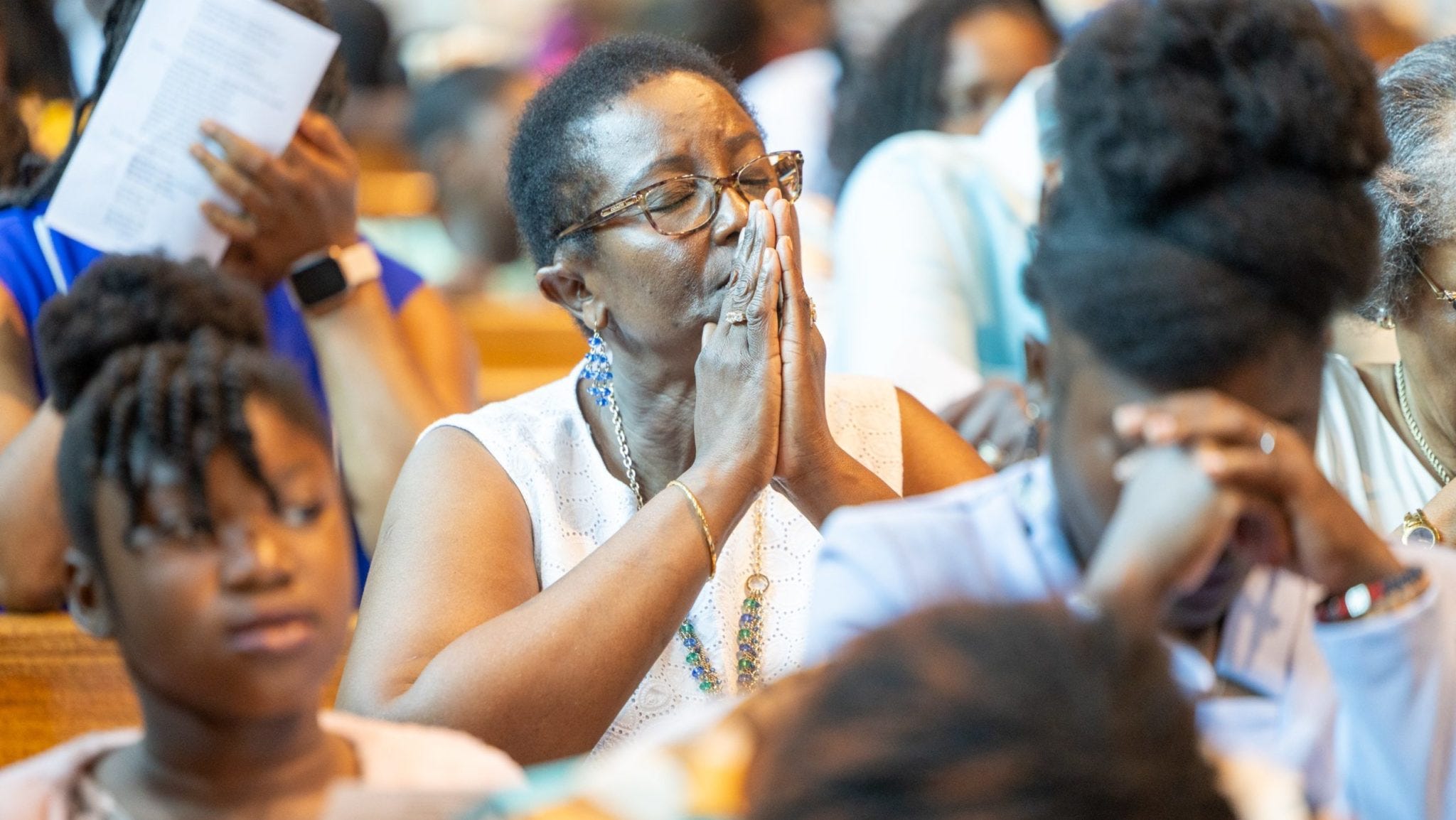
On Tuesday night, Haitian families filled the pews of Our Lady of Sorrows Catholic Church in Takoma Park, Maryland, for a mass of solidarity with a community that had just lost the protection of American law.
Temporary Protected Status for more than 300,000 Haitians expired the day before.
“I’m here for those who cannot be here,” Carole Philogene Coaxum told DC News Now from the parish. “I’m here to basically let them know that we’re praying, that we’re standing with them.”
Another worshipper, Yvanne Jean-Louis, was blunter: “I don’t know why they pick on Haitians like that.”
Marie Lourdes Price, an American citizen for 30 years with loved ones on TPS, described what awaits them in Haiti: “Going back is not safe. The people have no idea.”
Washington created TPS for Haiti after the 2010 earthquake killed more than 200,000 people. For sixteen years, the protection held — through cholera, hurricanes, a presidential assassination, and the gang conquest of Port-au-Prince — surviving even the first Trump administration’s attempt to end it.
The Trump administration ordered the program terminated in June 2025, claiming conditions in Haiti had improved. The State Department, at that very moment, held Haiti at Level 4 — do not travel — citing kidnapping, gang violence, and civil unrest.
The courts held the line for a year. U.S. District Judge Ana Reyes blocked the termination in February after finding it rooted “in part” in “racial animus.” Then, on June 25, the Supreme Court swept the litigation aside, ruling 6 to 3 that the courts cannot second-guess the process behind the secretary of homeland security’s decision to end the protections. The final court-ordered extension ran out Monday.
Work permits went void overnight, from Miami’s nursing homes to the factory floors of Springfield, Ohio, where Republican Gov. Mike DeWine observed that “while these Haitians were working and contributing to our community and economy yesterday, today it is now illegal to employ them.” ICE is preparing flights to Cap-Haïtien, in the country’s north, because the capital is considered too unstable to receive them.
The Department of Homeland Security marked the deadline with this: “What we would say now is it’s closing time which means you don’t have to go home, but you can’t stay here.”
Archbishop Thomas Wenski of Miami flew to Washington on Monday to fight it. For two days he worked the Senate alongside other faith leaders, pressing for the bill that would extend Haitian protections three more years — a measure the House passed in April, 224 to 204, with all three South Florida Republicans voting yes.
“It’s like sending people back into a burning house,” he said.
The archbishop counts the cost inside his own institutions: “In the Archdiocese of Miami, in our nursing homes, I have over 40 people on TPS that will lose their work permits today, and we will have to let them go.”
Wenski has spent his whole priesthood beside Haiti’s people. He learned Haitian Creole as a young priest, led the Notre Dame d’Haiti mission in Miami’s Little Haiti, and appeared before the Senate Judiciary Committee to defend Haitian asylum seekers in 2002.
Last summer he rode his Harley to the gates of Alligator Alcatraz and prayed the rosary for the men caged there. He returned in December to celebrate Christmas Mass inside the camp after months of stonewalling from the administration. In April, that same administration stripped $11 million from Miami’s Catholic Charities, forcing the closure of a children’s shelter whose lineage runs back to Operation Pedro Pan.
“To make America great again is a worthy goal,” Wenski wrote on Friday, “but you don’t make America great by making America mean.”
The Senate answered him with an objection. Democrats sought unanimous consent on July 22 to pass the extension; Sen. Eric Schmitt of Missouri rose against it, and the bill died on the floor five days before the deadline.
The deportation machine has already reached the Church’s own ministers. In the Archdiocese of Dubuque, two Haitian priests — Father Emmanuel Fenelus and Father Jangill Maime, each serving Iowa parishes for more than three years — watched their visas expire Tuesday while their renewals sat in a yearlong backlog. Their archdiocese can no longer legally pay them.
A bipartisan fix, the Religious Workforce Protection Act, has waited in the Judiciary Committees of both chambers since April of last year without so much as a hearing.
And there is Sister Leticia Ugboaja. ICE agents seized the 56-year-old sister and nurse on June 28 as she walked to Sunday Mass at Our Lady of Sorrows parish in McAllen, Texas — a church that shares its name with the one where Haitians prayed Tuesday night. The agents took her rosary. Hours later, after her parish and two congressmen — a Republican and a Democrat — demanded answers, she was released.
Her ordeal continues. She avoided detention at an ICE check-in Tuesday, Border Report noted, but the government still intends to deport her to a third country — a woman an immigration judge already ruled would likely be tortured if sent back to Nigeria.
“For me, a nun, not to go to Mass on Sunday, not to receive Communion, it was very, very heartbreaking,” she said last week.
Pope Leo XIV has pressed the Haitians’ case since the first summer of his pontificate. “The situation of the people of Haiti … is increasingly desperate,” he said at his Angelus last August. “Reports of murders, violence of all kinds, human trafficking, forced exile and kidnappings continue to pour in.” On Christmas Day, from the loggia of St. Peter’s, he prayed “for the beloved people of Haiti, that all forms of violence in the country will cease.”
His verdict on the American deportation campaign is just as plain.
“Someone who says ‘I’m against abortion, but I’m in agreement with the inhuman treatment of immigrants who are in the United States,’ I don’t know if that’s pro-life,” he told reporters in September.
In November he called the treatment of longtime immigrant residents “extremely disrespectful, to say the least” and invited “especially all Catholics” to listen carefully to the U.S. bishops’ special message against mass deportation — a rebuke the bishops adopted 216 to 5, their first of its kind in twelve years, at his urging.
Asked in June about the mass-expulsion ideology now fashionable on the American and European right, the pope answered: “So simply saying, ‘We’ll send them away, so we can wash our hands of the problem,’ doesn’t seem like the most Christian response to me.”
The administration has answered its Church with contempt.
Vice President JD Vance began 2025 by suggesting the bishops defend immigrants to protect their “bottom line” — a charge he privately admitted was false, Cardinal Timothy Dolan later revealed. ICE started targeting Church property that same January, when the administration tore up the policy that had kept enforcement away from houses of worship since 2011.
By this spring, Trump was attacking the pope on Truth Social as “WEAK on Crime” and demanding he quit “catering to the Radical Left.” Border czar Tom Homan supplied his own theology this year, musing that “if we jumped the wall at the Vatican, the penalties for doing that are much harder than the ones here in the United States.”
Last week the administration sued the Church itself, seeking to remove a shrine to build the border wall.
Wenski has already named what is happening here. “It would be an act of abject cruelty,” he said last month, “for the United States to send families back to such dangerous and unsafe conditions.”
The Gospel leaves no room for maneuver on this. “I was a stranger and you welcomed me,” Christ says in Matthew 25 — the verse Pope Leo set near the heart of Dilexi Te, his first apostolic exhortation, where he wrote of the Church: “Where the world sees threats, she sees children; where walls are built, she builds bridges.”
The hundreds of thousands of people this administration wants gone care for America’s sick and elderly, raise tens of thousands of American children, and fill the pews of parishes from Miami to Springfield to Takoma Park. Our government tells its own citizens not to set foot in Haiti, and it is about to fill planes with people it insists belong there.
The people in the pews Tuesday night answered with prayer. “God is our strength. We are a strong community. We are a strong people of Haiti,” Coaxum said. “And we will … get over it. We will make it.”
To them, Wenski addressed the last words of his statement: “You are not alone. The Catholic Church walks with you.”
At Letters from Leo, we stand with Archbishop Wenski, with Sister Letty, and with the Haitian faithful of Our Lady of Sorrows — the families who filled a church in Maryland this week to pray for neighbors the government has marked for removal.
This community is rooted in a faith that refuses to flinch before injustice. The Gospel was written by people who knew exile, and Jesus himself spent his infancy as a refugee fleeing state violence.
Letters from Leo has become the fastest-growing Catholic community in the country because people are hungry for something deeper than propaganda — for courage, for truth, for love made visible in action.
This week, as hundreds of thousands of our brothers and sisters lost the protection of the law, that hunger became an emergency.
If you believe this movement matters — Catholics and people of goodwill standing for human dignity against a deportation machine now aimed at the Church’s own people — I am asking you to join us.
If you’d like to invest in our mission, here are three ways you can help:
Subscribe as a paid member to receive exclusive posts about the life and formation of Pope Leo and help sustain this newsletter.
Donate with a one-time gift to fuel this project’s mission.
Share this post (and Letters from Leo) with a friend who might enjoy it.
Paid members receive our exclusive series on the life and formation of Pope Leo XIV, full access to the Epstein-Bannon investigation, and the Sunday scripture reflections that sustain this community between the headlines.
Whether you give $0, $5, $50, $500, $1,000, or more, your presence here matters — no matter your faith or your politics.
Thank you for reading. I’ll see you on the road.


Great read. More proof if one voted MAGA, one’s soul is in peril.
What a crime against humanity. These are people who have cared for our elderly, lived with and cared for our children, and prayed with us in our churches. What crime have they committed? What court is allowing this to happen? Our Catholic community must stand with these people and prevent this from going forward. How can we help them?