


Thank you for reading! Letters from Leo is a reader-supported publication and the fastest-growing Catholic community in the country. To receive new posts and support this movement, consider becoming a free or paid subscriber.
Pope Leo XIV released his prayer intention for September on Tuesday, and it asks Catholics to pray for the care of water. The video runs under two minutes, and it landed the same day Leo opened the Season of Creation with an evening Mass at Castel Gandolfo, on the same grounds where I reported on him eating lunch with 200 of Rome’s poor in July.
Within hours, a familiar corner of the Catholic internet had decided the pope was neglecting the salvation of souls.
The prayer deserves a reading before the outrage does, because almost nobody who mocked it appears to have given it one. Leo thanks God for water as a “source of fruitfulness, freshness, and hope,” which “quenches thirst, nourishes the earth, and heals wounds.”
Water, he adds, “is also a symbol of your grace and love that renews us through Baptism.” Then comes the confession. “Forgive us for turning it into a commodity,” he prays, “forgetting that it is a universal gift, a right without borders, meant for all your children.”
He asks the Holy Spirit to make Christians “pilgrims of the essential,” people who live simply and defend “the right of every brother and sister to drink without fear and without inequality.” The closing petition returns to the poor: “May our care for water be a sign of love for the Creator and a commitment to the lives of the poor.”
That is the text. Here is the reaction.
Fred Simon, whose X handle advertises the Traditional Latin Mass to 92,000 followers, replied to the pope’s post: “Seriously? What about souls?”

Nick Donnelly, an English deacon whose bishop shut down his blog in 2014, posted a corrected intention on Wednesday morning: “The most endangered resource isn’t water or glaciers. It’s the human soul.”


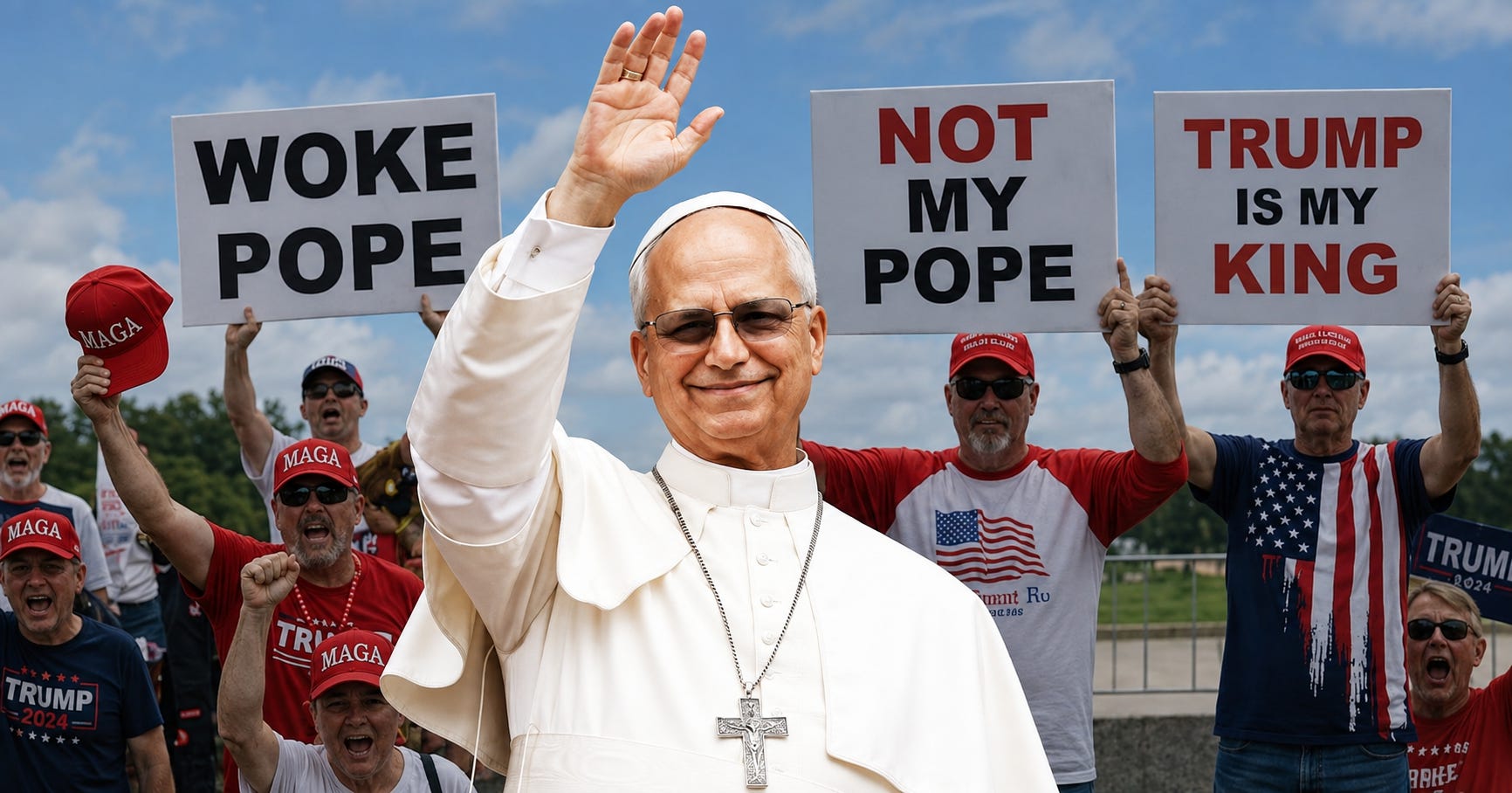
By Wednesday evening the complaint had traveled well beyond the Latin Mass corner of the internet. Mike Cernovich, one of MAGA’s top voices in the nation with 1.5 million followers on X, quote-posted the pope: “Much easier to post slop like this than discuss abortion.” Cernovich did not say which part of a prayer for people who walk for miles to find clean water qualifies as slop.

Tom Woods, the libertarian author of How the Catholic Church Built Western Civilization, told his nearly 250,000 followers to “head to the Vatican’s website and read papal documents from Popes Pius X, XI, and XII,” who “spoke with authority about important things, in contrast to the post-Vatican II papacy of ‘water is important’ and ‘sports are good things’ and ‘cancer is bad.’”

Woods should take his own advice. On May 25, 1945, Pius XII stood before Italian athletes and called sport “a school of loyalty, courage, endurance, resolution, and universal brotherhood,” adding that it “can and must be at the service of God.”
The monthly papal prayer intention that Woods finds beneath the office was the invention of Leo XIII, the pope of Rerum Novarum, who began entrusting his monthly concerns to the Apostleship of Prayer at the end of the nineteenth century.
And the teaching that water is a human right predates Francis by decades. Benedict XVI wrote in 2008 that water “is valued as a universal and inalienable right” founded “on the dignity of the human person,” and he warned against “those who consider and treat water merely as an economic commodity.” Francis carried the same line into Laudato Si’: “access to safe drinkable water is a basic and universal human right.” Leo is reading from a script his predecessors wrote.
A Jesuit in Paris answered the question directly. “People complaining ‘but what about saving souls?’” wrote Joseph Nolla, a Jesuit and Air Force veteran studying theology at the Jesuit Facultés Loyola, “don’t forget all the ways Jesus talks about people being damned. One of them is literally denying drink to the thirsty.”

He is pointing at the only extended account of the Last Judgment that Jesus gives us. In Matthew 25, the King tells the condemned, “I was thirsty and you gave me no drink.” Christ’s questions in that scene concern food, drink, clothing, sickness, and prison; liturgical preferences never come up.
Leo knows what thirst looks like. In early 2017, when the El Niño costero rains sent the La Leche River over its banks and swallowed whole neighborhoods around Chiclayo, Bishop Robert Prevost went out in rubber boots and a poncho to run the diocese’s response, airlifting aid into cut-off villages with help from local businesses and the Peruvian armed forces.
“He was the face of Christ, the one who went out into the mud to help his people,” Janinna Sesa, who ran Caritas Chiclayo at the time, told the National Catholic Reporter. A man who has hauled drinking water to flood victims does not need a lecture from a podcaster in Florida about what matters.
The numbers behind the prayer come from the United Nations, and they are large. The WHO and UNICEF reported last year that 2.1 billion people still lack safely managed drinking water; 106 million of them drink straight from rivers and ponds.
Reuters found in July 2025 that 21 American-funded water projects had been left unfinished across 16 countries after the Trump administration dismantled USAID, including a $100 million system in Kenya’s Taita Taveta County — 15 percent complete — that was meant to serve 150,000 people.
In May, the EPA moved to repeal drinking-water limits on four PFAS “forever chemicals.” A pope asking Catholics to pray about water in September 2026 is describing the news, and the American Right’s discomfort with the prayer starts with the policies it indicts, whatever the replies say about souls.
Leo answered his critics on Wednesday morning without naming one of them. At the general audience he opened a new series of catecheses on Gaudium et Spes, the Second Vatican Council’s constitution on the Church in the modern world, and he began with John XXIII’s warning in 1962 about the “prophets of doom” who “go about saying that our times, when compared with past centuries, are entirely worse.”
That description fits a deacon who believes “never before in the history of the world have billions of souls been so in danger of hell.”
Then Leo laid out the demand the Council makes on every believer.
“We cannot remain as unengaged spectators,” he said; “rather, we must listen with our hearts, allow ourselves to be challenged, and become involved.” Among the contradictions of the age that Christians are called to unmask, he listed “a shared awareness that the future of the planet is at stake, coupled with an inability to renounce selfish consumption.”
A Christian cares about the world he lives in.
That sentence is the whole of Gaudium et Spes compressed, and it is the reason the Church runs hospitals, digs wells, teaches children, and buries the dead. The soul the traditionalists want the pope to worry about lives in a body, and the body needs water before it needs anything else the Church can offer.
Jesus began the longest conversation the Gospels record by asking a Samaritan woman for a drink at a well, and Leo’s prayer starts in the same place, with the ordinary miracle of a cup of water. The critics who ask “what about souls?” skipped the line in the prayer about baptism, where water does the very work they claim to care about.
The freakout tells you something about the state of the Catholic Right in America, and it is the same thing the meltdown over Leo’s hunger speech in June and the eruption over his defense of the reformed Mass last week told you.
A movement that cannot pray for thirsty children without first checking whether the prayer is sufficiently anti-modern has lost the plot of the Gospel. Leo, meanwhile, is doing what popes have done every month for well over a century — asking the faithful to bring one of the world’s wounds to God. This month the wound is thirst, and praying for water will cost your soul nothing.
At Letters from Leo, we stand with Pope Leo XIV and with every Catholic who understands that a prayer for thirsty children is a prayer for souls. We stand with the sisters and Caritas workers digging wells in places the mockers will never visit, and with the 2.1 billion people whose morning begins with a walk for water.
This is the fastest-growing Catholic community in the country because people are tired of a faith that performs contempt for the world God made. They want the Gospel Jesus preached, in which a cup of cold water given in his name is never forgotten and the thirsty stranger turns out to be Christ himself.
If you believe this movement matters — Catholics and people of goodwill standing for human dignity against a politics that mocks mercy — I am asking you to join us.
If you’d like to invest in our mission, here are three ways you can help:
Subscribe as a paid member to receive exclusive posts about the life and formation of Pope Leo and help sustain this newsletter.
Donate with a one-time gift to fuel this project’s mission.
Share this post (and Letters from Leo) with a friend who might enjoy it.
Paid subscribers receive the full series on Pope Leo’s life and formation, including the Peru years that taught him what a flood does to a poor parish, along with the Pope Leo Takes On AI investigation and the Sunday Scripture Reflection Series.
Whether you give $0, $5, $50, $500, $1,000, or more, your presence here matters — no matter your faith or your politics.
Thank you for reading. I’ll see you on the road.

The people complaining about Pope Leo supposedly being unconcerned with saving souls have never had to live without the clean water and modern sewage and septic systems they take for granted. In the rural South, there are people who cannot afford to build or fix septic systems to safely dispose of sewage, and one of the first things Trump did was to strip funding from programs which were established to help rural communities build septic systems. The Dine (Navajo) people and other Native Americans often need clean water brought into their reservations on tank trucks as their residences don’t have distribution systems to get water piped in from outside. In the U.S., we also have a problem with decaying water and sewage systems which are in dire need of replacement.
Don’t talk about saving souls as providing the necessities for our brothers and sisters does exactly that.
The very first sacrament is all about water . Hmmmm wonder why this is ?