

Peter Thiel Accuses Pope Leo XIV of Working for the Chinese Communist Party
Thiel told a nonrecorded Aspen Ideas Festival panel with Francis Fukuyama that the pope’s AI encyclical serves Beijing. The billionaire behind JD Vance has spent a year casting Leo as an agent of the Antichrist.

Thank you for reading! Letters from Leo is a reader-supported publication and the fastest-growing Catholic community in the country. To receive new posts and support this movement, consider becoming a free or paid subscriber.
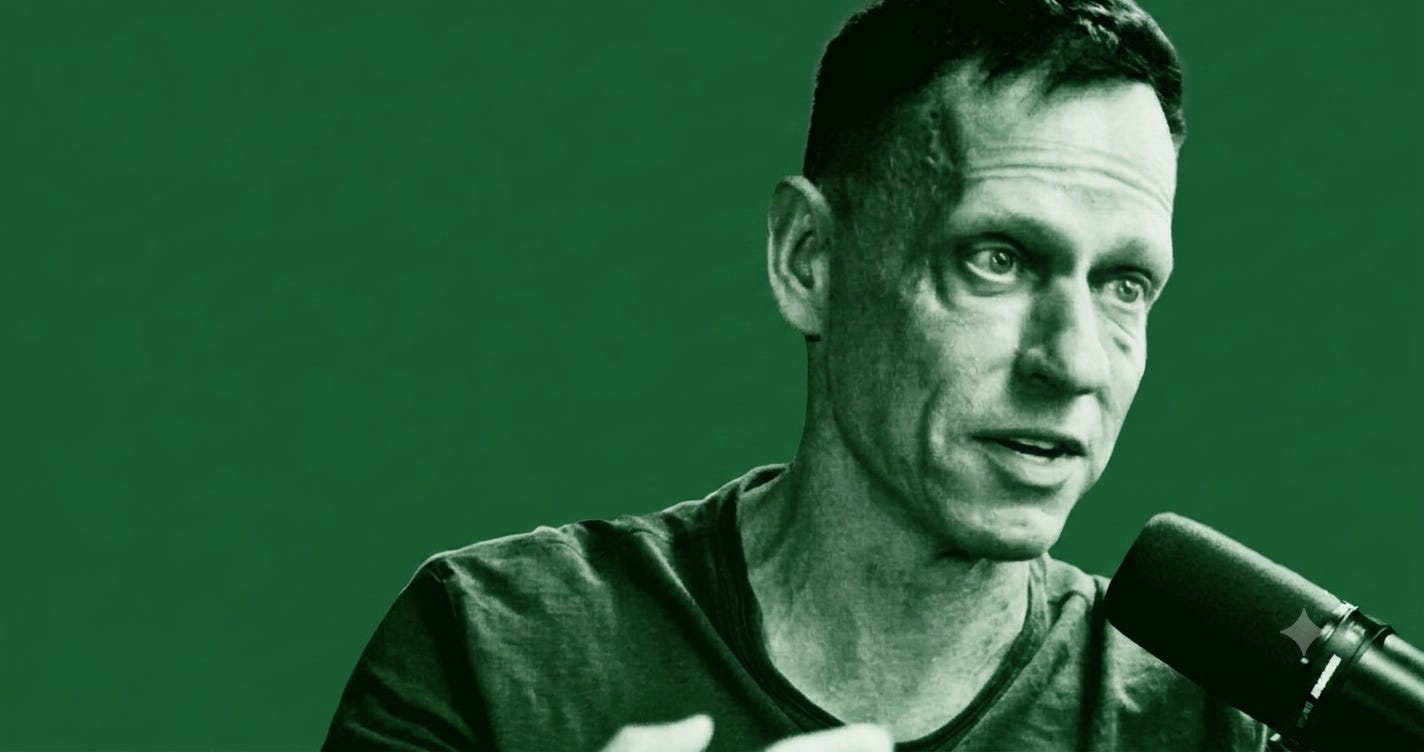
Peter Thiel stood before the Aspen Ideas Festival on Tuesday and told the crowd that Pope Leo XIV is “working for the Chinese Communists.”
The audience laughed, but Thiel was dead serious.
CNN reported the remarks Thursday from a non-recorded panel in Colorado, where Thiel appeared alongside the political scientist Francis Fukuyama, and reporters were permitted to take notes.
The logic behind the accusation runs through the pope’s own words. In May, Leo published Magnifica Humanitas, his first encyclical, a 40,000-word document declaring that artificial intelligence “must be disarmed” and calling for stronger international oversight of the technology.
Because Americans might actually heed that teaching while the Chinese Communist Party ignores it, Thiel argued, the encyclical threatens to slow exactly one side of the AI race between Washington and Beijing. A pope who asks his flock to think before they build becomes, by this arithmetic, an asset of a foreign adversary.
The Vatican did not respond to CNN’s request for comment.
Readers of this community know the longer arc.
Last November, I wrote the story of leaked audio from Thiel’s private San Francisco lecture series, in which he suggested Leo himself might be a manifestation of the Antichrist — and revealed that he has urged Vice President JD Vance to ignore the pope’s moral guidance.
By March, Thiel had carried his Antichrist lectures to Rome, staging the invitation-only events blocks from the Holy See. The lectures unnerved the Vatican and prompted two Catholic universities to state publicly that they had no role in hosting them.
The encyclical itself arrived on Memorial Day carrying a quotation from The Lord of the Rings — a literary choice that writers from the United States to Italy read as aimed squarely at Thiel, while the Catholic Herald in Britain asked whether the whole encyclical targets his empire. Within days, The New York Times found the billionaire settled into a $12 million mansion in Buenos Aires, steering dinner conversation — once again — toward the Antichrist.
JD Vance stands at the center of this collision, whether he acknowledges it or not. In Communion: Finding My Way Back to Faith, the memoir he published last month, the vice president traces part of his Catholic conversion to a 2011 talk Thiel gave at Yale Law School.
“Possibly the smartest person I’d ever met, he identified very openly as a Christian,” Vance writes of the mentor who later recruited him into venture capital and spent $15 million to put him in the Senate.
Thiel seeded the vice president’s Catholic faith, and he now tells wealthy festival audiences that the leader of that faith works for a communist government.
Vance has lately offered Rome his own instruction. On the same Tuesday that Thiel spoke in Colorado, the vice president went on Fox News and told Laura Ingraham that the Vatican’s views on immigration are “troubling” — and that he hopes the Catholic leadership has learned from the Trump administration.
The pope occupied one slot on a longer roster of enemies Thiel described in Colorado. He claimed, without offering evidence, that Anthropic — “a woke liberal company” he credits with “winning the AI race” — would “rig the elections in 2028” on behalf of Democrats.
The San Francisco lectures had already counted regulators, environmentalists, and Greta Thunberg among what Thiel calls the “legionnaires of the Antichrist.” Anyone who asks his industry a moral question ends up, in his telling, working for something sinister.
Thiel spent another stretch of the panel defending the name of his surveillance company, which he drew from the palantíri, the seeing-stones of J.R.R. Tolkien’s The Lord of the Rings.
“Toward the end, it gets used by the good guys,” Thiel said of the seeing-stone. “Anybody who tells you a different story of Tolkien,” he added, “doesn’t even know what they’re talking about, on the level of literature.”
The good guy in question is Aragorn, and the scene undoes Thiel’s defense. As John Grosso argued at Where Peter Is — a reading I walked through in May — Aragorn prevails with the stone by surrendering through it: he reveals himself to Sauron deliberately, drawing the enemy’s gaze away from Frodo so someone smaller and weaker can finish the work. The stone rewards sacrifice and destroys everyone who reaches for control.
The encyclical Thiel now brands as Chinese propaganda quotes Gandalf’s address to the captains of the West from the very council where that gambit is proposed: “It is not our part to master all the tides of the world, but to do what is in us for the succour of those years wherein we are set.”
Put the two theologies side by side, and the argument settles itself. Thiel warns that the Antichrist will arrive as a one-world government promising to protect humanity from existential threats like artificial intelligence. No world government has materialized. His software, meanwhile, already runs the data engine of the Trump administration’s mass deportation program, part of billions of dollars in Palantir’s federal contracts.
Leo’s teaching moves in the opposite direction. The human person carries a dignity no machine may override, and the technologies of the powerful must answer to the people they surveil, sort, and deport.
The pope chose his name with machines in mind. Days after his election, he told the College of Cardinals that Leo XIII had answered the first industrial revolution with Rerum Novarum, and that the Church now faces another industrial revolution in artificial intelligence, with new threats to human dignity, justice, and labor.
The Church has been asking who the machine serves since 1891, and no version of her answer has ever named a government or a fortune.
This week a room of wealthy Americans laughed while a billionaire accused the successor of Peter of serving a communist state. The laughter deserves attention, because it measures what money has learned it can say without consequence.
Leo shepherds a Church that buried her martyrs under emperors who demanded she choose sides, and that Church outlived every one of them. The laughter will fade by autumn, and Magnifica Humanitas will still be teaching long after the seeing-stones of Silicon Valley have gone dark.
At Letters from Leo, we stand with Pope Leo XIV and the millions of American Catholics — and countless others of goodwill — who believe that human dignity is not a bargaining chip in an arms race, and that a Church asking hard questions of powerful machines is doing exactly what the Gospel demands of her.
In an era when unimaginable wealth mocks moral authority for sport, we remain rooted in a faith that refuses to flinch before injustice or bow to the idols of fear and money.
This is the fastest-growing Catholic community in the country because people are hungry for something deeper than the nervous laughter of a wealthy and out-of-touch festival audience.
They’re looking for courage, for truth, for love made visible in action — and as some of the richest men in America teach one another that the pope is an enemy agent, that hunger has never been more urgent.
If you believe this movement matters — Catholics and people of goodwill standing for human dignity against the idols of wealth and unaccountable power — I am asking you to join us.
If you’d like to invest in our mission, here are three ways you can help this critical time:
Subscribe as a paid member to receive exclusive posts about the life and formation of Pope Leo and help sustain this newsletter.
Donate with a one-time gift to fuel this project’s mission.
Share this post (and Letters from Leo) with a friend who might enjoy it.
Paid subscribers receive exclusive essays on the life and formation of Pope Leo XIV, every installment of the Epstein-Bannon investigation, the complete Pope Leo XIV Takes On Silicon Valley series — where this story has unfolded from the first leaked lecture — and our Sunday scripture reflections.
Whether you give $0, $5, $50, $500, $1,000, or more, your presence here matters — no matter your faith or your politics.
Thank you for reading. I’ll see you on the road.

Thiel hates Pope Leo because he reminds the world of the dignity of human beings, and that it doesn’t rest upon their personal wealth. Pope Leo doesn’t follow the CCP, he follows Jesus Christ and shows how to apply Jesus’s message to all in today’s world. Thiel has a serious delusion he shares with Muskrat (whom Thiel dislikes,) and it is that their wealth endows them with wisdom they don’t have, and that it entitles them to lord it over the rest of us through the misanthropic “philosophy” of Curtis Yarvin.
Thiel and his ilk really are trying to take us back to the Dark Ages. They want a feudalistic society with themselves as the aristocracy and the rest of us as the serfs. During that time the rulers were constantly trying to bend the Church to their will. It’s history repeating itself.