


Thank you for reading! Letters from Leo is a reader-supported publication and the fastest-growing Catholic community in the country. To receive new posts and support this movement, consider becoming a free or paid subscriber.
Pope Leo XIV spent Thursday afternoon in Lima sitting with six people the Church had failed. That evening, he stood before 60,000 young Peruvians at the National Stadium and told them they were the hope their country had been waiting for.
In Part 1, I covered Thursday morning, when Leo called clergy abuse a crime in front of Peru’s bishops and asked a crowd of 40,000 outside the cathedral to value women and protect girls. I ended that piece by saying a meeting with survivors would show how far his words in a palace chapel actually reach.
That meeting happened a few hours later.
Six survivors, one at a time
At about 4:30 p.m., inside the Apostolic Nunciature, Leo met six survivors of abuse by clergy and Church institutions, the Holy See Press Office said. Some of them were former members of groups tied to the Sodalitium Christianae Vitae, the lay movement Pope Francis suppressed after a Vatican investigation into abuse.
The pope greeted them briefly in the nunciature chapel. Then he met with each person individually and heard each story on its own. According to the Vatican, the conversation turned to how the Church can change its mentality by listening to victims, seeking the truth, and building pathways to healing. It ran more than an hour. As they left, he thanked them for their testimony and asked that his closeness reach the victims he could not meet.
Thursday’s encounter was his second with survivors on this trip. He met five in Buenos Aires on Monday, and in September he sat with seven in Lourdes. The survivor coalition Ending Clergy Abuse criticized the Buenos Aires meeting for leaving out others, including at least 20 people abused at an Argentine institute for deaf children.
Peru is different terrain for him. As bishop of Chiclayo, Robert Prevost served as the Peruvian bishops’ point person for listening to victims, and Sodalitium survivors have said he helped them when others didn’t.
“What are you looking for?”
At 5:45 p.m., Leo left the nunciature for the Estadio Nacional. Roughly 60,000 young people filled the stadium, and authorities estimated another 300,000 in the surrounding streets. Two nights earlier, in Buenos Aires, he had drawn a million young Argentines.
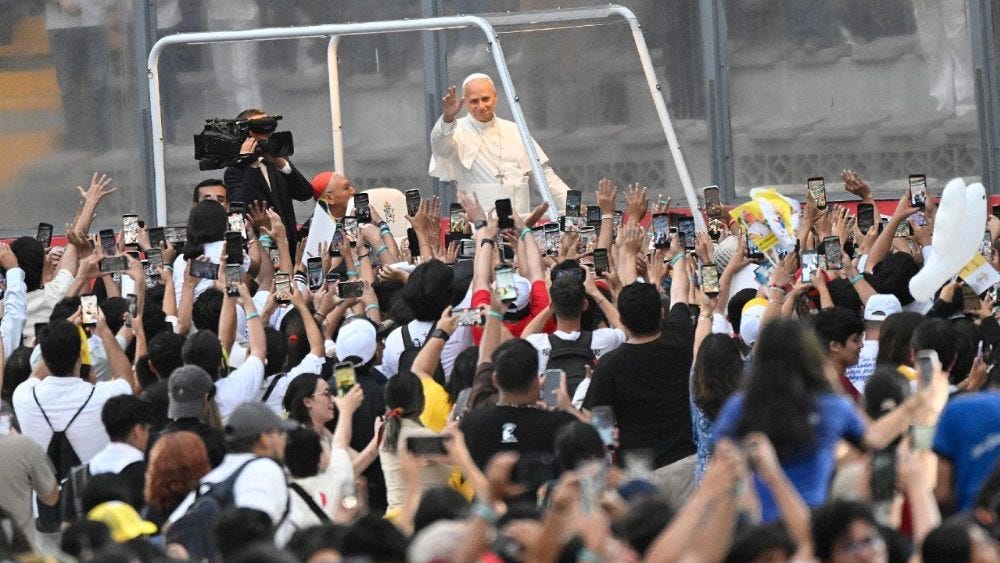
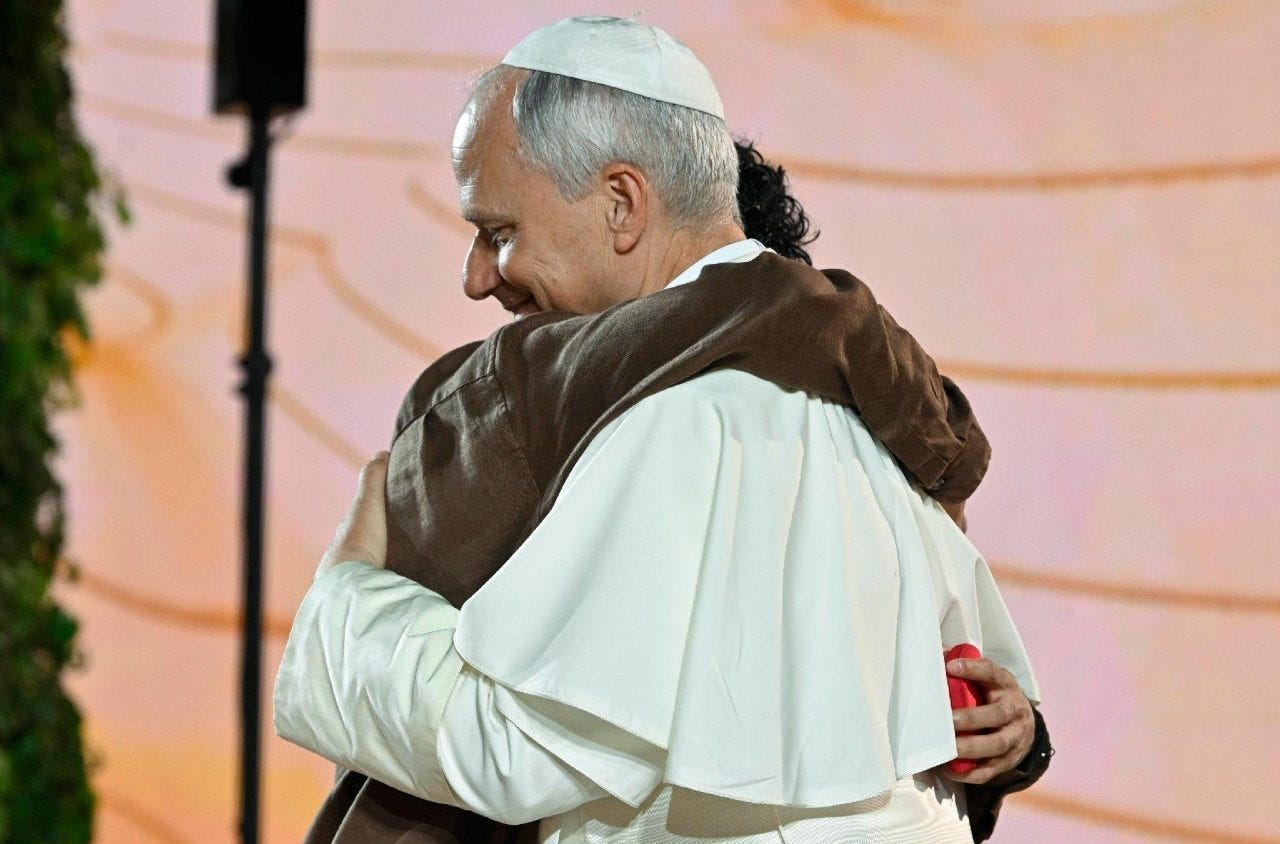
They greeted him with a chant he has now heard on two continents: “¡Esta es la juventud del papa!” — this is the pope’s youth. Three young people, Joao, Emily, and Sister Luzbinda Ramos Zurita of the Ursuline Sisters, told stories that moved through bullying, depression, and grief before arriving at the Church. Leo embraced each of them on stage.
When the stadium sang “Alma Misionera” for him, the pope was visibly moved.
He opened with a simple “Buenas noches a todos.” Someone had told him Peru needed a sign of hope, he said, and he had found it: “Here today at the National Stadium, you are that sign of hope.”
The address that followed rested on a question Jesus puts to two would-be disciples in John’s Gospel. “What are you looking for?” Leo asked, and then he pushed it further into their own lives: “What do you expect from life?”
He did not flatter them. Leo named the loneliness of young people who feel isolated even in a crowd, and he spoke about grief and uncertainty as things they already carry. Then he pointed them to the cross, where, he said, Christ “did not desire the cross; he desired our salvation.”
Why the afternoon and the evening belong together
A pope can only tell 60,000 young people to trust the Church if he has first sat down with the people that Church betrayed. Leo did those two things in the same afternoon, a few miles apart, and I don’t think the order was an accident.
The young Peruvians in that stadium grew up with the Sodalitium scandal on the front pages. Their generation took to the streets in last year’s Gen Z protests, and Lima’s Cardinal Carlos Castillo, who welcomed Leo to the stage Thursday night, spent those months defending young protesters against those who branded them violent. Suspicion of institutions comes naturally to them, and Leo spent his Thursday earning their attention before he asked for it.
His answer to their suspicion was friendship. Quoting Jesus in John 15 (“I have called you friends”), he told them a vocation grows out of time spent with Christ, and he urged them to find that time in silence before the Blessed Sacrament, whether the call turns out to be priesthood, religious life, or marriage.
He closed by asking the stadium to repeat a single line after him three times: “Jesus, I trust in you.”
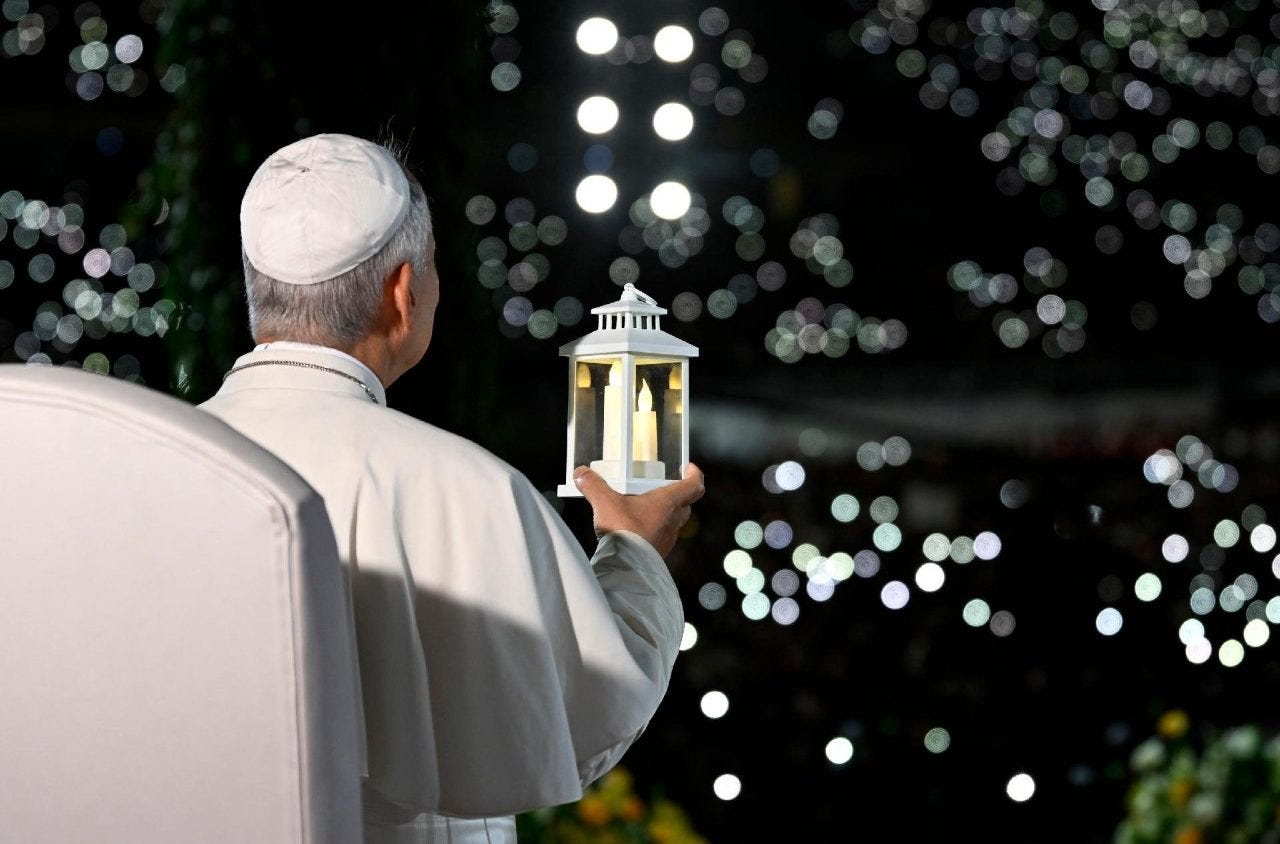
Then Daniela Darcourt and Donnie Yaipén came onstage with a group of young people to sing “Aquí estoy, Señor,” the Spanish version of “Here I Am, Lord,” as thousands of phone flashlights lit the stands. Leo held a small lantern against his chest for the whole song, and the cameras found him in tears.
The hymn is about answering a call no one goes looking for. Leo answered his in a conclave 18 months ago, and on Thursday night he listened to it with his eyes closed.
A second night on the balcony
From the stadium, Leo went back to the nunciature for dinner with Peru’s bishops. A crowd was waiting outside, chanting the stadium’s refrain into the night.
For the second night in a row, he stepped onto the balcony. “Muchas gracias por esta presencia tan hermosa, por este entusiasmo,” he told them, thanking them for their beautiful presence and their enthusiasm. He asked God to bless everyone below and to help them “ser siempre fieles,” always to remain faithful. Then he led a short prayer and gave his blessing.
On Wednesday, from the same balcony, he had told Lima he was home and joked that the neighbors wanted to sleep, so the party could go on for a while, but not all night. Thursday’s appearance was quieter. He had given his morning to the bishops and his afternoon to survivors, and he still came to the window.
On Friday morning, Leo flies north to Chiclayo, the diocese he led as bishop from 2015 to 2023, for Mass in Pimentel. Part 3 picks up there.
At Letters from Leo, we stand with the six survivors who sat with Pope Leo XIV in Lima on Thursday, and with every young Peruvian who walked into the National Stadium still hoping the Church has something true to say to them.
Thursday showed what a shepherd looks like when the cameras leave. He listened for more than an hour before he addressed the stadium, and the people the Church wounded got his time before the crowd that came to cheer.
This is the fastest-growing Catholic community in the country because people are hungry for a Church that tells the truth about its own sins and still dares to hope. They’re looking for a faith with room for both the survivor and the teenager in the stands.
If you believe this movement matters — Catholics and people of goodwill standing for the dignity of every person the powerful would rather forget — I am asking you to join us.
If you’d like to invest in our mission, here are three ways you can help:
Subscribe as a paid member to receive exclusive posts about the life and formation of Pope Leo and help sustain this newsletter.
Donate with a one-time gift to fuel this project’s mission.
Share this post (and Letters from Leo) with a friend who might enjoy it.
Paid subscribers can read our full series on Pope Leo’s Life & Formation, including his decades in Peru, along with the Sunday Scripture Reflection Series.
Whether you give $0, $5, $50, $500, $1,000, or more, your presence here matters — no matter your faith or your politics.
Thank you for reading. I’ll see you on the road.

A true leader.
https://garethgore.substack.com/p/pope-leo-heard-my-warnings-about?r=wflz8&utm_medium=ios
Opus Dei = Pay to Pray