



Thank you for reading! Letters from Leo is a reader-supported publication and the fastest-growing Catholic community in the country. To receive new posts and support this movement, consider becoming a free or paid subscriber.
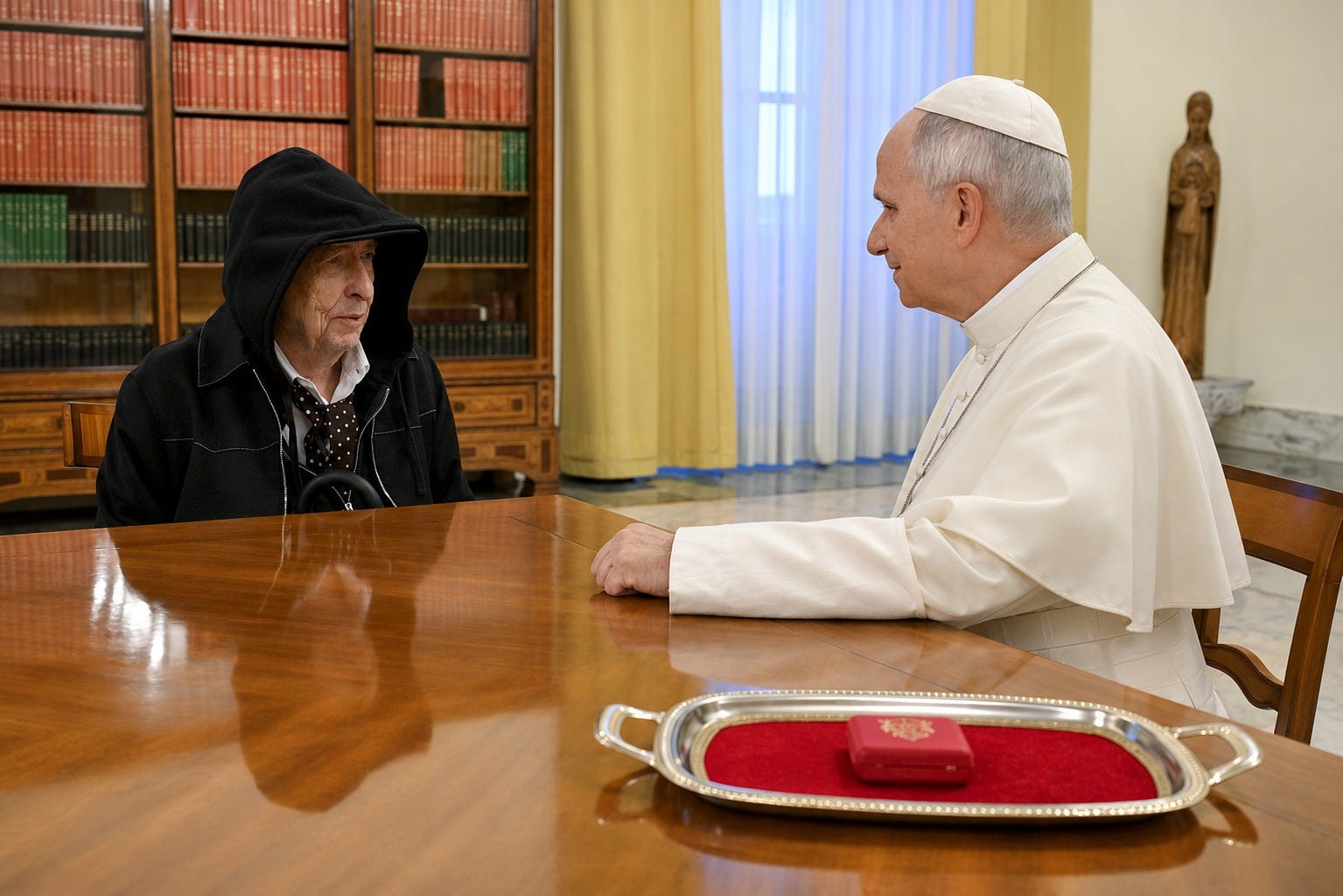
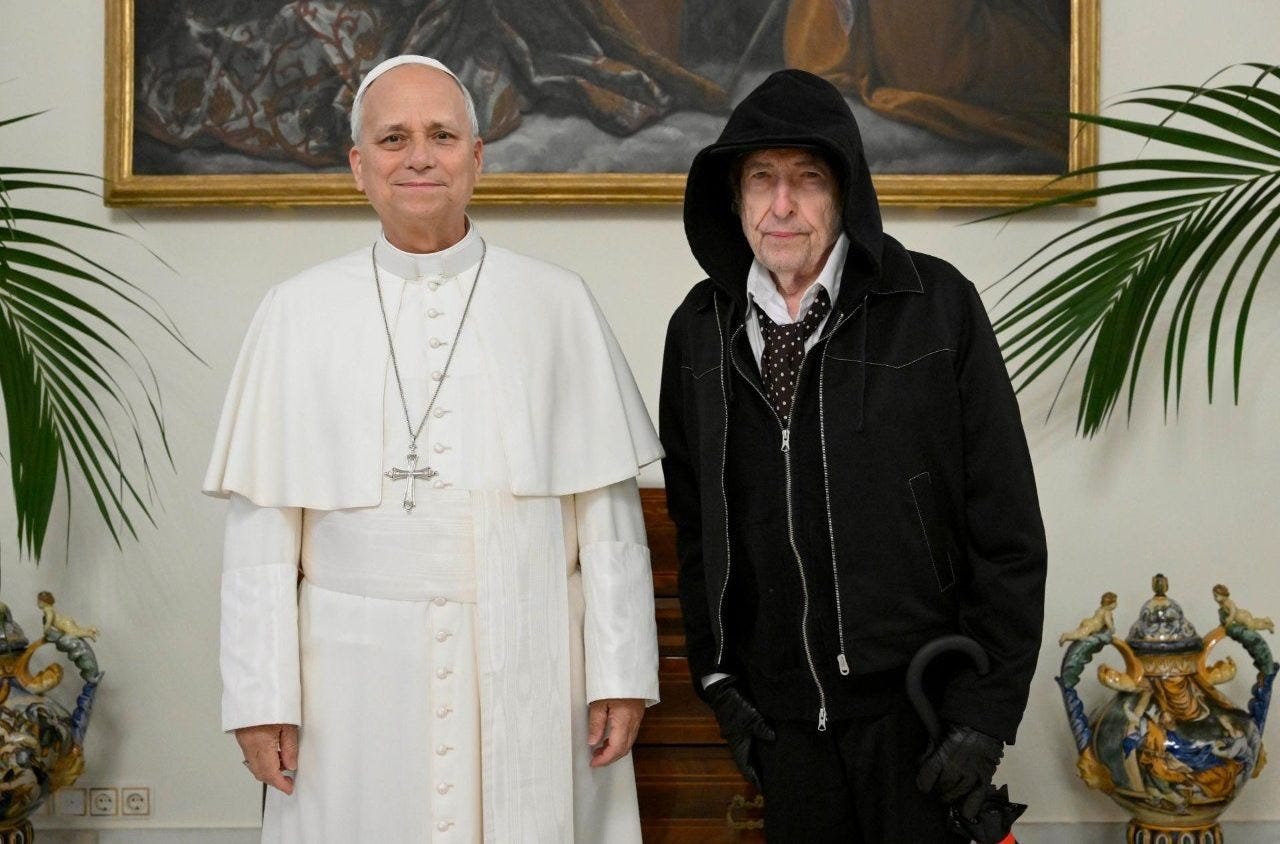
Bob Dylan wore a black hooded sweatshirt to the Apostolic Palace on Wednesday afternoon. By the time he left, Pope Leo XIV had given him a rosary.
The audience was short, a few greetings and some lighthearted back-and-forth, according to Vatican News. Dylan, 85, handed the pope a copy of Chronicles: Volume One, his 2004 memoir. He plays Rome’s Palazzo dello Sport on Thursday night, a stop on the autumn leg of his “Rough and Rowdy Ways” tour.
The audience came one day after the midterm elections, in which Catholics rejected the Trump-Vance administration, with the war in Iran weighing heavily on their verdict. The political scientist Ryan Burge found that every heavily Catholic battleground House district he tracked will be held by a Democrat in January.
Leo came to the meeting prepared. Four months ago, the first American pope quoted one of Dylan’s rarest songs in a book on peace, and his ear for music goes back much further, to his mother’s voice in a Chicago parish choir.
Mildred’s contralto
Mildred Martínez Prevost earned a library science degree from DePaul in 1947, but singing was her calling. She had a deep contralto and performed as a soloist in sacred-music concerts; in 1941 she sang at the Chicagoland Music Festival at Soldier Field before more than 100,000 people. She also played the piano and served in the music ministry at St. Mary of the Assumption, where her youngest son was an altar boy.

That inheritance, which I traced in my profile of Mildred, has shown up all through this papacy. Leo sang the Regina Caeli from the loggia on his first Sunday as pope. At a Vatican concert last December, he asked Michael Bublé to sing Schubert’s “Ave Maria,” a favorite of his mother’s, and was caught singing along to “L-O-V-E” from his seat. Music, he told the audience that night, “is like a bridge that leads us to God.”
A pope who knows the deep cuts
Leo’s Dylan habit is newer, and it carries an edge. In Bamenda, Cameroon, on April 16, he warned that “the masters of war pretend not to know that it takes only a moment to destroy, yet often a lifetime is not enough to rebuild.” He never named the songwriter. Marina Corradi wrote in Avvenire, the Italian bishops’ daily, that anyone close to the pope’s age would hear Dylan’s 1963 song “Masters of War” in that phrase.
By July, the citation was explicit. In his foreword to Disarmed and Disarming: Peace Is a Gift, a collection of his peace addresses released by the Vatican Publishing House on July 21, Leo quoted Dylan addressing the atomic bomb: “I hate you cause yer man-made and man-owned an’ man-handled.”
The line comes from “Go Away You Bomb.” Izzy Young, who ran the Folklore Center in Greenwich Village, was gathering songs for a book against the bomb in 1963, and Dylan brought him one the next day. The book never appeared. Dylan left the song unrecorded, and Young’s typed, hand-corrected lyric sheet sat in a drawer for decades before it surfaced at Christie’s in 2013, and that May the Dutch singer Melle Dielesen set the lyric to music on Dutch television.
Bologna, 1997
Dylan has stood before a pope once before. On Sept. 27, 1997, he played the Italian National Eucharistic Congress in Bologna for St. John Paul II and some 300,000 young people, in a three-song set that included “Knockin’ on Heaven’s Door.” Then he took off his cowboy hat, climbed to the papal stage, and shook the pope’s hand.
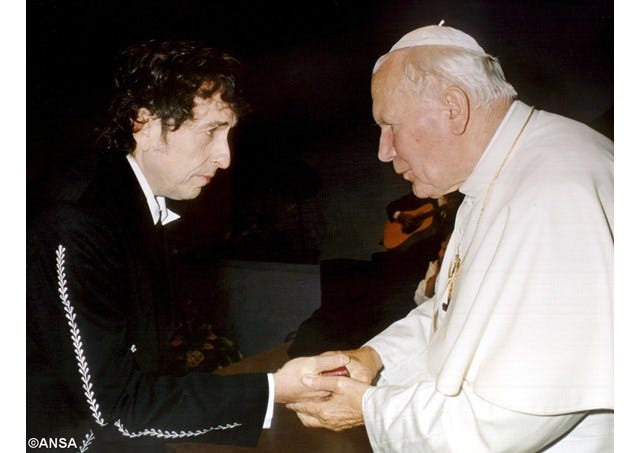
John Paul took up “Blowin’ in the Wind” in his own address. The answer the young people were seeking, he told them, comes in the breath of the Spirit. “There is only one road for man, and that is the road of Jesus Christ.”
Some in the Curia were unimpressed. Cardinal Joseph Ratzinger, the future Benedict XVI, wrote a decade later that he had opposed Dylan’s appearance and doubted the worth of “prophets” of his kind.
Twenty-nine years after Bologna, a pope from Chicago quotes Dylan’s most obscure work in a Vatican book.
Bono, Patti Smith and three popes
Rome’s friendship with rock’s poets reaches well past Dylan.
On Sept. 23, 1999, Bono led a Jubilee 2000 delegation, Bob Geldof and Quincy Jones among them, to Castel Gandolfo, where John Paul called debt relief for the poorest nations an “urgent” first step.
Bono gave the pope a volume of Seamus Heaney’s poems along with his own sunglasses, and John Paul put them on, grinning. Years later, Bono said “we would never have gotten the debts of 23 countries completely canceled without him.”
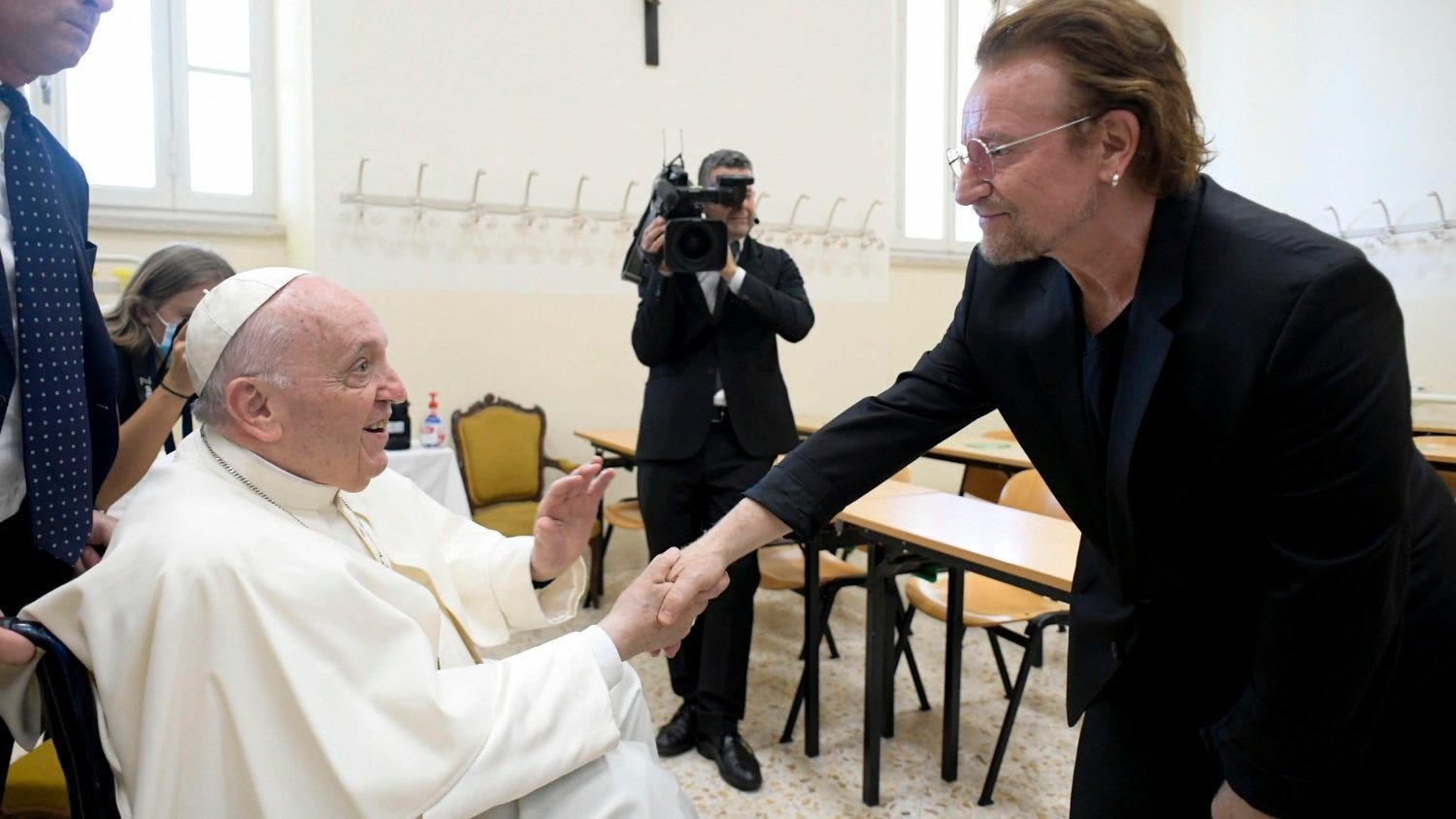
Bono kept the conversation going with Francis, meeting him in 2018 over the abuse crisis and again in 2022 at a Scholas Occurrentes event in Rome.
Patti Smith took a longer road.
Raised a Jehovah’s Witness, she met Francis at a general audience in April 2013 and sang at the Vatican Christmas concert the following year. When critics quoted the first line of “Gloria” back at her, she shot back: “Anyone who would confine me to a line from 20 years ago is a fool!” After Francis died, she wrote that she “felt safer knowing he was among us.”
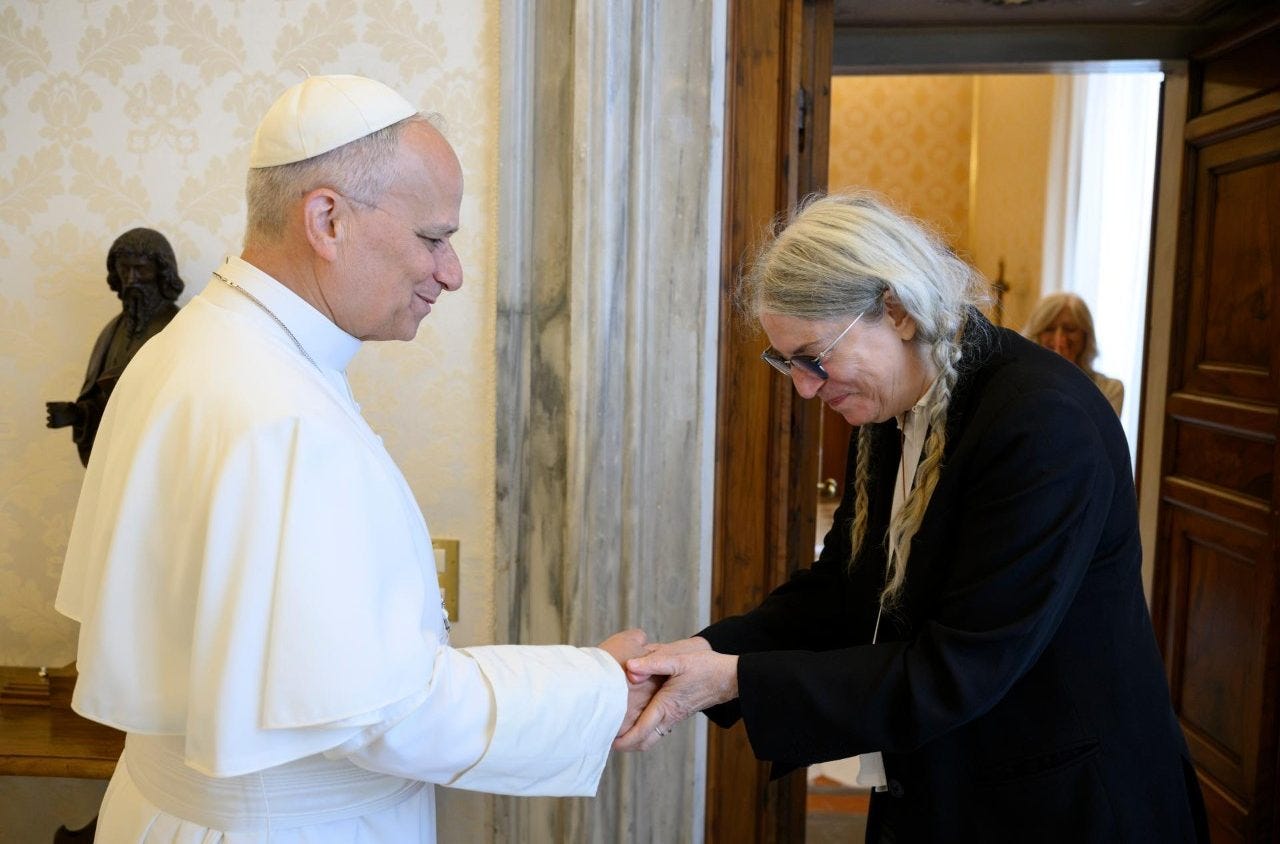
On July 31, Smith (born, like Leo, in Chicago) sat across from the pope for 40 minutes in the Apostolic Palace. She opened with a breathy “Hi,” the greeting that begins “Wave,” her 1979 song imagining a conversation with John Paul I.
Leo caught the reference. “That was marvelous,” he told her. Smith also knows Dylan well. She opened ten shows for him on the East Coast in December 1995, and in 2016 she sang in his place at the Nobel ceremony in Stockholm.
Leo keeps this company for a reason.
His foreword arrived in a year of war, as the U.S.-Israeli strikes on Iran drew his sharpest rebukes, and in late October he declared that there is no such thing as a holy war.
In the same foreword, he held up Dorothy Day and wrote that peace begins in “small daily gestures: the gift of a smile, an injury pardoned, a kind word.”
A weapon made by human hands can be unmade by them.
Dylan, 22 years old and writing for a folk shop’s songbook, understood that in 1963. Leo, writing six decades later, put it in the Church’s language: “The conscience of a single person can be worth the entire world.”
John Paul told the young people in Bologna that the answer would not scatter in the wind. Leo, who learned to sing from a mother who could fill Soldier Field, seems to believe a songwriter can carry part of that answer anyway.
On Wednesday he put a rosary in Dylan’s hand, and on Thursday night, across the city from St. Peter’s, the old prophet takes the stage.
At Letters from Leo, we stand with a pope who hears the Gospel in his mother’s “Ave Maria” and in a protest song written for a Greenwich Village folk shop, and who uses both to call a world at war back to disarmament.
Our leaders talk of holy wars and bigger arsenals. We remain rooted in a faith that calls peace a gift, one that begins, as Leo wrote, with something as small as a pardoned injury.
This is the fastest-growing Catholic community in the country because people are hungry for a Church that sings louder than the bombs. That hunger has never been more urgent than it is right now.
If you believe this movement matters — Catholics and people of goodwill standing for human dignity against the masters of war — I am asking you to join us.
If you’d like to invest in our mission, here are three ways you can help:
Subscribe as a paid member to receive exclusive posts about the life and formation of Pope Leo and help sustain this newsletter.
Donate with a one-time gift to fuel this project’s mission.
Share this post (and Letters from Leo) with a friend who might enjoy it.
Paid members get our biographical series on Pope Leo’s Life & Formation, including the full story of Mildred Prevost, along with our exclusive investigations and the Sunday Scripture Reflection Series.
Whether you give $0, $5, $50, $500, $1,000, or more, your presence here matters — no matter your faith or your politics.
Thank you for reading. I’ll see you on the road.
