


Thank you for reading! Letters from Leo is a reader-supported publication and the fastest-growing Catholic community in the country. To receive new posts and support this movement, consider becoming a free or paid subscriber.
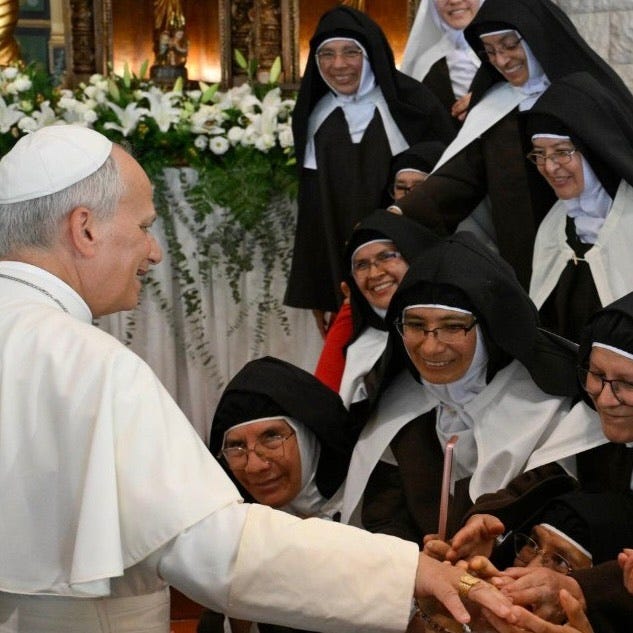
Before he addressed his old clergy at the Shrine of Our Lady of Peace on Friday afternoon, Pope Leo XIV stopped to pray before its image of the Virgin, which St. John Paul II blessed in 1985.
He left a golden rose at her feet, one of the highest honors a pope can give a Marian devotion.
The contemplative nuns of the Monastery of St. Joseph had something waiting for him too. They served him a Peruvian lemon pie, which EWTN reports is his favorite dessert.
The quiet subsided at the university.
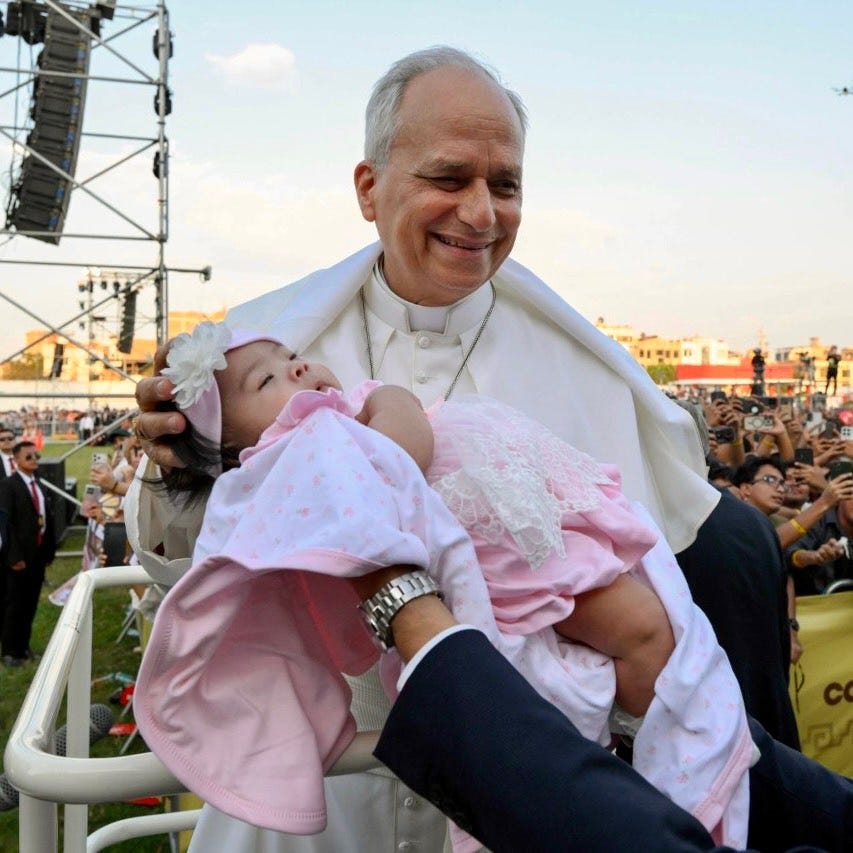
Leo rode a small electric popemobile across the campus of the Catholic University of St. Turibius of Mogrovejo, the school he oversaw as grand chancellor during his eight years as bishop of Chiclayo.
About 9,000 students from 18 universities were waiting on the esplanade, according to Peru’s state news agency, and they greeted him with a chant of their own (“¡León, hermano, tú eres chiclayano!”) that translates to “Leo, brother, you’re from Chiclayo.”
This is part two of my dispatches from Leo’s homecoming. Part one covered the Mass for half a million on the Pampas de Pimentel, his private visit to the Romero chapel, and his charge to the priests he once led.
The university’s rector, Patricia Campos, recalled the white smoke of May 8, 2025, and told him the school “will always be his home, his people, his university.” Leo opened by thanking the people who had taught him.
“During my years as grand chancellor of this institution,” he said, “you helped me understand that authority means service, that governing means listening, and that education is a noble act of hope.”
“Agustín is our ladder to heaven”
Before the pope spoke, three members of the university community told their stories.
Adriano Alonso Rafael Durand, a 22-year-old law student raised Protestant, described how he became Catholic in November 2025. María Guzmán spoke about her 20-year-old son, Agustín, who lives with autism, Lennox-Gastaut syndrome and cancer.
“Agustín is our ladder to heaven,” she said. “He is the one who leads us to God.”
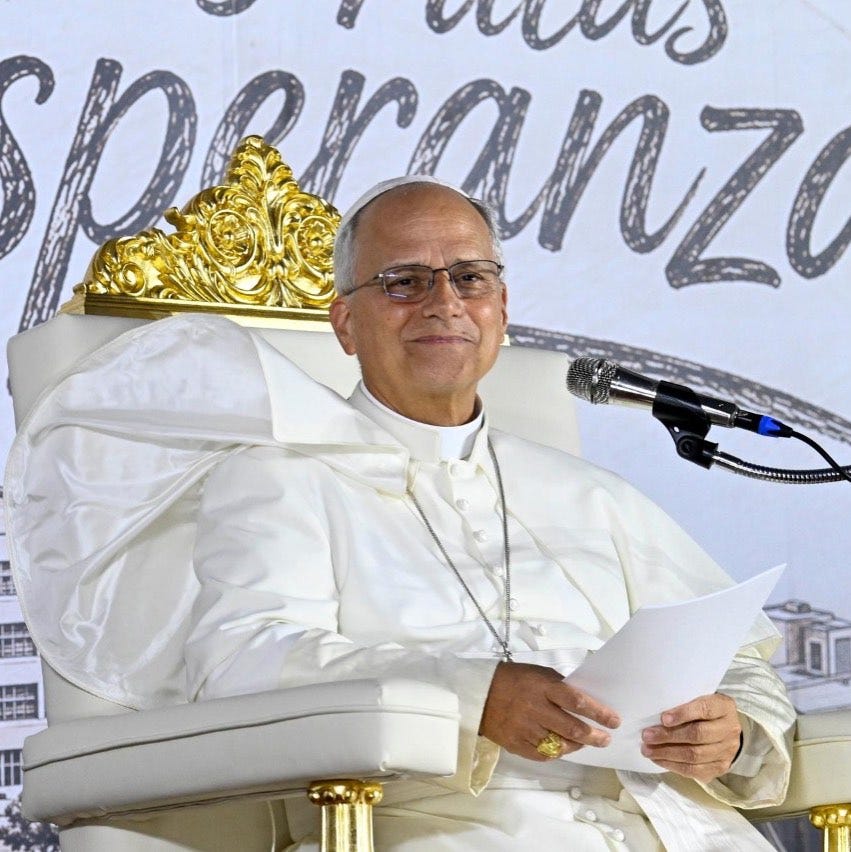
Leo listened from his chair on the stage, a month after his own surgery for lung cancer.
“Millionaires seeking immortality”
The speech was about what a Catholic university is for, and Leo gave it a hard edge. “Science without a conscience ruins everyone’s life,” he said, and “technology without a soul does not truly improve life.”
He warned that technology “is not always neutral,” since it carries the interests of whoever designs and controls it, and he urged students to seek a wisdom “which neither machines nor computer programs can possess.”
Then he took on the people promising to beat death.
“The promises of transhumanism and posthumanism are multiplying,” Leo said, describing ideological currents that claim technology will one day end disease, pain, aging and death itself. Scientific progress, he said, “must not be confused with a privilege reserved for millionaires seeking immortality, while entire peoples suffer from poverty and oppression.”
“In the face of this mirage, which promotes the illusion of human beings perfected by cybernetics and biotechnology,” he went on, “Christian anthropology reminds us that a limitation is not a manufacturing defect, but rather the very condition of human grandeur.” The myth of self-sufficiency, he added, “locks us in selfishness and leads us to discard the weak.”

Leo named no names in particular. Silicon Valley’s longevity movement has a face in Bryan Johnson, the entrepreneur who spends millions a year trying not to age and who has boasted that he has done more against death in two years than Jesus managed in two thousand. Leo answered him in August, telling a congregation at Castel Gandolfo that true beauty lies in revealing the signs of love rather than hiding the signs of age.
Peter Thiel, the billionaire who bankrolled JD Vance’s rise, pledged $3.5 million to anti-aging research in 2006, and his strange religion has made him one of the pope’s loudest critics.
Leo laid out the theology behind Friday’s answer in May, when he released Magnifica Humanitas, the first papal encyclical on artificial intelligence. In Chiclayo he called the students the “natives” of this new era and urged them to embrace its opportunities, while warning that “the most deadly risk is that of submission to the technocratic paradigm.”
He held up the university’s patron as their model. St. Turibius, archbishop of Lima from 1579 to 1606, crossed the region’s deserts on horseback and learned the languages of the Indigenous peoples he served, even writing a catechism in them. Leo said he defended their dignity while enduring illness, exhaustion and “the misunderstanding of the powerful.”
“A photo with each one of you”
Leo ended his day the way he spent so many evenings here, at a table with his priests.
About 140 priests of the Diocese of Chiclayo shared dinner with him at the Colegio Santo Toribio de Mogrovejo. Fr. Jorge Millán, a former pastor of the cathedral, told EWTN what happened when the meal ended. “Instead of us asking him for a photo,” he said, “he said, ‘I want to take a photo with each one of you.’”
On Saturday Leo crowns the image of the Immaculate Virgin at his old cathedral and takes a helicopter to celebrate Mass in the Andean town of Santa Cruz de Succhabamba. He returns to Chiclayo in the evening for a meeting at the shrine of St. Turibius, and I’ll bring you that next.
On Friday, a man one month out of cancer surgery told the next generation of Peru’s doctors and engineers that human weakness is where human greatness begins.
At Letters from Leo, we stand with Pope Leo XIV and every person of goodwill who believes that no billionaire’s fortune can buy a way out of being human, and that the weak deserve our care.
Science has a home in the Church. Its first patient should be a sick son in Chiclayo, long before the richest men in California get their turn.
This is the fastest-growing Catholic community in the country because people are hungry for a faith that sees human limits as a gift. Silicon Valley is selling immortality, and that hunger keeps growing.
If you believe this movement matters, Catholics and people of goodwill standing together for the dignity of every person, I am asking you to join us.
If you’d like to invest in our mission, here are three ways you can help:
Subscribe as a paid member to receive exclusive posts about the life and formation of Pope Leo and help sustain this newsletter.
Donate with a one-time gift to fuel this project’s mission.
Share this post (and Letters from Leo) with a friend who might enjoy it.
Paid subscribers can read our full series on Pope Leo’s Life & Formation, including how Peru made Pope Leo XIV, along with our Sunday Scripture Reflection Series.
Whether you give $0, $5, $50, $500, $1,000, or more, your presence here matters — no matter your faith or your politics.
Thank you for reading. I’ll see you on the road.
