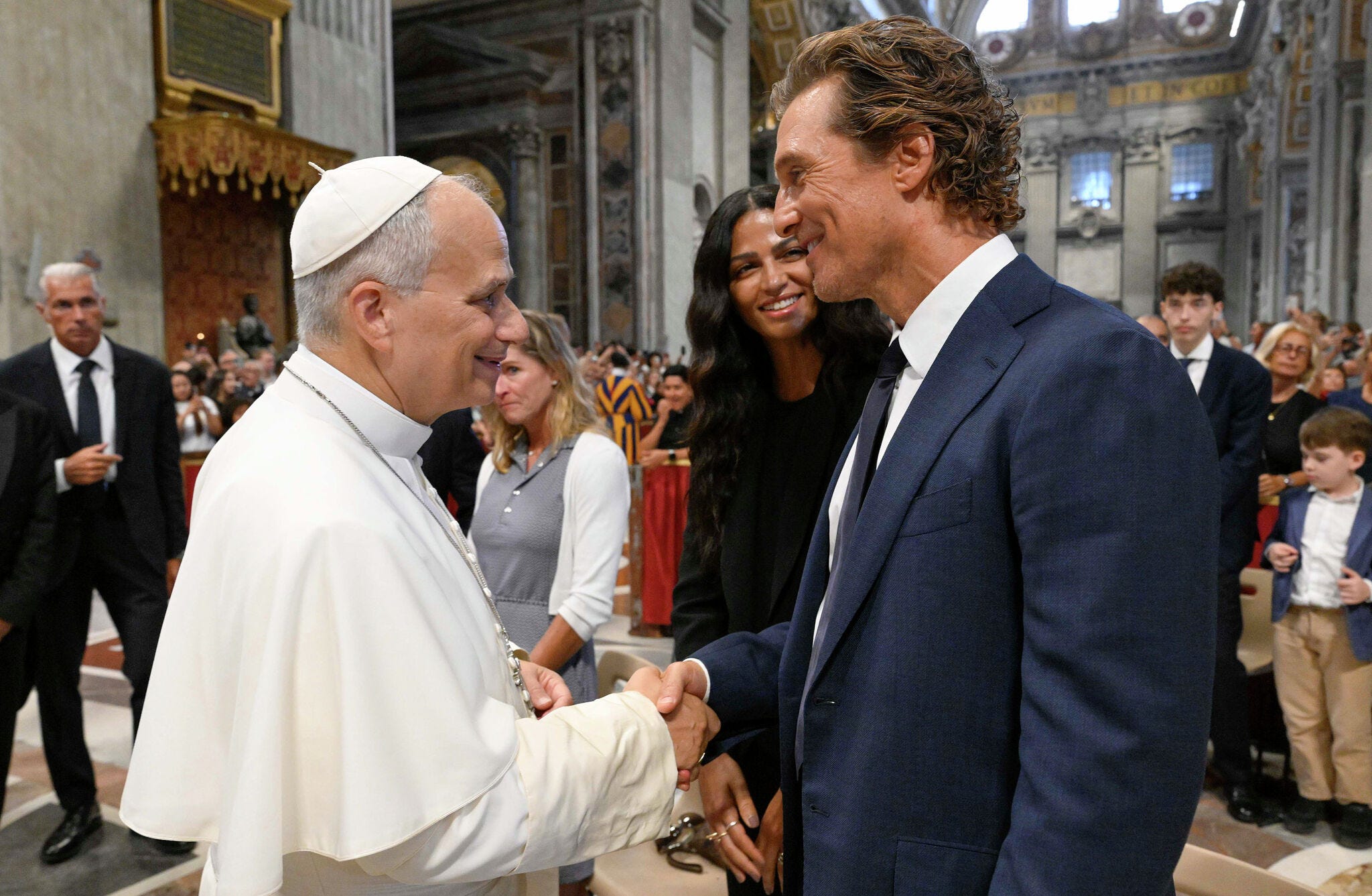
“The Moral Compass of the World” — Matthew McConaughey Meets Pope Leo XIV
The actor told Jimmy Fallon that meeting the pope was like writing an Oscar speech — and that Leo made him laugh. From Harry Styles to Patti Smith, secular America keeps arriving at the American pope’s door.

Thank you for reading! Letters from Leo is a reader-supported publication and the fastest-growing Catholic community in the country. To receive new posts and support this movement, consider becoming a free or paid subscriber.
Matthew McConaughey sat down across from Jimmy Fallon earlier this week and told the world what it was like to meet the first U.S.-born pontiff.
“This is a man who sits in a seat to represent the moral compass of the world,” the actor said of Pope Leo XIV.
The two stars met on August 5, when McConaughey and his wife, Camila Alves, joined the crowd at St. Peter’s Basilica for Leo’s first general audience after the summer pause. They had visited from the Amalfi Coast, where McConaughey is filming Positano, a thriller for Netflix.
The video of the encounter shows the pope grasping the actor’s hand and McConaughey patting the pope on the shoulder. The two of them talked for several minutes while the cameras pressed in.
The Wednesday general audience is the least exclusive event on the papal calendar. Tickets are free, and anyone can request one.
Tens of thousands do whenever the pope is in Rome. McConaughey waited his turn like everybody else, and the catechesis he heard that morning was on the prayer of the Church.
McConaughey, 56, is not Catholic. Raised Baptist in Texas, he worships at a non-denominational Protestant church and last year published a collection titled Poems & Prayers.
That didn’t keep him and his Catholic spouse, Camila, from crossing the Tiber to visit the vicar of Christ.
On The Tonight Show, he compared his preparation to the Academy Awards.
“If you prepare things to talk to the pope about, it’s kind of like preparing a speech for the Oscars,” he told Fallon. “You don’t know if you’re going to win, so if you win and you pull out a speech, it’s kind of arrogant, right? But I got to talk to him about some nice things.”
The conversation went off script anyway, he said, and the pope surprised him with his quick humor.
“He made me laugh, which is one of the things I think is consistent about the holiest and most spiritual people in the world; they’ve all got a great sense of humor,” McConaughey said.
The Texan was deeply reflective about what the office itself means. “Different popes in the past had maybe more political power and stuff,” he said, “but to meet him, I had some things I wanted to talk to him about.”
Sources close to McConaughey tell me the trip wasn’t accidental tourism.
For years, McConaughey has been edging toward public questions of faith, in his memoir and in the prayers he now publishes, and given a free morning in Italy, he chose to spend time in the world’s largest church. He has told interviewers he goes to church every week and uses prayer to take stock of himself.
The scene has repeated itself since Leo’s May 2025 election, so much so that it now counts as a signature of this pontificate: famous Americans keep turning up at the door of the first American pope.
Harry Styles was in a barber’s chair five minutes from the Vatican on the day Leo was elected. He let the barber finish the haircut, then scurried over and stood in the crowd at St. Peter’s Square like any other pilgrim.

Spike Lee handed the pope a customized Knicks jersey (#14, of course) at a November audience for the world of cinema. The event’s guest list was reportedly drawn up in consultation with Martin Scorsese. Leo signed the jersey, and Lee wore it courtside at the NBA Finals seven months later.

Leo told the assembled filmmakers that day that cinema “articulates the questions that dwell within us, and sometimes, even provokes tears that we did not know we needed to express.”
At the Vatican’s annual Concert with the Poor in December, Carson Daly and Michael Bublé met the pope with their wives. During the encounter, Daly asked him to pray for his children, “that God may continue to hold their hands when we no longer can.”
That same day at the same time, Chris Pratt was touring the Vatican while producing a documentary on the tomb of St. Peter.
He later recounted for Jimmy Kimmel his subsequent meeting with the pope and the moment Leo switched from Italian to English mid-sentence
“I was like, ‘Whoa, you became an American all of a sudden!’”
Two weeks ago, Patti Smith, the godmother of punk, was received by the pope for an unusually long private audience that lasted about 40 minutes.
Father Antonio Spadaro later described it as a conversation “between two people discovering they were old friends.” Smith wore a Franciscan Tau cross to the meeting.

She has been a guest at the Vatican for years, performing at Vatican Christmas concerts under Pope Francis and inaugurating the Holy See’s pavilion at the Venice Biennale earlier this spring.
The pull crosses over into politics as well. Days after his Leo’s election, a bipartisan group of House members led by Tennessee Republican Chuck Fleischmann invited him to address a joint session of Congress, and Nancy Pelosi joined the congressional delegation at his inaugural Mass.
The Trump administration has sent emissaries of its own, with less to show for. JD Vance was received the day after the Inaugural Mass.
This spring, Marco Rubio sat across from Leo amid the open rift between the White House and the Holy See. Rubio gave the first American pope a glass football. Leo is famously a baseball fan.
Asked this spring about the president’s attacks on him, Leo answered that he had no fear of speaking out.
Members of Congress were in the crowd again at Wednesday’s general audience.
Ro Khanna, the California Democrat who spent that same day making his 2028 case to NPR, was among them. Khanna’s enthusiasm has a track record: back in June, his suggestion that Democrats should solve their primary problem by simply running the pope ricocheted around social media, offered perhaps only half in jest.
Whatever his own ambitions, Khanna evidently knows where Americans currently locate their moral authority.
The spectacle has its critics. Bishop Marian Eleganti, a retired Swiss auxiliary, published a broadside at LifeSiteNews on Tuesday arguing that audiences with “leftist celebrities” are “degrading the papacy.”
“Recent popes have lost authority and spiritual capital,” he wrote, pointing to the Smith audience and warning that such receptions come across to many as “a trivialization” of what the Church’s guests stand for.
He used John the Baptist’s famous utterance to buttress his argument: “He must increase, but I must decrease.”
But the bishop has his Gospel backward. Jesus scandalized the religious authorities of his own day by keeping exactly this kind of company, eating with tax collectors and with people a holy man was ‘supposed’ to avoid.
In Luke’s Gospel, the critics barked: “This man welcomes sinners and eats with them.”
The charge Bishop Eleganti now levels at Leo, that receiving such guests cheapens what the office stands for, was leveled against the Nazarene carpenter first.
A half century ago, Paul VI wrote in Evangelii Nuntiandi that evangelizing is the Church’s “deepest identity,” that she “exists in order to evangelize.” The document never specifies what venues are appropriate for this exercise.
A Wednesday audience crowded with cameras qualifies just as surely as the mission churches of Peru where a young Father Robert Prevost served for nearly three decades.
Evangelization rarely begins with a catechism lesson anymore. Curiosity comes first, and the Church’s task is to be worth that curiosity no matter the venue.
Consider what actually happened here. A Baptist from Texas flew home from Rome and told a network late-night audience that the papacy holds “the moral compass of the world.”
He said the pope made him laugh. Millions of Americans who will never open an encyclical will hear this endorsement of the Church in the milieu of their days. No Vatican press office project could script that, and the airtime cost the Church nothing.
Ezra Klein, a secular Jew by his own description, told listeners of his show this week that he takes this pope seriously. The occasion was Ross Douthat’s exit interview after seventeen years at the Times. For Klein, Magnifica Humanitas made the episode’s reading list.
The American Church has spent two generations wringing its hands over secularization. Leo’s answer so far looks less like a program than a style and a posture: the door stays open to anyone and everyone without exception.
America manufactured modern celebrity and exported it to every corner of the earth; it is the nearest thing our secular culture has to a common language. Leo grew up inside that culture, a White Sox fan raised just south of Chicago, and he speaks it fluently without succumbing to it.
Every one of these photographs carries the Gospel into rooms the Church could not otherwise enter. Whatever Bishop Eleganti thinks, the Church under Leo XIV is doing exactly what Paul VI said she exists to do.
The modern secular age keeps finding its way to Leo’s door, and so far no one has been left standing outside. The line, by every indication, is getting longer.
Thank God for that.
At Letters from Leo, we stand with a pope who believes the Gospel belongs everywhere Americans actually live — on a movie set, at a late-night desk, courtside at the Garden, or in the bleachers at a White Sox game.
When Leo receives a movie star or a punk poet, the welcome Christ offered on the roads of Galilee reaches one more searching soul, and a largely secular culture watches it happen.
People in this country are hungry for something deeper than rage and propaganda, and they can tell a Church barricaded against the world from one standing out in the middle of it.
That hunger is why this has become the fastest-growing Catholic community in the country.
If you believe this movement matters — Catholics and people of goodwill who want the Gospel out among the people rather than locked behind the sanctuary — I am asking you to join us.
If you’d like to invest in our mission, here are three ways you can help:
Subscribe as a paid member to receive exclusive posts about the life and formation of Pope Leo and help sustain this newsletter.
Donate with a one-time gift to fuel this project’s mission.
Share this post (and Letters from Leo) with a friend who might enjoy it.
Paid members receive the full biographical series on Pope Leo’s life and formation and the Sunday scripture reflections that anchor this community week after week.
Whether you give $0, $5, $50, $500, $1,000, or more, your presence here matters — no matter your faith or your politics.
Thank you for reading. I’ll see you on the road.


Bishop Eleganti sounds like a Pharisee saying who Jesus should and should not be with. This was an interesting article to read. I do believe Pope Leo is the moral compass of the world.
I do not understand religious leaders actually voicing their preference for empire, ie hierarchies and an “us vs. them” system. That’s the opposite of Christlike.