


Thank you for reading! Letters from Leo is a reader-supported publication and the fastest-growing Catholic community in the country. To receive new posts and support this movement, consider becoming a free or paid subscriber.
Pope Leo XIV’s first full day in Argentina ran from a home for people with disabilities at dawn to Pope Francis’s old cathedral after dark, so we’re covering it in two parts. Part One covered the morning in Claypole and the Mass in Palermo. This is Part Two: the afternoon and evening, from the Catholic University to Vespers.
Before Pope Leo XIV said a word in public on Monday afternoon, he sat down in private with five Argentines who had been abused by Catholic clergy or inside Church institutions. The meeting ran more than an hour. The Holy See said he “spoke individually with each of them,” listened to their proposals for redress, and expressed his commitment to a Church that protects and supports victims.
Then he went to the Catholic University of Argentina and laid out Catholic social teaching for Javier Milei’s Argentina, point by point.
“A social mortgage”
The room in Puerto Madero held business owners and union leaders, teachers, Indigenous leaders, and the cartoneros who pull recyclables out of the city’s trash. Leo heard five of them speak first. A recycler from La Plata told him, “We cartoneros are not garbage,” and the pope was visibly moved.
His answer went straight at the libertarian creed Milei has preached since taking office. “To deprive a person of work is not simply to deny that person an income,” Leo said. It wounds their dignity and pushes them into exclusion. The Church defends private property, he added, but “this right is always subject to a social mortgage,” because the land and its fruits were given by God for all of humanity.

He called trade unions “indispensable institutions when they defend those who have no voice,” in a country whose unions have called several general strikes against Milei’s reforms since he took office in December 2023.
Then Leo turned to the informal workers in the room and quoted the three words Francis made famous.
Leo also warned that “artificial intelligence and unregulated automation can put countless jobs at risk.” Milei opposes regulating the technology and is courting billions of dollars in AI investment. American Catholics heard the same warning this fall, when three of Leo’s cardinals came back from several days with the frontier labs and told union members that millions of jobs are on the line.
The afternoon had a lighter moment too. The folk singer Agustín Day, founder of Los del Portezuelo, performed a song about Leo in the musical tradition of Argentina’s north, and the pope sat grinning through it.
“We are not the god of others”
From the university, Leo crossed to the Palacio San Martín, the Foreign Ministry’s ceremonial palace, where Foreign Minister Pablo Quirno received him alongside leaders of Argentina’s Christian churches and other faiths. As archbishop, Francis made this kind of friendship a habit in Buenos Aires, and Leo built on it.
He asked the religions to free people from three idols: domination, “because we are not the god of others”; vainglory, because what we own does not make us divine; and war, “because there is only one Lord and Judge of history.” Creation came next. “We did not make the earth,” he said. “So let us not destroy with our own hands the ‘garden’ that the Creator has entrusted to us!”
Francis’s cathedral
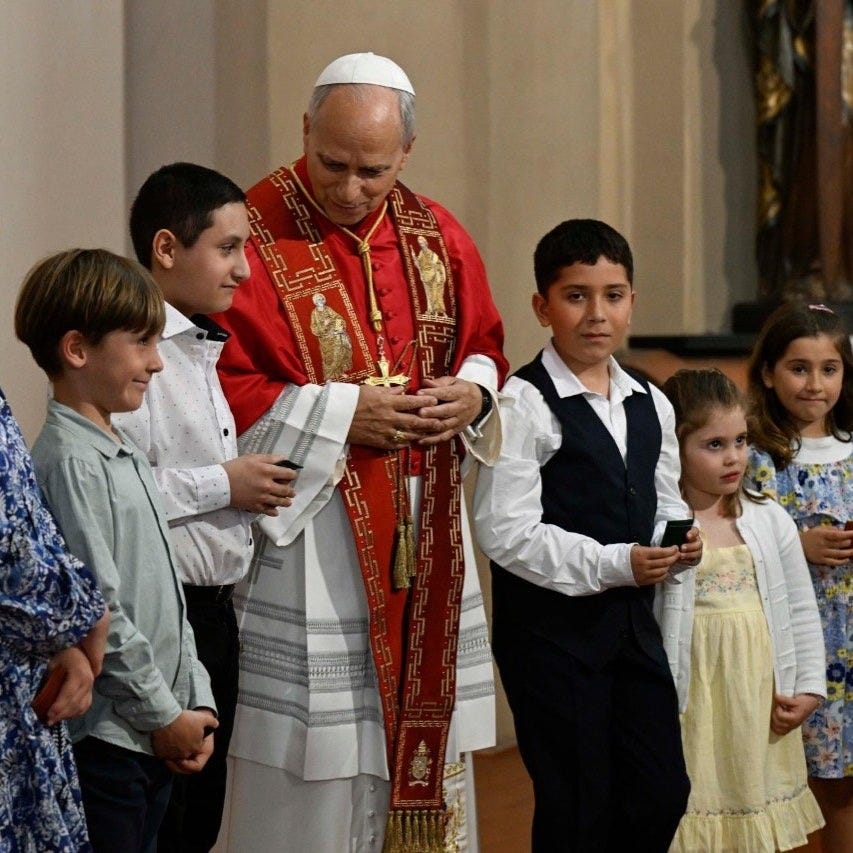
At dusk Leo reached the Metropolitan Cathedral on the Plaza de Mayo, where Jorge Mario Bergoglio served as archbishop from 1998 until the conclave of 2013. He stopped first at the plaque that now honors his predecessor and prayed in silence. Six children came forward with flowers; afterward he gave each of them a rosary.
Inside, before Argentina’s bishops and the diocesan teams carrying the synodal process forward, he preached Vespers. His homily was about whom pastors are for. They must know the real circumstances of their people, he said: “These include the unemployed, young people forced to emigrate, the elderly who have been neglected,” along with communities pushed to the margins.

He asked the bishops to work together “to care for those living in poverty, who are unemployed or who lack decent housing.” And he gave them the principles for every pastoral decision ahead: the dignity of each person, “the commitment to the universal destination of goods, the preferential option for the poor, and care for creation.”
Argentina’s bishops did not need the reminder (as I reported Sunday, of 44 public documents their conference released between January 2024 and September 2026, 42 criticized Milei’s government). What they received on Monday night was the pope’s cover.
The crowd outside got its own moment. After Vespers, Leo stepped onto the balcony of the archbishop’s residence beside the cathedral, the house Bergoglio lived in for fifteen years, and blessed the people waiting below. “Thank you for welcoming me,” he told them. “Thank you, Argentina.”
The rest of the week
Leo flies to Córdoba early Tuesday for a Mass at the Military Aviation School and a private meeting with 20 people the archdiocese has chosen, including men and women who live on the street. He returns to Buenos Aires for a youth vigil at the same monument where 2.5 million people gathered on Monday. On Wednesday morning he visits the prisoners of the Federal Penitentiary Complex, then celebrates his farewell Mass at Luján before flying on to Peru.
The pattern of this trip is hard to miss. Leo has gone looking for the disabled, the jobless, the recycler, the abuse survivor, the homeless, and the prisoner, and he has said their names in front of the men who run the country. He has done it in the language of his namesake, Leo XIII, whose Rerum Novarum defended a worker’s right to a just wage and to organize in 1891. Back home, where Trump and Vance attacked him and voters answered, plenty of Catholics are learning that language for the first time.
At Letters from Leo, we stand with Pope Leo XIV, with the five survivors who told him their stories, and with every Argentine worker, recycler, and young person a pope named out loud on Monday.
Work is how a person shares in the life of a community. Take it away and you wound something no unemployment check can heal, which is why the Church will keep insisting that the economy answer to the people inside it.
This is the fastest-growing Catholic community in the country because people are hungry for a Church that sits with victims, defends the worker, and asks its bishops to look first at the people on the margins.
If you believe this movement matters — Catholics and people of goodwill standing for human dignity against an economy that forgets the worker — I am asking you to join us.
If you’d like to invest in our mission, here are three ways you can help:
Subscribe as a paid member to receive exclusive posts about the life and formation of Pope Leo and help sustain this newsletter.
Donate with a one-time gift to fuel this project’s mission.
Share this post (and Letters from Leo) with a friend who might enjoy it.
Paid subscribers sustain our series on Pope Leo’s life and formation, including his two decades in Peru, where this trip ends next week, along with our Pope Leo Takes On AI series.
Whether you give $0, $5, $50, $500, $1,000, or more, your presence here matters — no matter your faith or your politics.
Thank you for reading. I’ll see you on the road.
