Thank you for reading! Letters from Leo is a reader-supported publication and the fastest-growing Catholic community in the country. To receive new posts and support this movement, consider becoming a free or paid subscriber.
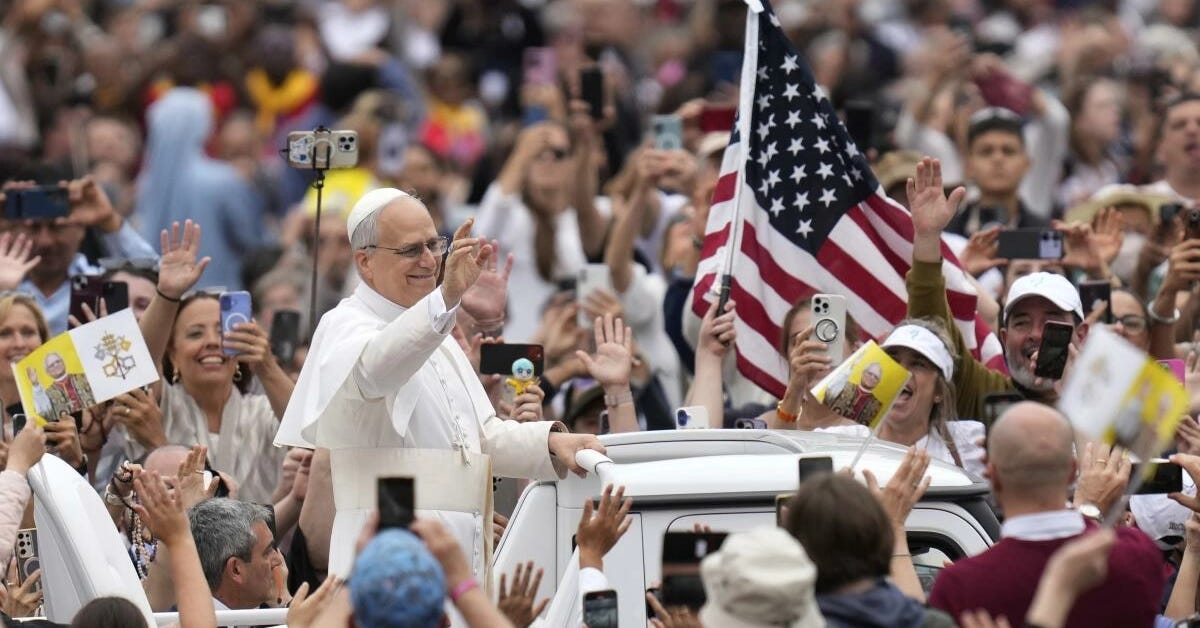
Pope Leo XIV told the crowd in St. Peter’s Square on Wednesday that Catholics “cannot remain as unengaged spectators” before the injustices of their own age.
The line came early in a new chapter of his weekly catechesis. Since January 7, the pope has spent his Wednesday audiences walking the Church through the documents of the Second Vatican Council, one at a time: Dei Verbum on Scripture, Lumen Gentium on the Church, and Sacrosanctum Concilium on the liturgy, the series that set off right-wing traditionalists last week when he defended the reform of the Mass.
On September 2, he began the last of the Council’s four constitutions, Gaudium et Spes, the pastoral constitution on the Church in the modern world that Paul VI promulgated on December 7, 1965.
He started where St. John XXIII himself started.
Opening the Council on October 11, 1962, the pope who summoned it took aim at the “prophets of doom” who, in the passage Leo read aloud, “go about saying that our times, when compared with past centuries, are entirely worse; and go so far as to behave as if they had nothing to learn from history.”
Leo quoted him to a square full of pilgrims from England, Scotland, Malta, Canada, and the United States, in a season when the prophets of doom hold most of the microphones in American religious life.
The constitution’s first sentence is the one Catholics of a certain age can recite from memory.
The Church, it says, makes her own “the joys and the hopes, the griefs and the anxieties of the men of this age, especially those who are poor or in any way afflicted.”
That line has meant so much to me in my own journey as a Christian. In fact, I’m confident I’m the only federal candidate in the history of the United States to use a quote from a Second Vatican Council document in their campaign ads.
Leo said the sentence carries an obligation. “It is a sharing that calls on us to leave behind all passivity and indifference in the face of current events, history and people’s lives,” he said, “especially in the face of the rapid and profound changes we are experiencing today.”
He continued: “We cannot remain as unengaged spectators; rather, we must listen with our hearts, allow ourselves to be challenged, and become involved. With Christ and sustained by the power of his Spirit, believers are called to take on the burdens of their brothers and sisters, especially those who are crushed by injustice, discrimination, and violence.”
The pope was specific about what the Church is supposed to see when it looks at the world. Christian solidarity, he said, commits believers to “unmasking the contradictions” of contemporary life, and he named four of them.
Scientific and technological progress “constantly offers new possibilities, but only to some.”
Societies understand their own laws better than any generation before them while remaining uncertain “about the direction to give” them.
Wealth and economic power pile up, and still “a huge proportion of the world’s citizens” remain “tormented by hunger and poverty.”
Everyone now knows the planet’s future is at stake; what Leo sees alongside that knowledge is an inability “to renounce selfish consumption and the illusion that war is an effective means of building peace.”
Readers of Magnifica Humanitas, his encyclical on artificial intelligence, will recognize the first of those contradictions; the last one describes the Iran war he spent the spring trying to stop.
None of this, Leo insisted, is “merely a moral imperative.” He, as he often does, quoted his predecessor Francis.
“The option for the poor is primarily a theological category rather than a cultural, sociological, political or philosophical one,” he said, quoting Evangelii Gaudium. “We are called to find Christ in them, to lend our voice to their causes, but also to be their friends, to listen to them, to speak for them.”
The pope who was told to stay out of politics
Americans should hear Wednesday’s catechesis against the noise of the past five months.
In April, JD Vance twice told Pope Leo XIV to stay out of American politics.
When the Trump administration claimed in July that the pope was speaking as a politician, the Vatican answered with a sentence every American Catholic should memorize: “the pope always speaks as a shepherd.”
Leo has not accepted the premise that a shepherd keeps quiet about the wolves.
On April 7, speaking to reporters at Castel Gandolfo, he asked ordinary citizens to pick up the phone: “I would invite the citizens of all the countries involved to contact the authorities, political leaders, congressmen, to ask them, tell them to work for peace and to reject war.”
In Rimini on August 24, with Washington’s deportation campaign in full swing, he told the crowd at the Rimini Meeting that “before borders, there are always persons.”
Wednesday’s catechesis supplies the theology underneath it all, and the document he chose to teach does it well. Gaudium et Spes is the Council text with an entire chapter on political life, and it does not hedge.
Paragraph 43 warns Christians, “as citizens of two cities,” against imagining “that they may therefore shirk their earthly responsibilities,” and it calls the split between the faith people profess and their daily lives one of “the more serious errors of our age.”
In paragraph 75, the Council talks about participating in free and fair elections: “All citizens, therefore, should be mindful of the right and also the duty to use their free vote to further the common good.” Wednesday’s installment covered only the first ten paragraphs. The chapter on political life is still ahead of him, and so is the American election.
What this community is for
That work is the purpose of Letters from Leo.
Since the summer of 2025, this community has existed to do what the pope described from the square this week: refuse the spectator’s seat.
Our writing covers what Leo says and what the people in power do with it, naming the Catholics who carry the burdens of the crushed, along with those adding to the load. Then the community acts on what it has read.
That last part is about to matter more than it ever has. On November 3, sixty-one days from today, Americans vote in the first nationwide election of Leo’s pontificate. Two years later, on November 7, 2028, they will choose a president.
Here is what we intend to do between now and then.
Every week through both elections, Letters from Leo will track where Catholic voters stand, and where the candidates courting them actually stand, on the questions Leo raised on Wednesday, including the wars fought in our name and the machines being handed authority over human lives.
Bishops who speak will be quoted here, and when others go quiet in an election year, readers will learn their names too.
Readers will also get the tools to register and vote, and to organize inside their own parishes and dioceses, the places where the Church’s teaching on the common good is either lived or ignored (and where the prophets of doom have had the room to themselves for too long).
On Tuesday I wrote a letter about why I refuse to give up on the Church or the country, and I said our mission is to make America more just, less cold, and brimming with hope.
Leo’s Wednesday catechesis was the Church’s own presentation of that mission.
Leo closed by praying that “joy and hope — gaudium et spes — be the distinctive features of a Church who proclaims and bears witness to the Gospel, drawing close to the women and men of our time.”
In the United States, the women and men of our time are about to vote.
At Letters from Leo, we stand with Pope Leo XIV and the millions of American Catholics, along with countless others of goodwill, who heard him on Wednesday and understood that a faith which stays in the pew while neighbors are “crushed by injustice, discrimination, and violence” has stopped being faith.
In a political culture that wants believers silent or for sale, we remain rooted in a Gospel that sends people into the square.
This is the fastest-growing Catholic community in the country because people are tired of watching. They want to know what the pope actually said, what their leaders did with it, and what to do about it before November 3.
If you believe this movement matters — Catholics and people of goodwill refusing the spectator’s seat in the first elections of Leo’s pontificate — I am asking you to join us.
If you’d like to invest in our mission, here are three ways you can help:
Subscribe as a paid member to receive exclusive posts about the life and formation of Pope Leo and help sustain this newsletter.
Donate with a one-time gift to fuel this project’s mission.
Share this post (and Letters from Leo) with a friend who might enjoy it.
Paid subscribers receive our exclusive series on Pope Leo’s life and formation, our reporting on his confrontation with the AI industry, and the Sunday Scripture Reflection Series, alongside investigations no one else is publishing.
Whether you give $0, $5, $50, $500, $1,000, or more, your presence here matters — no matter your faith or your politics.
Thank you for reading. I’ll see you on the road.


Thank you for the newsletter, Chris. Today I am thinking about an iconic women who stood for equality for everyone. I will continue to pray for Pope Leo and this country. RIP Gloria Steinem.
The Pope wants you to vote for the Democrats. Da!
