


Thank you for reading! Letters from Leo is a reader-supported publication and the fastest-growing Catholic community in the country. To receive new posts and support this movement, consider becoming a free or paid subscriber.
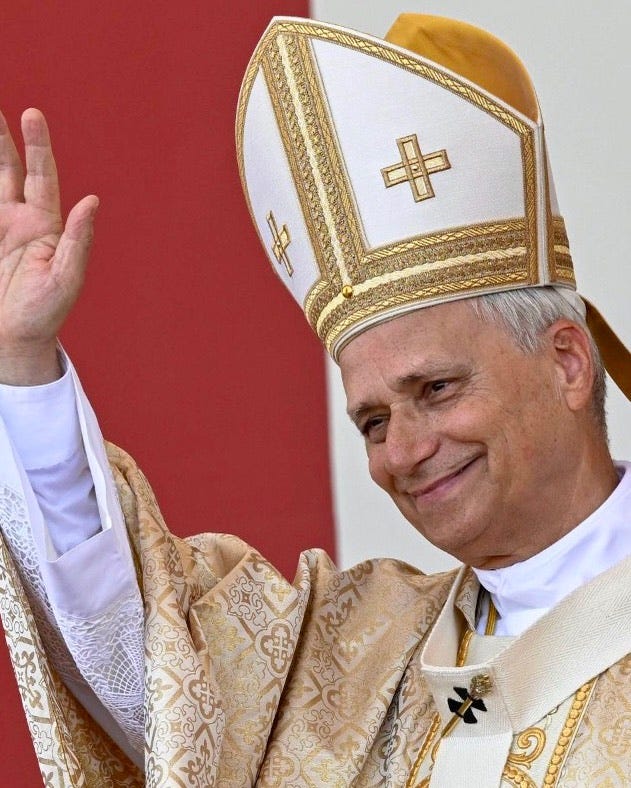
Pope Leo XIV landed at the air base in Chiclayo just after 9 on Friday morning, in a LATAM jet with “#LeonXIVvuelaaCasa” (Leo XIV flies home) painted on its side.
Dancers met him on the tarmac with the marinera norteña, the handkerchief-waving courtship dance of Peru’s north coast, and EWTN’s cameras caught the pope delighting in every turn of it.
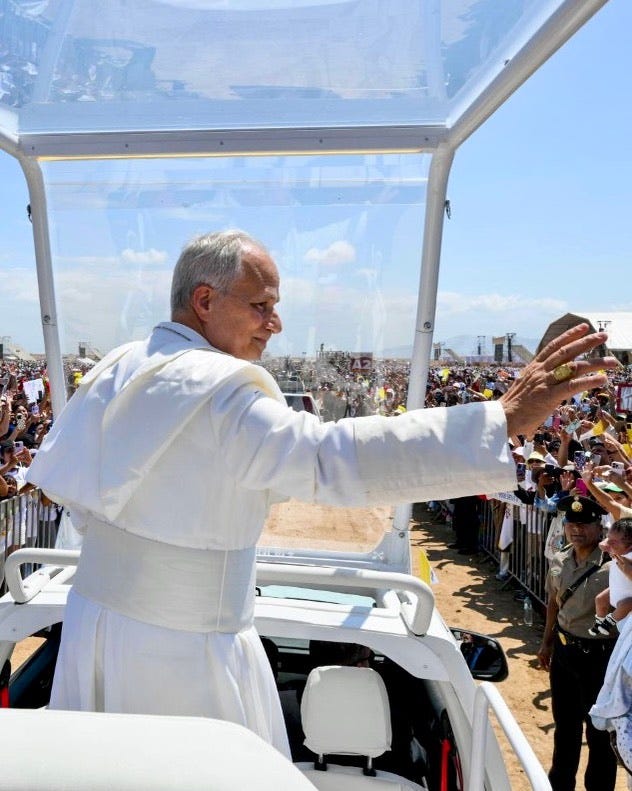
Then he rode nine miles in the popemobile through the city he led as bishop from 2015 to 2023. About a million people lined the route, OSV News reported, many of them holding yellow and white balloons, and they had a chant ready for him: “¡El papa es chiclayano!”
At the end of the road, half a million more had been waiting for hours on the Pampas de Pimentel, a dusty plain outside the city where the temperature reached 90 degrees, according to EWTN.
This is part one of my dispatches from Leo’s homecoming to the north, after three million people filled the streets of Lima to welcome him back to Peru. Friday belonged to the people who still call him Padre Roberto. On Saturday he crowns the image of the Immaculate Virgin at the cathedral and prays at the shrine of St. Turibius in Zaña, and I’ll bring you that next.
“With God’s help, I am overcoming”
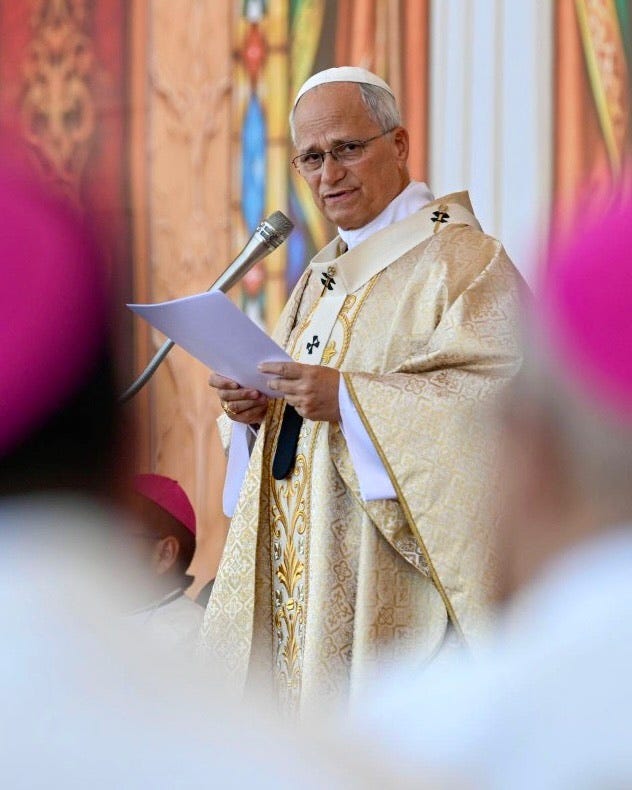
“What a joy it is to return to Chiclayo!” Leo said as he began his homily. “It is a blessing for me to be with you once again.”
He thanked the crowd for its prayers, “especially for my health during this time of trial which, with God’s help, I am overcoming.”
Every Peruvian on that plain knew what he meant. A month ago, surgeons at Rome’s Gemelli hospital removed the lower lobe of his right lung, and the Vatican confirmed that the pope has lung cancer. Days later, his doctors said he would need no further treatment, and he flew to South America as planned.
The rest of the homily was a missionary’s charge to every baptized person in the field, lay and ordained alike. “Mission cannot be improvised,” Leo said. Evangelizing, he told them, has nothing to do with “imposing doctrines or trusting in efficient strategies”; Christians proclaim Christ “through the witness of an authentically Christian and coherent life.”
He closed with a sentence worth hearing from a man one month out of cancer surgery: “The world is waiting for us and the mission is only beginning.”
Bishop Edinson Farfán, the Augustinian who now leads the diocese, answered for Chiclayo at the end of Mass. “Your presence allows us to thank God for all that you sowed among us,” he said.
A chapel for Romero
After Mass, Leo left the crowds behind and drove to El Bosque, a poor settlement in Chiclayo’s La Victoria district, for a private visit to the chapel of St. Óscar Romero.
For years the chapel sat in disrepair. Its pastor, Father José Alonso, told EFE that no priest could ever raise the money to rebuild it, until Father Edgard Rimaycuna (the Chiclayo priest who now serves as Leo’s personal secretary) took up the cause.
When Alonso wrote to congratulate Leo on his election, the new pope answered with a request of his own. “No se olvide de la capilla,” he wrote back, asking the pastor not to forget the chapel.
It was consecrated on Nov. 1. Leo brought it a reliquary holding a piece of the alb Romero wore when an assassin shot him at the altar of a hospital chapel in San Salvador in 1980.
The stop tells you something about the bishop Chiclayo received in 2015. Prevost was the first bishop of Chiclayo in 46 years without ties to Opus Dei, according to the National Catholic Reporter.
When he arrived, Opus Dei priests held something close to a monopoly on the diocese’s parishes, NPR’s Daniel Burke and Scott Detrow write in their new biography, American Pope, and the Catholics most devoted to Romero had been left on the outside. Prevost kept a photograph of the Salvadoran martyr in his office.
“Not optional tasks”
In the afternoon, Leo went to the Shrine of Our Lady of Peace. On Oct. 21, 2015, the new bishop had written in the shrine’s guest book that he was entrusting his ministry to the Virgin, EWTN reported. On Friday he came back to meet the priests, sisters, seminarians and parish councils he once led.
He told them he felt “even more strongly the bond that unites us in Christ.”
Then he handed them their work. A synodal Church, Leo said, has to accompany “families, young people, migrants, Indigenous peoples, people living in poverty,” and it has to carry “the commitment to justice, peace and the common good.” He drew a line under the whole list in words that El Comercio put in its headline: “These are not optional tasks; they are demands of our ecclesial mission.”
American Catholics should read that sentence slowly. Last year Vice President JD Vance told the country to look up ordo amoris, arguing that Christian love runs in a ranked order with the stranger near the bottom, and both Francis and the cardinal who would become Leo corrected him.
In June, Vance went on Fox News and said he hoped the Catholic leadership had learned something from the Trump administration about immigration.
Leo never mentioned Vance on Friday. Standing in the diocese that taught him how to be a bishop, though, he told the priests who know him best that caring for migrants is part of the mission itself.
Chiclayo formed this pope. On Friday it showed the world the Church he learned there, one that says Mass for half a million in the desert heat and then slips away to pray with Romero in a chapel the poor built.
At Letters from Leo, we stand with Pope Leo XIV and with the people of Chiclayo who taught a missionary from Chicago how to be their bishop. They showed him that the Gospel is lived in floodwater and on dirt roads, and he has carried that lesson all the way to the chair of Peter.
This is the fastest-growing Catholic community in the country because people are hungry for a Church that keeps faith with the poor and the stranger, the same Church Leo preached on the Pampas de Pimentel. In a season when our own leaders rank human beings by their passports, that hunger has only grown.
If you believe this movement matters, Catholics and people of goodwill standing together for the dignity of every person, I am asking you to join us.
If you’d like to invest in our mission, here are three ways you can help:
Subscribe as a paid member to receive exclusive posts about the life and formation of Pope Leo and help sustain this newsletter.
Donate with a one-time gift to fuel this project’s mission.
Share this post (and Letters from Leo) with a friend who might enjoy it.
Paid subscribers can read our full series on Pope Leo’s Life & Formation, including how Peru made Pope Leo XIV, along with our Sunday Scripture Reflection Series.
Whether you give $0, $5, $50, $500, $1,000, or more, your presence here matters — no matter your faith or your politics.
Thank you for reading. I’ll see you on the road.

Chris, I love each of your posts. Thank you.