
New York’s Odd Couple: A Muslim Democratic Socialist Mayor and Pope Leo XIV’s New Archbishop
What Mayor Mamdani and Archbishop Hicks share turns out to matter more than what divides them.
Thank you for reading! Letters from Leo is a reader-supported publication, 100% sustained by your generosity. To receive new posts and support this work, consider becoming a free or paid subscriber.
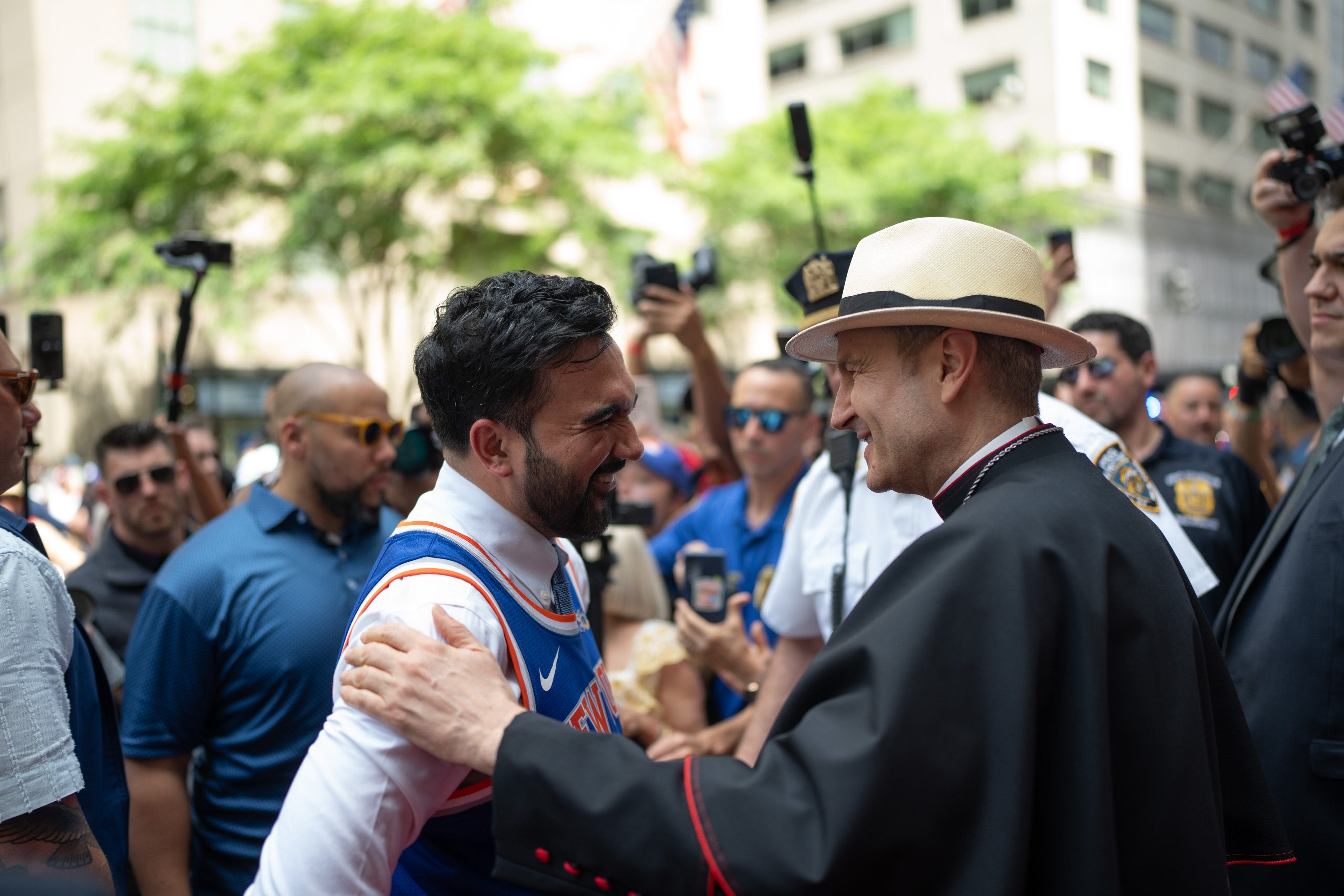
At the Puerto Rican Day Parade this past Sunday, Mayor Zohran Mamdani handed Archbishop Ronald Hicks a New York Knicks jersey. Hicks took it, grinned, and stuck his tongue out like a kid who had just been handed the keys to the city. The two men looked completely at ease with each other, and by dinnertime, the clip had gone viral.
It capped a weekend in which Hicks leaned all the way into his adopted city, turning up in a Knicks jersey, a World Cup soccer shirt, and a Puerto Rican parade hat as New York celebrated a championship, a World Cup summer, and its Puerto Rican community all at once.
To many, a scene this warm between the Catholic archbishop of New York and its Muslim mayor would have been hard to imagine. When Hicks was installed as the eleventh Archbishop of New York at St. Patrick’s Cathedral in February, Mamdani did not attend. The absence made headlines for a day.
The freeze did not last. Within days, the two crossed paths at a police department event and spoke by phone, and Mamdani went out of his way to make peace in public.
“I know that Archbishop Hicks and I share a deep and abiding commitment to the dignity of every human being,” he wrote, “and look forward to working together to create a more just and compassionate city.”
The contrast with the rest of the American hierarchy is hard to miss. Hours after Mamdani’s inauguration in January, Bishop Robert Barron went after the new mayor over a single phrase in his inaugural address — a rebuke from a bishop who has had little to say about Trump and Vance’s ICE raids.
Barron governs a diocese in Winona-Rochester, Minnesota, more than a thousand miles from City Hall. Mamdani’s own archbishop, the one who actually shares his city, chose a different posture entirely.
It helps to know who Hicks is. Born in Harvey, Illinois, ordained for Chicago in 1994, he spent five years in El Salvador running Nuestros Pequeños Hermanos, a charity that cares for orphaned and abandoned children across Latin America.
He is fluent in Spanish, took the Franciscan phrase Paz y Bien — “Peace and Good” — as his episcopal motto, and came to New York after stints as a Chicago auxiliary under Cardinal Blase Cupich and then as Bishop of Joliet. He is, by formation and temperament, a missionary — a man who has spent his priesthood close to the poor and comfortable in two languages.

Mamdani is an unlikely partner for a Catholic archbishop, and that is the point. Born in Kampala to the filmmaker Mira Nair and the scholar Mahmood Mamdani, raised in Queens, he rose from a state assembly seat in Astoria to become the first Muslim mayor in the city’s history, a democratic socialist who won City Hall on a promise of affordability — a rent freeze, free buses, universal child care.
He is, in almost every demographic sense, the opposite of the man in the cassock.
What they share is a set of priorities. By St. Patrick’s Day, Hicks used his first parade Mass to defend immigrants from the pulpit — quoting Hamilton, telling the story of an Irish farmer who died to save a hunted priest, then turning the lesson on the families Trump’s ICE was hunting in 2026.
Homelessness, poverty, and the dignity of the migrant are the issues both men return to most, and they have begun returning to them together. It is the same ground Pope Leo XIV keeps reclaiming.
After the Mass, Hicks spoke with Fox News and other local news networks. “I think we’re off to a great start,” he said.
And then there were the Knicks.
The championship run brought the Church and the city together in a way New York hadn’t seen in generations. The heart of the team is Villanova — Jalen Brunson, Josh Hart, and Mikal Bridges, the core of the “Nova Knicks,” all national champions in college. Pope Leo XIV graduated from Villanova in 1977.

That coincidence became a citywide article of faith. Spike Lee, the Garden’s patron saint, hand-delivered the pope a personalized Knicks jersey, and a fan in St. Peter’s Square shouted “Pope Leo, go Knicks” until the popemobile passed and the pope flashed him a double thumbs-up.
The most New York version of it came from a 23-year-old named MD Hossain, whose interreligious chant went viral mid-series. “My mayor still Muslim, my bagel still Jewish, the pope on our side, Knicks in five,” he shouted into a microphone on the street — a whole improbable coalition packed into one rhyme, with the first American pope somewhere near the center of it.
I talked about all of it on CNN this week — how a team out of a Catholic university gave a divided city something to share, and how the first American pope became the most famous Knicks fan in Rome.
It may not be over. According to team sources I’ve spoken with, the Knicks are interested in visiting their patron, Pope Leo XIV, in Rome this offseason. We’ll see if it happens. And I hope Spike Lee can come along too.
Pull the threads together, and a pattern emerges. Around a basketball team and a shared fight for the poor, Zohran Mamdani and Ronald Hicks are building a flourishing friendship.
That matters beyond New York.
In a national moment when faith and politics are trained to despise each other — when a Catholic vice president spends his days at war with his own Church, and a bishop in Minnesota reaches across the country to scold a mayor he will never have to serve — a Muslim democratic-socialist and a Catholic archbishop keep finding reasons to stand side by side.
They disagree about some issues, and neither pretends otherwise. But they have decided that the dignity of the New Yorker who is hungry, undocumented, or priced out of his own city is bigger than the lines between them.
For a Church that exists, as Hicks put it at his installation, “to go out and serve all,” that friendship is a small, stubborn sign of what solidarity can still look like.
The Knicks were the easy part. What keeps a friendship like theirs alive is the harder, quieter work of caring for the people their city forgets.
At Letters from Leo, we stand with the Catholics and people of goodwill who believe that the dignity of the poor is bigger than our politics — that a city is judged by how it treats the hungry and the stranger, and that the Gospel is meant to be lived in public, on parade routes and at podiums and in the stands.
This is the fastest-growing Catholic community in the country because people are hungry for that kind of hope — for leaders who would rather build something together than tear each other apart.
If you believe this movement matters — Catholics and people of goodwill standing for human dignity and the common good — I am asking you to join us.
If you’d like to invest in our mission, here are three ways you can help during this critical time:
Subscribe as a paid member to receive exclusive posts about the life and formation of Pope Leo and help sustain this newsletter.
Donate with a one-time gift to fuel this project’s mission.
Share this post (and Letters from Leo) with a friend who might enjoy it.
Paid members make this work possible and unlock the full archive — including the biographical series on Pope Leo’s Life & Formation, our reporting in The Epstein-Bannon Investigation, the Sunday Scripture Reflection Series, and Pope Leo Takes on Silicon Valley.
Whether you give $0, $5, $50, $500, $1,000, or more, your presence here matters — no matter your faith or your politics.
Thank you for reading. I’ll see you on the road.


Oh my gosh can I just say how much I LOVE this?!? This is America!! Of my father, mother, grandparents…🥰⭐️☮️🥰
I don’t get what’s so remarkable about this. A moderately-liberal American Catholic prelate and a quite-liberal but still very sincerely-believing Shi’a Muslim? It would seem to me that they only might disagree about abortion. What is the “plenty” that divides them? I would argue that they share far more with each other politically and even spiritually than either shares with reactionaries and traditionalists within their own faith traditions.