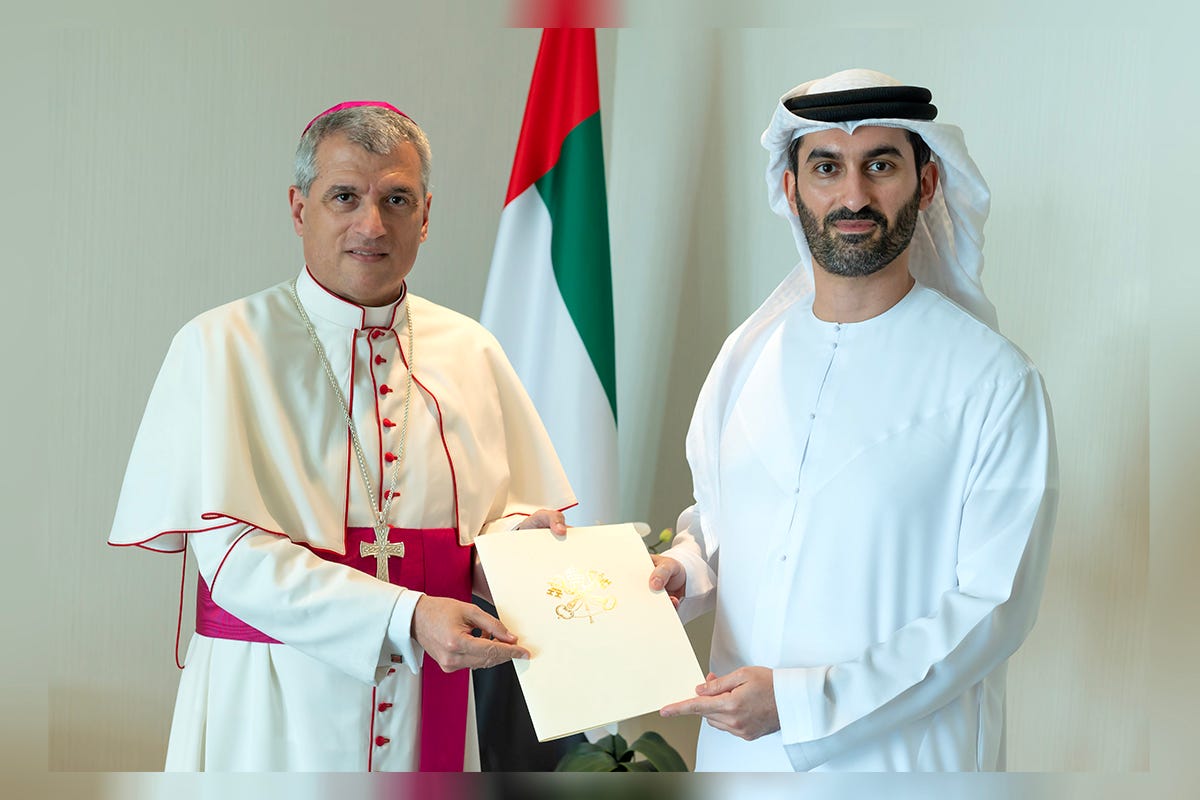
Pope Leo XIV Sends a Maronite from Beirut to the United Nations as Israeli Troops Hold Southern Lebanon
Archbishop Christophe-Zakhia El-Kassis is the first Arab country prelate ever to represent a pope at the UN, and the first Eastern Catholic in the job.

Thank you for reading! Letters from Leo is a reader-supported publication and the fastest-growing Catholic community in the country. To receive new posts and support this movement, consider becoming a free or paid subscriber.
Pope Leo XIV named Archbishop Christophe-Zakhia El-Kassis the Holy See’s permanent observer to the United Nations on Saturday, handing the Vatican’s seat in New York to a Maronite priest born in Beirut while Israeli troops still hold ground inside southern Lebanon.
El-Kassis is 57. He was born in Beirut on August 24, 1968, ordained for the Maronite Archeparchy of Beirut in May 1994, and entered the papal diplomatic service in June 2000. Nunciature postings in Indonesia, Sudan and Turkey came first, followed by more than a decade handling relations with states inside the Secretariat of State.
Pope Francis made him an archbishop in November 2018 and sent him to Pakistan. He became the first nuncio the Holy See has ever posted to the United Arab Emirates in January 2023, adding Yemen and the whole Arabian Peninsula to his territory eighteen months later. He works in eight languages, Arabic and Indonesian among them.
He replaces Archbishop Gabriele Caccia, the Italian diplomat Leo pulled out of New York in March and installed as nuncio to the United States.

The Vatican bulletin carried the appointment as a routine line under the day’s nominations. Per custom, there was no press conference and no explanatory note.
So I went back through the record myself. Seven men have held the post since the Holy See opened its observer mission in 1964 — Alberto Giovannetti, Giovanni Cheli, Renato Martino, Celestino Migliore, Francis Chullikatt, Bernardito Auza and Caccia — and five of the seven were Italians, the exceptions being an Indian and a Filipino.
El-Kassis breaks the pattern two ways. He is the first bishop from the Middle East, and the first Eastern Catholic in a line that has otherwise belonged entirely to the Latin Church.
Leo has also, for the first time, given the job to a man whose home region is majority Muslim and whose Church has spent its whole history as a minority inside the Islamic world.
The seat is a strange one. The Holy See sits at the UN as a permanent observer state, a status shared with exactly one other entity, the State of Palestine. El-Kassis may address the General Assembly, co-sponsor documents, circulate texts and exercise a right of reply, though no ballot is ever placed in his hands. What the Vatican brings to that room is a moral argument, and Leo has just given it a Middle Eastern accent.
The country he comes from is still being shelled
Hezbollah fired rockets into Israel on March 2 for the first time since the November 2024 ceasefire, days after the American-Israeli strikes on Iran and the assassination of Ali Khamenei. Israeli divisions crossed into southern Lebanon two weeks later. By late June, Al Jazeera counted more than 4,000 dead and 1.2 million Lebanese driven from their homes, better than a fifth of the country.
A framework agreement signed at the State Department on June 26 ties an Israeli pullback to the verified disarmament of Hezbollah. Naim Qassem, the group’s secretary-general, called the deal “null and void,” and Benjamin Netanyahu says Israel will hold its buffer zone until the disarmament happens. An Israeli drone hit a car in Nabatieh al-Fawqa on July 6, killing four people, among them a school principal and her mother.
Lebanese President Joseph Aoun spent nearly two hours in the Oval Office on Tuesday asking Donald Trump for a withdrawal and reconstruction money. “It’s been a very badly treated place and country,” Trump said of Lebanon, “and we’re going to have it properly treated.”
Leo knows the terrain personally. He landed at Beirut airport on November 30 last year, prayed at the tomb of St. Charbel in Annaya, stood in silence at the port where the 2020 explosion killed hundreds, and closed the trip with a Mass on the Beirut waterfront that drew roughly 150,000 people.

The priest, the parish, and the phone calls
On the afternoon of March 9, an Israeli Merkava tank fired a shell into a house in Qlayaa, a Christian village in the Marjayoun district. The blast wounded the family inside. Father Pierre El-Rahi, the Maronite pastor who had refused an Israeli evacuation order days earlier, ran toward the house with several young men from the village, and a second shell killed him.
The Holy See Press Office put out a statement of papal sorrow that night. Two days later at his general audience, Leo called El-Rahi “a true shepherd, who always stayed beside his people, with the love and sacrifice of Jesus the Good Shepherd,” and prayed “that the blood he shed be a seed of peace for beloved Lebanon.” I wrote about that killing here.

Ten weeks into Leo’s pontificate, Israeli shelling had struck Holy Family Church in Gaza City, the only Catholic parish in the strip, where about 500 displaced people were sheltering. Saad Salameh, the 60-year-old janitor, died in the yard, along with Fumayya Ayyad, who was 84, and Najwa Abu Daoud, who was in her seventies. The Israeli military later attributed the strike to “an unintentional deviation of munitions.”
Netanyahu telephoned the pope the next day to express regret. At the Angelus that Sunday, Leo called for an immediate end to “the barbarity of the war” and insisted that every party respect the prohibition on collective punishment and the indiscriminate use of force.
Father Gabriel Romanelli, the parish priest wounded in that strike, is Argentine — a countryman of Pope Francis, who telephoned Holy Family at seven o’clock nearly every evening from the first weeks after October 7, 2023. Francis asked the parishioners what they had eaten for dinner and told them, “I am with you, don’t be afraid.” His last call to Gaza came on Holy Saturday 2025, two days before he died.
What Jerusalem will read into this
Relations between the Vatican and Netanyahu’s government have been raw for two years. Israel’s foreign ministry summoned the nuncio, Archbishop Adolfo Tito Yllana, on Christmas Eve 2024 after Francis called the machine-gunning of Gaza’s children an act of cruelty, though the ministry took care to describe the meeting as something short of a reprimand.
Its embassy to the Holy See went after Cardinal Pietro Parolin publicly in October 2025, objecting that he had applied the word massacre both to Hamas’s attack of October 7 and to Israel’s campaign in Gaza. “There is no moral equivalence between a democratic state that protects its citizens and a terrorist organisation that tries to kill them,” the embassy said. Leo backed his secretary of state that same day, telling reporters that Parolin had “very clearly expressed the Holy See’s position.”
Israeli police barred Cardinal Pierbattista Pizzaballa from the Holy Sepulchre on Palm Sunday this year, and the Vatican protested to Ambassador Yaron Sideman — the same envoy who had told Crux eleven days earlier that the Iran war was “the most just war conceivable.”
Underneath the diplomacy sits a pattern of street-level violence that Christians in the Holy Land have documented for years. Israel’s Religious Freedom Data Center recorded 83 acts of harassment against Christians between April and June, nearly double the previous quarter, with spitting accounting for 56 percent of them. A French nun researching at the École biblique was thrown to the ground and kicked near the Cenacle in April. Outside Jerusalem’s Lutheran Church of the Redeemer in May, a crowd shouted “Death to Christians.” I have been writing on this crisis all year.
Into that room walks a Maronite archbishop from Beirut.
Personnel is policy — and in Catholicism, doctrine
Leo has stayed thoughtful with his words, but has moved boldly in who carries his voice on these issues. He declined a seat on Trump’s Gaza peace board in February, has fought the Iran war from the pulpit week after week, and has now put the Church’s permanent voice at the United Nations in the hands of a man whose country buries his own priests.
Catholic teaching holds that the poor and the wounded are never merely subjects to be discussed by their betters. Solidarity means the injured party gets a chair and a microphone. For sixty-two years the Holy See promoted peace in the Middle East at the United Nations through envoys who flew in from Rome, and starting now, the argument will be made by someone from the neighborhood who has experienced the pain of this war in the flesh.
That is what lifts this above a personnel note. Grieving Father El-Rahi at a Wednesday audience was an act of pastoral care; seating his countryman in the General Assembly carries consequences, because the governments that found this pope’s words inconvenient will find his diplomat considerably harder to ignore.
At Letters from Leo, we stand with the Christians of Lebanon, Gaza and the West Bank who have buried their dead without cameras, and with everyone of goodwill who refuses to accept that a priest running toward wounded neighbors is a tolerable cost of anyone’s war.
The Gospel makes a public claim about the world — that every human being carries the image of God, and that any government treating some lives as expendable is telling a lie about creation itself.
This is the fastest-growing Catholic community in the country because people are hungry for a faith with a spine, one that names the dead, tells the truth about who killed them, and refuses to bow to the idols of fear and force.
If you believe this movement matters, Catholics and people of goodwill standing for human dignity against the machinery of war, I am asking you to join us.
If you’d like to invest in our mission, here are three ways you can help during this critical time:
Subscribe as a paid member to receive exclusive posts about the life and formation of Pope Leo and help sustain this newsletter.
Donate with a one-time gift to fuel this project’s mission.
Share this post (and Letters from Leo) with a friend who might enjoy it.
Paid members keep this work possible and receive everything behind the wall — the biographical series on Pope Leo’s life and formation, the reporting on how this pope is taking on artificial intelligence, and the Sunday Scripture Reflection Series.
Whether you give $0, $5, $50, $500, $1,000, or more, your presence here matters — no matter your faith or your politics.
Thank you for reading. I’ll see you on the road.


The message is unambiguous. May it be heard and resonate.
I must believe this is the Universe speaking through Pope Leo XIV.