


Thank you for reading! Letters from Leo is a reader-supported publication and the fastest-growing Catholic community in the country. To receive new posts and support this movement, consider becoming a free or paid subscriber.
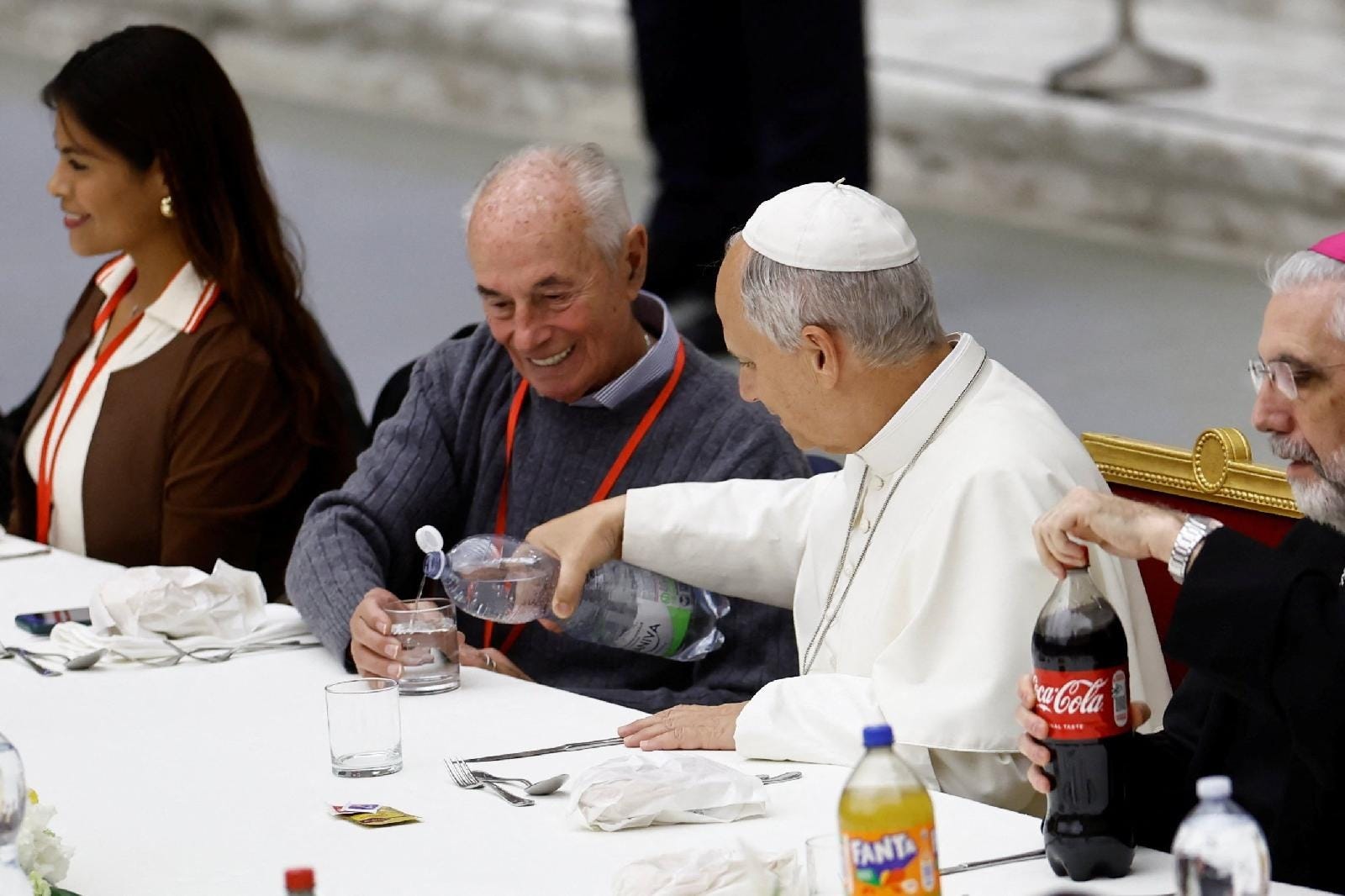
Pope Leo XIV sat down to lunch on Sunday with 1,300 people living in poverty in Rome, about an hour after he told St. Peter’s Square that Christ the King “stands alongside the least and the oppressed to redeem them from all evil.”
The guests had watched that Angelus address on large screens inside the Paul VI Audience Hall. When the American pope arrived around 1 p.m., he took a seat at a table with 18 of them and Archbishop Luis Marín de San Martín, a fellow Augustinian who leads the Vatican’s Dicastery for the Service of Charity.
“Good morning, everyone, and welcome!” Leo said. He thanked the archbishop and the Italian Red Cross, whose volunteers staffed the meal. “Today,” he told the room, “we are all one family.”

Before anyone ate, Leo led grace. He asked that the food help everyone in the hall “build your kingdom of love,” and he prayed that no one would go without what they need to live. Then he told his guests to enjoy their meal.
Sunday’s lunch marked the tenth World Day of the Poor, which Pope Francis created in November 2016, as the Jubilee of Mercy closed, and first celebrated the next year with a lunch for the poor in this same hall. The theme Leo picked for 2026 is “The Lord is the refuge of the poor.”
The Church usually keeps the day on the next-to-last Sunday of the liturgical year (this year, Nov. 15).
Leo spent that Sunday in Cusco, near the end of his twelve days in Uruguay, Argentina, and Peru, so Archbishop Marín celebrated the Mass in St. Peter’s Basilica in his place and the Vatican held the lunch for the pope’s return.
More than 400 Red Cross volunteers set over 100 tables and served cannelloni, beef stew with peas, and donated ice cream while the Red Cross national band played. Each guest went home with a bag holding a wool hat, razors, a toothbrush, and shampoo.
The hall could not hold everyone, so soup kitchens and shelters across Rome served a special meal on the pope’s behalf. “We would love to be able to welcome everyone with us in the Paul VI Hall, but it is not possible,” Archbishop Marín said.
“Neither a despot who threatens”
The Gospel for the Solemnity of Christ the King was Matthew 25, the last judgment, in which the Son of Man tells the righteous that whatever they did for the hungry, the thirsty, the stranger, and the prisoner, they did for him. Speaking from the window of the Apostolic Apartment at noon, Leo used the passage to describe the kind of king Jesus is.
“The One who speaks to us is neither a despot who threatens nor a tyrant who crushes others with his power,” the pope said.
Earlier in the address, he had noted that Jesus’ words apply to all times and all peoples, because “we are all equal before the law of God.”
Leo described the judgment as mercy
“The word that God speaks to the world is a proclamation of mercy,” Leo argued.
It is a verdict as well, he said, one that brings “the condemnation of all iniquity.” He then quoted the warning Jesus gives in Matthew’s Gospel: “Just as you did not do it to one of the least of these, you did not do it to me.”
He also recalled why Pope Pius XI created the feast in 1925, with the encyclical Quas Primas, three years after Mussolini’s March on Rome.
His predecessor, Leo said, wished to emphasize “that the Lord of history is the King of peace and justice.” (I wrote yesterday about what this feast meant to Óscar Romero.)
Leo tied the two events together himself. Before leaving the window, he told the crowd that he was about to join the lunch, moved to this Sunday because of his trip, and that he hoped it would be “a way of fraternal sharing that leaves no one alone in their time of need.”
Inside the hall, he told his guests that a gathering like theirs shows people they are “never alone.”
Leo learned this in Peru, where he spent roughly two decades, first as a missionary and later as bishop of Chiclayo.
Last week, before flying home, he returned to a home for abandoned elderly people in Callao that he had kept supplied during the pandemic. In July, he invited 200 vulnerable Romans to Mass and a meal at Castel Gandolfo.
His first major document as pope, Dilexi Te, took love for the poor as its subject.
He has kept Francis’s guest list, too.
Last year’s lunch included a group of transgender women, among them the activist Alessia Nobile, just as Francis had welcomed transgender women from the seaside town of Torvaianica to his own World Day of the Poor lunches.
Christ the King is the last Sunday of the Church’s year, and Advent begins next Sunday, Nov. 29.
Leo spent this one at a table of 18 guests in the Paul VI Hall while the Red Cross band played and volunteers carried out the beef stew.
At Letters from Leo, we stand with Pope Leo XIV, with Archbishop Marín and the 400 Red Cross volunteers who worked Sunday’s lunch, and with every Catholic and every person of goodwill who reads Matthew 25 as a set of instructions.
Leo’s king is the one in Matthew 25, who turns up hungry and in prison and then asks who fed him. On Sunday, the pope made room at his own table for 1,300 people the rest of Rome finds easy to forget.
This is the fastest-growing Catholic community in the country, and as far as I can tell the reason is simple: readers want a faith they can watch sit down with the poor, and this pope keeps giving them one.
If you believe this movement matters — Catholics and people of goodwill standing for the dignity of the poor — I am asking you to join us.
If you’d like to invest in our mission, here are three ways you can help:
Subscribe as a paid member to receive exclusive posts about the life and formation of Pope Leo and help sustain this newsletter.
Donate with a one-time gift to fuel this project’s mission.
Share this post (and Letters from Leo) with a friend who might enjoy it.
Paid subscribers receive every installment of our series on Pope Leo’s Life & Formation, including his years among the poor of Peru, along with the Sunday Scripture Reflection Series.
Whether you give $0, $5, $50, $500, $1,000, or more, your presence here matters, no matter your faith or your politics.
Thank you for reading. I’ll see you on the road.
