


Thank you for reading! Letters from Leo is a reader-supported publication and the fastest-growing Catholic community in the country. To receive new posts and support this movement, consider becoming a free or paid subscriber.
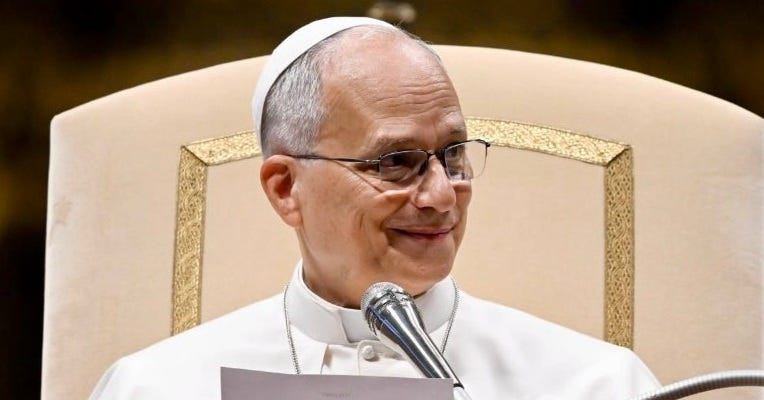
On Wednesday, Pope Leo XIV used his weekly general audience to defend the Second Vatican Council’s decision to significantly reform the Mass.
Arguing that the pre-Council Latin Mass didn’t adequately promote the inclusion of the laity in the celebration, he said: “Since the gestures and the words of the sacred liturgy are critical to realizing this experience, the participation of the faithful cannot be passive.”
Wednesday’s catechesis was Leo’s eighth in his series on Sacrosanctum Concilium, the Council’s constitution on the liturgy, and he quoted its teaching that Christ’s faithful should not attend Mass “as strangers or silent spectators.”
The reform, the first U.S.-pontiff argued, grew out of “the need to make the richness of the biblical texts and prayers more accessible to all the faithful, and to streamline the order of the celebration compared with that set out in the liturgical books then in use.”
He then quoted the future St. Paul VI, who wrote before the Council that the laity “cannot and must no longer remain silent and passive. Their physical presence cannot be reconciled with their spiritual absence.”
Now it’s important to note that the pope never said the words “Latin Mass,” though nobody who follows these fights even in a casual way needed him to.
The liturgical books then in use were the 1962 Missal — the rite American traditionalists somewhat anachronistically call the Mass of the Ages — and Leo XIV had just argued that the faithful were too passive at it for the Church to leave things alone.
The reaction arrived within the hour. John-Henry Westen, the founder of LifeSiteNews, posted a clip of Leo’s remarks claiming that the pope had said there was “NOT a conscious participation of the faithful” at the Traditional Latin Mass. In Western’s defense, that does appear to be what Leo XIV was arguing.

By evening he had gone back through Leo’s catechesis line-by-line to prove it and concluded that the pope “treats the pre-conciliar books” as “the problem.”
Deacon Nick Donnelly, a British deacon whose bishop told him in 2014 to stop posting on his blog, called the pope’s reasoning “discredited black propaganda” and said the audience was “like listening to a speech from a member of the USSR politburo.”


Maike Hickson, also of LifeSiteNews, wrote: “What an insult to the Mass of All Ages.”


Taylor Marshall went live on YouTube by mid-afternoon under the title “Is Pope Leo Turning His Back on Traditional Latin Mass?” Marshall, whose 2019 book Infiltration argues that the Church’s hierarchy has been subverted from within, warned cardinals three days before Prevost’s election that he “could be the worst case scenario” and “the scariest dark horse,” a man who “looks more moderate, but he’s actually liberal.”
He deleted the video after the election and posted, “I submit myself to His Holiness Pope Leo XIV, Vicar of Christ on earth.”
Westen treated the claim as news, though Leo had told his audience where it came from. “The assertion that the faithful should not attend celebrations ‘as strangers or silent spectators,’” Leo XIV said, “had already been raised in Pope Pius XI’s Apostolic Constitution Divini Cultus.”
In that 1928 constitution, Pope Pius XI wrote that the faithful at the sacred ceremonies “should not be merely detached and silent spectators.”
His predecessor Pius X made a similar argument at the turn of the twentieth century.
His 1903 motu proprio Tra le sollecitudini is where the phrase “active participation” (partecipazione attiva in Italian) enters the papal magisterium. He said that lay participation in the Church and, in particular, the Mass was the “foremost and indispensable font” of the Christian spirit.
He then ordered the simple and accessible Gregorian chant restored to the people, “so that the faithful may again take a more active part in the ecclesiastical offices, as was the case in ancient times.”
Faithful readers of Letters from Leo will note the irony. The pope whose name the again excommunicated Society of St. Pius X carries was describing congregations that had lost their rightful voice in the Tridentine Mass, the rite the now right-wing ultratraditionalists defend as untouchable.
It seems St. Pius X would disagree.
Addressing Italy’s National Liturgical Week in August 2017, Pope Francis said: “We can affirm with certainty and with magisterial authority that the liturgical reform is irreversible.”
Francis’s 2021 motu proprio Traditionis Custodes declared the reformed books “the unique expression of the lex orandi of the Roman Rite” and handed control of the 1962 Missal to each diocesan bishop.
It’s important to clarify that Francis restricted the old rite rather than abolishing it entirely. His letter barred new groups from celebrating the Mass and moved existing ones out of parish churches.
His 2022 letter Desiderio Desideravi explained his decision in plain language: “We cannot go back to that ritual form, which the Council fathers, cum Petro et sub Petro, felt the need to reform.”
Leo has been building toward Wednesday’s comments since January.
He opened the year by devoting his Wednesday catecheses to the Council, document by document, calling Vatican II the Church’s “guiding star”, and he reached Sacrosanctum Concilium on May 20.
On June 29 he sent Cardinal Arthur Roche, his liturgy prefect, a letter insisting on “fidelity to the approved texts and instructions” and respect for “the rites promulgated by Pope Saint Paul VI and Pope Saint John Paul II.”
In an interview with The Tablet published July 29, Roche told Maggie Fergusson: “Pope Leo is not going to change Traditionis Custodes, and he’s not going back to Summorum Pontificum.”
Conservatives had spent a year hoping the American pope would undo his predecessor’s restrictions. That’s been to no avail so far.
He kept the Latin Mass off the table at his second consistory in June, and a Spanish daily reported this month that Roche’s January liturgy document had been commissioned and approved by Leo himself, without a comma changed.
None of this is abstract in the United States, where the old rite has become a badge among conservative Catholics.
On Sunday, Eric Sammons, the editor of Crisis Magazine, who lives in the Cincinnati area, posted on X that he had seen Vice President JD Vance and his family at Mass that morning at Old St. Mary’s in Cincinnati, a Missa Cantata, the sung form of the old rite in which the priest chants the Mass without a deacon or subdeacon.
Sammons later deleted the post, though Rorate Caeli had already declared Vance the first sitting Catholic president or vice president to attend a Traditional Latin Mass openly since John F. Kennedy died. Vance told the Napa Institute in 2021 that the pope’s order on the Latin Mass was “not the right order for the Church,” adding, “Even though I’m not a big Latin Mass guy, it felt wrong.”
Precision matters here, because some will blur it. The Society of St. Pius X celebrates the old Mass, and the Vatican excommunicated its bishops in July. The penalty followed the society’s decision to consecrate bishops on July 1 without a papal mandate, an act Cardinal Víctor Fernández had warned in May would be schismatic.
Nobody has been excommunicated for participating in or even preferring a Traditional Latin Mass. Referring to the current Mass, Leo said last September that “you can say Mass in Latin right now. If it’s the Vatican II rite, there’s no problem.” His complaint is that the liturgy “has become a political tool.”
He’s completely correct in that conclusion.
Sacrosanctum Concilium calls conscious and active participation the “right and duty” of the faithful “by reason of their baptism.” Leo reiterated that on Wednesday, when he claimed that Masses “are not private functions, but are celebrations of the Church,” which the Council called the “sacrament of unity.”
Leo also refused extremes in the other direction. A correct understanding of the reform, the pope argued, “enables us to reject the abuses that occurred in certain sectors of the Church during the post-Conciliar period, and which, unfortunately, still occur from time to time today.”
His answer is to celebrate the reformed Mass well, with what he and the Council called “noble simplicity,” so that the dignity people look for at the Latin Mass is waiting for them at every parish altar across the globe.
Three popes across a hundred and twenty-three years have described a congregation of silent spectators as a failure of worship, and a fourth added that the reform which answered it cannot be undone.
In short, we’re not going backward, because that’s not how the Spirit works.
The “breaking news” right-wing traditionalists heard on Wednesday was a pope reading from a 1928 constitution and calling it “the living tradition of the Church,” a tradition he intends to keep carrying forward.
At Letters from Leo, we stand with Pope Leo XIV and with every Catholic who believes the Mass belongs to the whole baptized people of God, the ones in the pews as much as the one at the altar. The Council called the liturgy the sacrament of unity. We refuse to let it become a political tool or a weapon against the pope.
In an era poisoned by cruelty and cynicism, we remain rooted in a faith that refuses to flinch before injustice or bow to the idols of fear and authoritarianism.
This is the fastest-growing Catholic community in the country because people are hungry for something deeper than rage and propaganda. They are looking for courage, for truth, for a Church that prays with one voice, and right now, as the loudest voices on the Catholic right treat the pope’s catechesis as an insult, that hunger has never been more urgent.
If you believe this movement matters, Catholics and people of goodwill standing for human dignity and for a Church that moves forward together, I am asking you to join us.
If you’d like to invest in our mission, here are three ways you can help:
Subscribe as a paid member to receive exclusive posts about the life and formation of Pope Leo and help sustain this newsletter.
Donate with a one-time gift to fuel this project’s mission.
Share this post (and Letters from Leo) with a friend who might enjoy it.
Paid subscribers receive the full biographical series on Pope Leo’s life and formation, our Epstein-Bannon investigation, the Pope Leo Takes On AI series, and the Sunday Scripture Reflection Series, along with every exclusive report from Rome.
Whether you give $0, $5, $50, $500, $1,000, or more, your presence here matters — no matter your faith or your politics.
Thank you for reading. I’ll see you on the road.

"...[T]he pope had said there was 'NOT a conscious participation of the faithful' at the Traditional Latin Mass." If you think that was not true, ask any Catholic who attended Mass before 1965 how many people were saying their rosary. You stood or knelt when everyone else did, but the words in Latin didn't explain why you were doing this. My wife and I attended a Latin Mass recently, and will not attend another. Notice I said that we "attended" a Mass, we didn't really participate, and we're old enough to remember the Mass back then.
JD cosplays as Catholic, and it’s all about the trappings rather than the actual heart of our faith, so of course he’d go to Latin Mass.