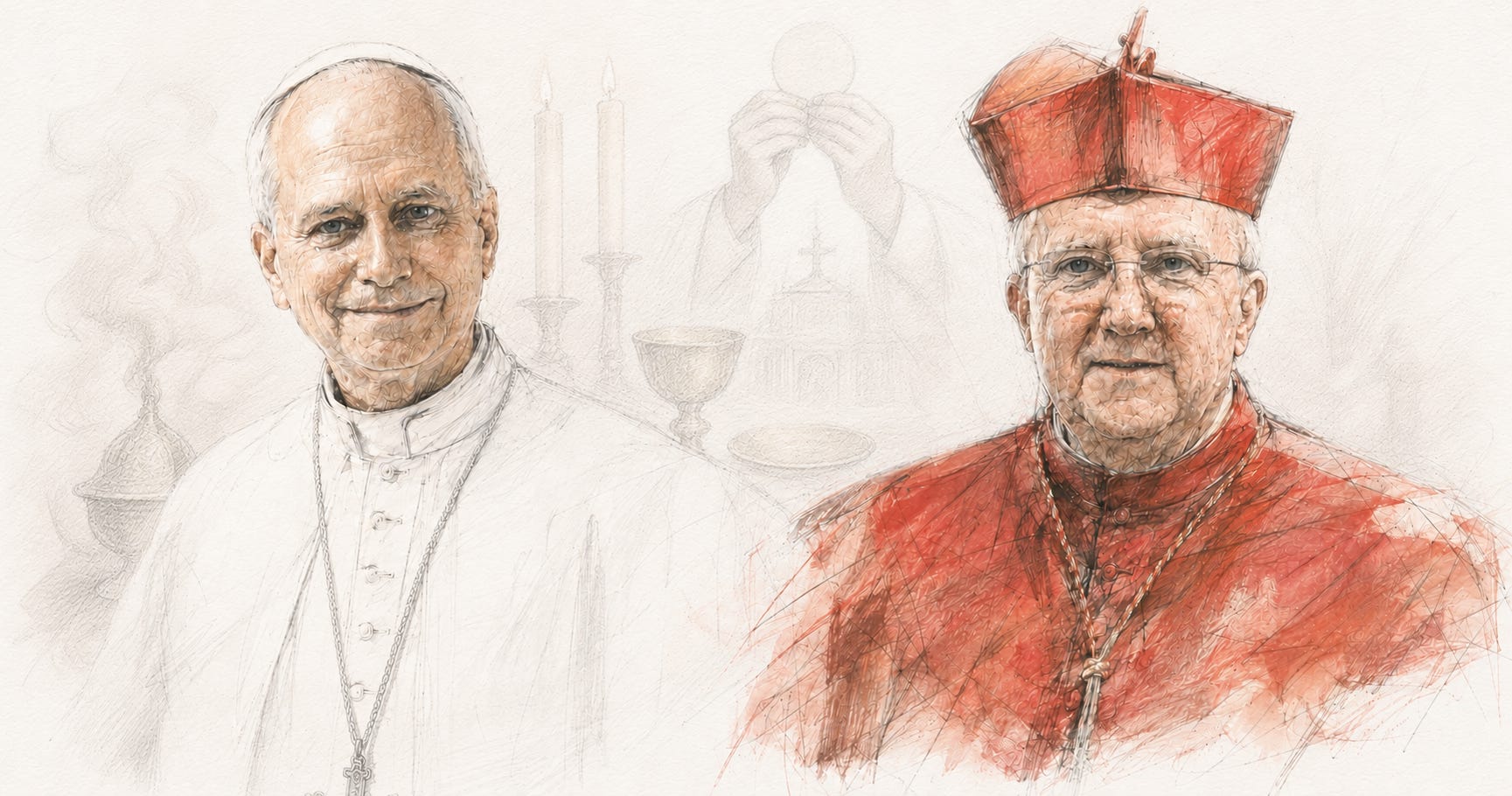
Report: With Leo XIV’s Approval, Roche Shuts the Door on the Ultratraditionalists
A Spanish daily now reports the cardinal’s January liturgy document was commissioned and approved by the pope himself, with “not a single comma” changed. Rome’s direction is unmistakable.

Cardinal Arthur Roche seemingly settled a year of speculation about Pope Leo XIV and the traditional Latin Mass in a single sentence.
“No, Pope Leo is not going to change Traditionis Custodes, and he’s not going back to Summorum Pontificum,” the Vatican’s liturgy chief told The Tablet in an interview published July 29.
Traditionis Custodes is Pope Francis’s 2021 decree restricting the traditional Latin Mass. Summorum Pontificum, Benedict XVI’s 2007 ruling, had given priests wide latitude to celebrate it.
Roche, who has led the Dicastery for Divine Worship since May 2021, grounded the claim in the altar itself. The traditional Latin Mass is “a very complex area,” he said, and an important one, “because the Eucharist is the sacrament of unity: it’s the place where we should all be able to be together to celebrate Mass.”
Four days later, the Spanish daily La Razón went further. Citing anonymous Vatican sources, the paper reported on August 2 that Roche’s consistory document (the one traditionalist media spent the winter dismissing as one man’s crusade) was written at Leo XIV’s request. The pope read it himself, the sources said, and approved it; not one comma changed.
The traditionalist press erupted. Diane Montagna, the movement’s most dogged chronicler, pronounced the report woefully inaccurate; Archbishop Salvatore Cordileone of San Francisco (Leo named him to the Church’s highest court on July 25) went on EWTN to question how well Roche knows the pope’s mind. If the restrictions stand, the archbishop warned, some of the faithful “will then go to these other groups that are not in full communion with the See of Rome.”
He did not need to name the group.
Six decades of war over the Mass
The old Mass has been a battlefield since Paul VI promulgated the reformed liturgy in 1969.
Archbishop Marcel Lefebvre, who rejected the Second Vatican Council’s reforms, built the Society of St. Pius X around the 1962 Missal.
When he consecrated four bishops without papal permission in 1988, Rome declared him excommunicated. Benedict XVI spent years trying to close the breach. He lifted those excommunications in 2009 — two years, as it happened, after his decree Summorum Pontificum gave priests broad freedom to celebrate the old rite without asking their bishops.
Francis judged that experiment a failure. His July 2021 motu proprio Traditionis Custodes found that Benedict’s concession had been raised as a banner against the Council itself, and it handed bishops (and Rome) control over where, and by whom, the 1962 Missal could be used. Roche arrived at the worship office less than two months before the decree landed; he enforced the new rules, then tightened them with rescripts of his own.
Leo inherited the battlefield and said, for more than a year, almost nothing in public. His one extended comment came in September 2025, in an interview with Crux: the liturgy, he lamented, had become “a political tool” in a Church so polarized that “people aren’t willing to listen to one another.”
His actions told the rest. I reported in January that his first consistory deferred every Latin Mass hope while the pope launched a catechesis series calling Vatican II the Church’s “guiding star.”
When the cardinals gathered again in June, he kept the liturgy off the agenda a second time. La Razón’s sources describe that June meeting bluntly: the old rite is a matter “that a vocal minority wants to stir up.”
None of this has made Leo XIV cruel. In March, he sent a message to the French bishops, through Cardinal Pietro Parolin, asking for “concrete solutions” and the “generous inclusion” of Catholics sincerely attached to the Latin Mass.
“It is troubling that a painful wound continues to open within the Church concerning the celebration of the Mass, the very sacrament of unity,” he wrote.
Cardinal Raymond Burke got permission to celebrate the 1962 Missal in St. Peter’s Basilica in October 2025. The superiors of the Fraternity of St. Peter and the Institute of Christ the King (two traditional communities in full communion with Rome) found a warm welcome when they came to see the pope.
The tent at Écône
The Society of St. Pius X tested Leo XIV’s goodwill when they announced plans to consecrate four new bishops without papal approval.
Cardinal Víctor Manuel Fernández warned on May 13 that the ordinations would constitute “a schismatic act.” Leo followed with a June 29 personal letter to the society’s superior general pleading with its members to “please turn back.”
They refused.
On July 1, in a tent outside the society’s seminary in Écône, Switzerland — 38 years to the day after Rome declared Lefebvre excommunicated — Bishop Alfonso de Galarreta consecrated the four men anyway before a crowd of some 15,000 faithful.
The next day the Vatican declared the society’s bishops and priests in schism and excommunicated, and it extended the penalty to any layperson who formally adheres to the group.
No pope had ever gone that far against the society; John Paul II’s 1988 declaration touched only the bishops involved.
If you put the sequence together, the shape of Leo’s pontificate comes into better focus.
A canon lawyer by training, Leo begged the ultratraditionalists to come home, then signed the harshest decree in the society’s history when they marched into schism instead.
He told the French bishops to treat the faithful who love the old rite with generosity. The faction that wields that rite against the Council received a different answer.
The numbers explain the confidence. A 2025 Pew Research Center study found 2 percent of American Catholics claiming weekly Latin Mass attendance; the sociologists Stephen Cranney and Stephen Bullivant, who study the movement closely, put the real Sunday number between 100,000 and 110,000.
The movement’s online megaphone dwarfs the movement.
Unity, in Leo’s mind, has never meant surrender to extremists.
The Eucharist Roche correctly calls “the sacrament of unity” is the same sacrament Leo named in his letter to France. A liturgy conscripted into ideological war has stopped doing what a liturgy is meant to do.
According to Pope Leo XIV, the Second Vatican Council remains the Church’s “guiding star,” whatever the SSPX dissidents decide.
Skeptics note that Roche is beyond retirement age, and that his five-year term expired in May. Therefore, they argue, his words carry little authority.
That doesn’t add up.
If a prefect put words in the pope’s mouth, we would expect an official correction from Rome, and a week later, none has surfaced.
The silence says as much as the interview did.
Leo travels to France next month, where the traditionalist pilgrimage from Paris to Chartres drew roughly 20,000 mostly young walkers this spring.
He will meet them as a father rather than a combatant. The restorationists mistook his patience for weakness, and the excommunication decree makes that painfully clear.
The Church is moving forward, and the pope is holding the door open for everyone willing to walk through it.
At Letters from Leo, we stand with Pope Leo XIV and with every Catholic who believes the Eucharist belongs to the whole people of God rather than to whichever faction shouts loudest.
The schism at Écône was a bid for a smaller and purer Church, one facing permanently backward. Leo answered it with a father’s grief and a shepherd’s firmness.
This community exists to tell that story honestly, free of the rage merchants and the nostalgia trade, rooted instead in the Gospel’s stubborn insistence on communion.
People across this country are hungry for a Catholicism that is neither a museum nor a weapon. That hunger has made this the fastest-growing Catholic community in America. In a Church wounded by six decades of liturgy wars, we choose the wholeness Leo is building.
If you believe this movement matters — Catholics and people of goodwill standing with a pope who moves the Church forward in unity — I am asking you to join us.
If you’d like to invest in our mission, here are three ways you can help during this critical time:
Subscribe as a paid member to receive exclusive posts about the life and formation of Pope Leo and help sustain this newsletter.
Donate with a one-time gift to fuel this project’s mission.
Share this post (and Letters from Leo) with a friend who might enjoy it.
Paid members receive our ongoing biographical series on Pope Leo’s life and formation, our exclusive investigations, and the full Sunday Scripture Reflection Series each week.
Whether you give $0, $5, $50, $500, $1,000, or more, your presence here matters — no matter your faith or your politics.
Thank you for reading. I’ll see you on the road.


I’m a convert— I was Anglo-Catholic priest and chaplain for a quarter century, celebrating ad orientum, careful to ensure my maniple didn’t knock over the chalice, celebrating what was essentially a Tridentine Low Mass in Elizabethan English. That Mass is, I believe, truly a thing of reverent beauty when done well.
Reverent beauty, but not unity. When I left the Episcopal Church and swam the Tiber, I didn’t expect the Catholic Church to adapt to me— I came making the most painful sacrifice of my life, giving up my life as a priest, and placing myself life under obedience to the Holy Father and the Catholic Church.
Do I think that the old rite’s liturgy is more beautiful than the new.? Yes. But my opinions about liturgical esthetics are unimportant. What’s important, no, essential is the cohesion and unity of Christ’s Church.
I now live just outside the Sanctuary of Our Lady of Fátima in Portugal, where I attend daily Mass and Adoration with the faithful from all over Europe, from sub Saharan Africa, from Asia and the Americas. Being among the faithful and devout from all over the world as we share together in receiving Christ’s Body, the ultimate sign of our unity, is a deeply moving thing.
I don't understand why there's so much polarity around this. The Latin Mass is beautiful and always sustained us. Everyone has the translation in the vernacular. It was comprehended by the heart, where the meaning is ascertained, not just by words. So long as the "sermon" is in the vernacular, what's the issue? That Mass's beauty appeals to the senses and lifts them above the mundane into the supersensible, into the Mystery.
Is it about disobedience, a power struggle? Do the traditionalists reject the other teachings of Vatican II?