

Thank you for reading! Letters from Leo is a reader-supported publication and the fastest-growing Catholic community in the country. To receive new posts and support this movement, consider becoming a free or paid subscriber.
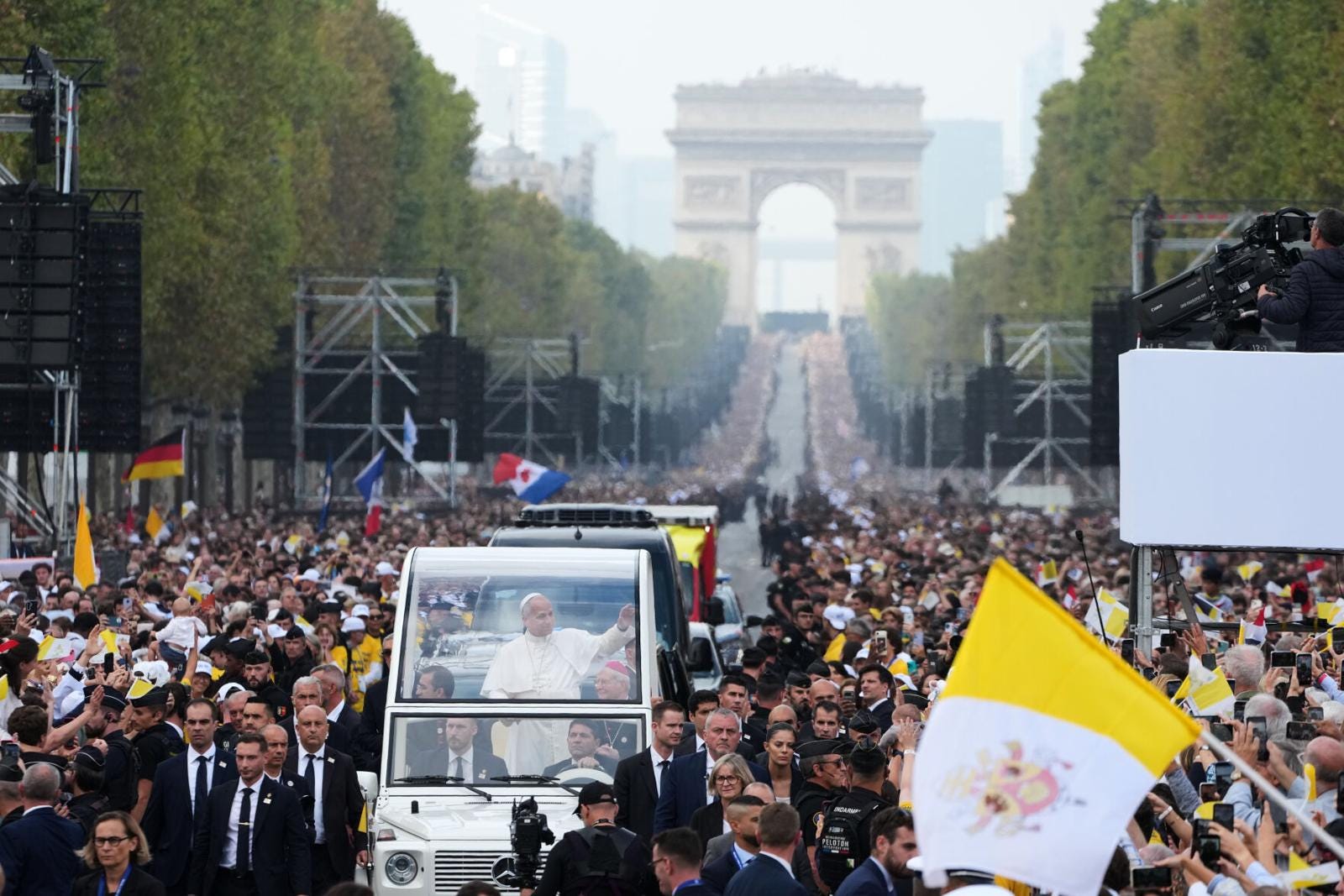
Pope Leo XIV flew home from Metz on Monday night after four days in France, a journey that drew 800,000 people to the Champs-Élysées and carried him from the Élysée Palace to the grotto at Lourdes.
The speeches will get the headlines. The more revealing material came in the margins, in offhand answers on the papal plane and a line in French caught on Emmanuel Macron’s camera.
Here are six things we learned about the man.
1. He reads the news as it breaks
Nvidia unveiled a new AI safety platform on Monday morning, and CEO Jensen Huang spent part of that morning on CNBC’s Squawk Box promoting it.
By that evening, Leo was standing in the aisle of the papal plane, microphone in hand, answering a question about artificial intelligence.
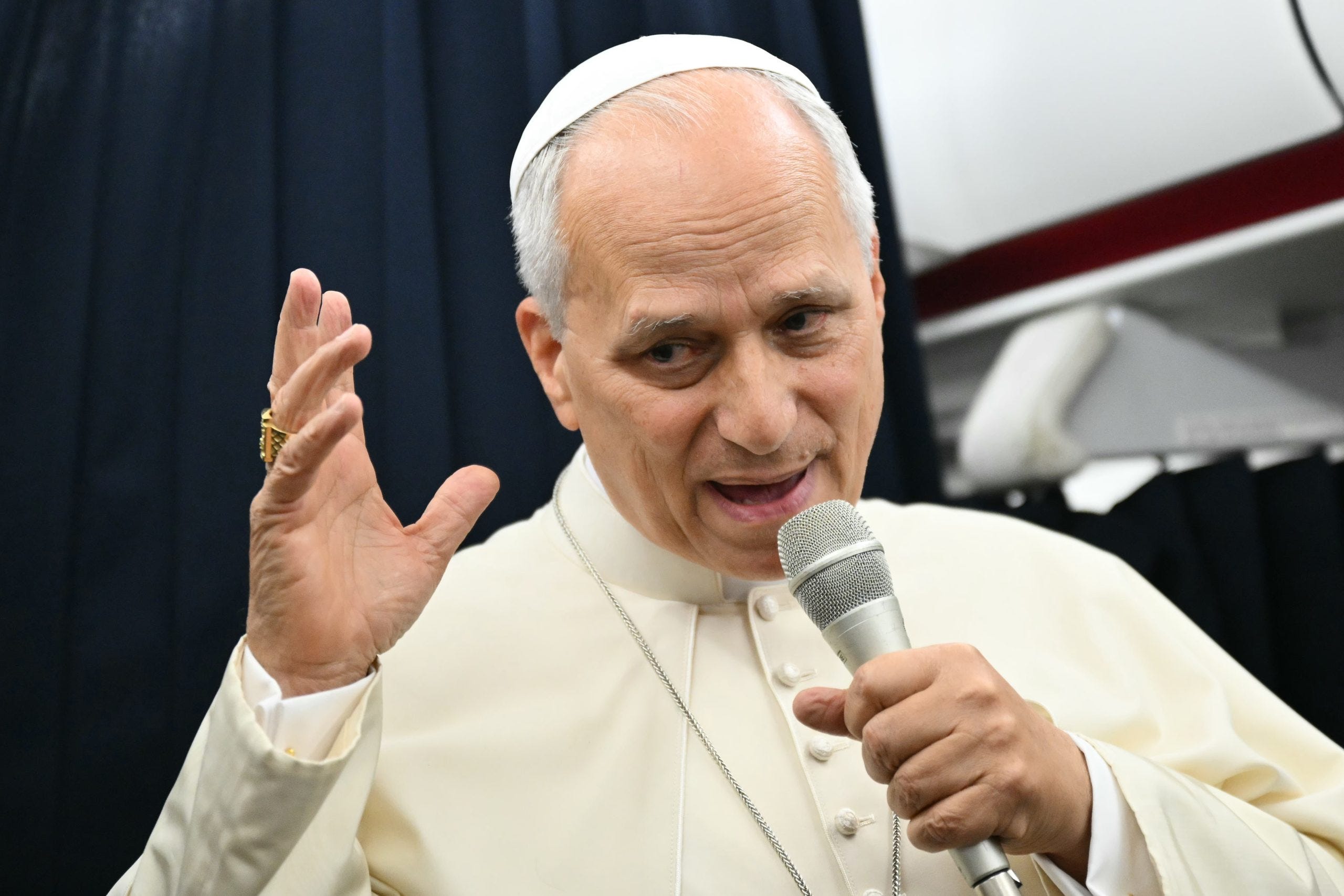
“It’s interesting to note that just today I read that the head of NVIDIA claims that he has found some way of inserting into AI certain guardrails,” Leo told reporters. Huang, he added, is “the same one, however, that says there should be no limits placed and no government regulation.”
Popes have always followed the news. Francis read about migrants drowning off Lampedusa in an Italian newspaper in the summer of 2013, and only weeks after reading the news, on July 8, he stood on the island and said the tragedy had “constantly come back to me like a painful thorn in my heart.”
What sets Leo apart is the way he takes it in. Rome runs six hours ahead of New York, so a pope (he turned 71 this month) rebutting a Silicon Valley product launch on the day it happened is reading on his iPhone between events. His news seems to reach him the way ours reaches us, through a fast, algorithmic feed.
We saw the same thing in April. On April 19, the parents of 168 children killed in the bombing of a school in Minab, Iran, published a letter to Leo that surfaced through Iranian state media and spread mostly on X. Four days later, on the flight home from Africa, Leo told reporters, “I have just seen a letter from families of children who were killed on the first day of the attack.”
My read is that Leo keeps his own window onto the internet, quite possibly an anonymous account he uses to follow the news. To be clear, the Vatican has never said so. Still, a pope who found a Press TV letter within days and an Nvidia launch within hours is getting his news from somewhere beyond the morning briefing.
Put it this way: Leo is tethered to reality day in and day out. He sees the world we see, on the same kind of screen and at the same speed, and he answers it in real time. If the Vatican ever releases his Sunday iPhone screen time report, I suspect the number will be high.
2. The European project is his family’s story
Popes have championed a united Europe since the rubble of 1945, and Leo cited Paul VI’s 1964 decision to name St. Benedict the continent’s patron. Pius XII backed a European federation as early as 1933, when he was still Cardinal Pacelli, and in 1957 he told the Congress of Europe that “the construction of the union is going forward.” His hope was that Europe’s middle-sized nations, none of them superpowers, could hold off tyranny together after fascism and Nazism had crushed them one at a time.
It seems to me that Leo sees something of that in today’s world, where great powers again treat smaller nations as pieces on a board.
During the trip, I told BBC News that many Catholics felt Francis, who understandably spent his energy on the peripheries, “did not do enough to lift up the rise of Catholicism that was happening in Europe.” That choice made sense, since Francis wanted to make sure the Church touched parts of the world it had long overlooked. Leo, I argued, wants to show there really is a vibrant church emerging there.
What I underestimated was how central the European project is to him, and the reason seems to be personal.
In a video Macron posted from Metz, the pope explains, in French, “My father was in Normandy during the Second World War. I grew up with the ideas of Liberation and unification.” Louis Prevost, a U.S. Navy veteran of D-Day, raised a son who now speaks about Europe with the conviction of an heir.
At the Robert Schuman Congress Center that afternoon, Leo called international law and multilateralism “the best antidote to the desire for domination” and asked young Europeans to make “a Europe reconciled, united and strong” their watchword. As I wrote this week, I think that makes him the leader of the free world.
3. He trusts the crowds over the charts
Ryan Burge, the political scientist whose charts have become gospel for anyone tracking American religion, has written that Catholic Mass attendance has dropped by half since 1972 and that the cause is “just generational replacement.” Leo reads the moment differently.
Days after his election, he shared an anecdote with NBC’s Lester Holt about people coming back to church because there was an American pope. France gave him more to point to. The French bishops counted about 13,200 adult baptisms and 8,200 teenage ones at Easter this year, a 20 percent jump from 2025, and 80,000 young people filled the Stade de France to pray with him.
Surveys take years to register what happens in a parish. Something has been stirring beneath the surface of European Catholicism for a while, and Leo went to France to say that he sees it. So do I.
4. His language skills keep getting better
Leo delivered most of his speeches in France in French, and it showed real work. Last fall, word spread that he had returned to Duolingo after a year away. On the flight to Paris, he told reporters he had been practicing his French but no longer uses the app.
Whatever his method, a man who sharpens a language in his seventies has a plastic mind. He already works in Spanish, Italian and Portuguese alongside his native English, and the Church is blessed to have a polyglot pope for a century when so much depends on being understood.
I’ve said before that Leo’s superpower is that he can speak native English and when he does, his words go viral. What I underestimated is how much his willingness to learn and perfect other languages means to people across the globe.
Leo worked hard to speak French well, and per social media reports on the ground, that meant a lot to the French pople.
5. Euthanasia stirs him the way the death penalty does
French lawmakers voted in July to legalize assisted dying. Leo warned against it at the Élysée on his first day, then returned to the subject with far more force at Lourdes. Meeting the sick at the Accueil Notre-Dame, he warned that “medicine must never become the servant of programmed death.”
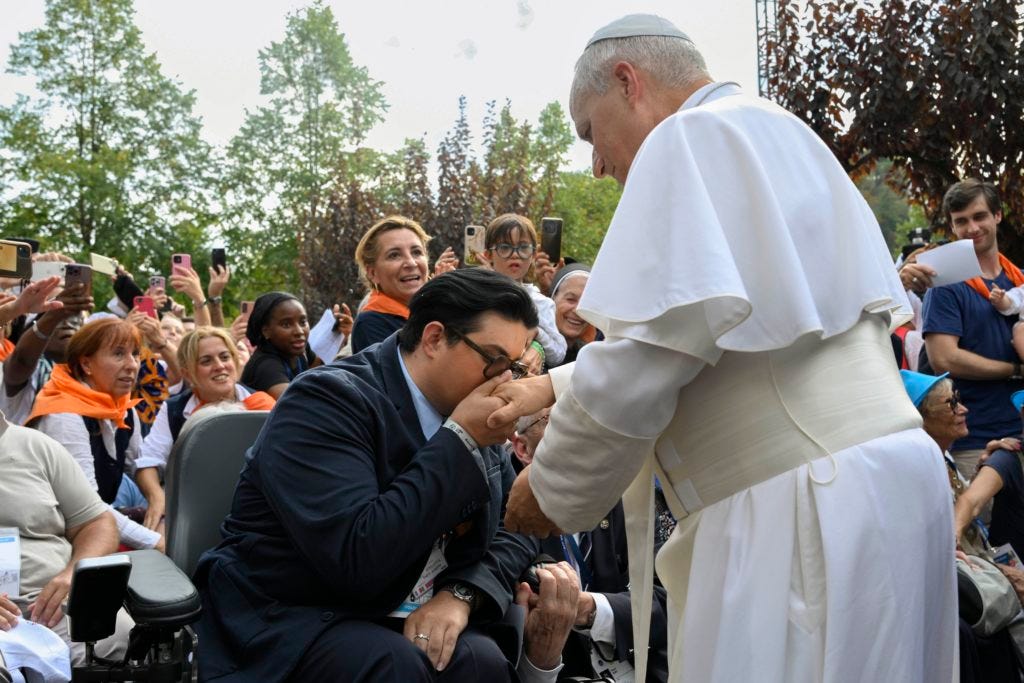
“It is impossible to regard causing death as something normal,” he said. “What is legal is not necessarily moral.”
The passion has a long history. On March 9, 2011, the day Illinois Gov. Pat Quinn signed the state’s death penalty repeal, Robert Prevost, then prior general of the Augustinians, filled out the contact form on the governor’s website. “THANK YOU for your courageous decision,” he wrote. “You have my full support!”
A year ago this week, on Sept. 30, 2025, he told reporters at Castel Gandolfo that someone who opposes abortion but supports the death penalty “is not really pro-life,” and he said the same of the inhuman treatment of immigrants. After France, euthanasia belongs on that list.
The method stood out as much as the message. When Pope Francis called doctors who perform abortions “hitmen” on his flight home from Belgium in 2024, the Belgian government summoned the papal nuncio. Leo pressed France on euthanasia throughout the trip, yet Macron still stood beside him in Metz and posted their exchange to his own X account.
“When the Church speaks about defending life,” Leo said on the plane, “we’re not entering into politics, we’re applying the Gospel to people’s lives.”
6. He is willing to name the far right
The last surprise came at 30,000 feet. Ludwig Ring-Eifel of KNA, the German Catholic news agency, asked Leo about the Church’s decline in Germany and “the astonishing rise of extremist parties.” Earlier this month, the Alternative for Germany took nearly 44 percent of the vote in Saxony-Anhalt.
A cautious pope had easy exits. He could have blamed secularism, or taken a swipe at the Synodal Way, the German reform process that Rome has spent years reining in. Leo chose neither.
He said it would be worth studying “if and how there may be a relationship” involving “the growth of these groups on the far right,” then drew the line himself. The fusion of “these far-right points of view with a certain kind of religion,” he said, is “not an authentic expression of Christianity.”
Early in his pontificate, Leo weighed every political word like a diplomat. In France he took aim at a movement that dresses nationalism in the language of the faith, a movement with plenty of admirers in Washington.
At Letters from Leo, we stand with a pope who reads the same news we do and answers it with the Gospel. He defends the dying patient in a French hospital with the same conviction he once brought to the condemned on Illinois’s death row.
He refuses to let the faith become a costume for nationalism. In a season when powerful men borrow the name of Christ to sell cruelty, that refusal is a gift to every Catholic who wants the Church to be a home for human dignity.
This is the fastest-growing Catholic community in the country because people are hungry for a faith that tells the truth about power and still believes in the common good.
If you believe this movement matters, with Catholics and people of goodwill standing for every human life against the idols of nationalism, I am asking you to join us.
If you’d like to invest in our mission, here are three ways you can help:
Subscribe as a paid member to receive exclusive posts about the life and formation of Pope Leo and help sustain this newsletter.
Donate with a one-time gift to fuel this project’s mission.
Share this post (and Letters from Leo) with a friend who might enjoy it.
Paid subscribers get our series on Pope Leo’s Life & Formation, including the Dolton kitchen table where his father shaped him, along with our reporting on Pope Leo Takes On AI and the Sunday Scripture Reflection Series.
Whether you give $0, $5, $50, $500, $1,000, or more, your presence here matters — no matter your faith or your politics.
Thank you for reading. I’ll see you on the road.

Having a technology and mathematical interest provides a stronger stance to address AI and the inherent challenges. I am glad he tracks the information in real time, so to speak. A rational voice among all the "happy talk" some of us are exposed to in the AI space.
Pope Leo is the greatest Pope in my lifetime (his only fault is that he’s a Chicago White Sox fan, but that’s forgivable).