


Thank you for reading! Letters from Leo is a reader-supported publication and the fastest-growing Catholic community in the country. To receive new posts and support this movement, consider becoming a free or paid subscriber.
Dear friends —
Before you read today’s essay, one important note:
Anyone who purchases a yearly subscription to Letters from Leo or donates $80 or more from this post will receive a free copy of The Private Diary of Pope Francis, the book Cardinal Víctor Manuel Fernández released around the world today.
This offer is available through tonight, Tuesday, November 24, at 11:59 PM PST. We have also extended our offer on Armando Lovera’s From Robert to Pope Leo through the same deadline, for anyone who missed it on Sunday.
We have done this six times now, with Gerard O’Connell and Elisabetta Piqué’s conclave book, Christopher Lamb’s American Hope, Elise Ann Allen’s biography, Leo’s own Freedom Under Grace, NPR’s American Pope, and Lovera’s memoir. Many of you joined this community through those books.
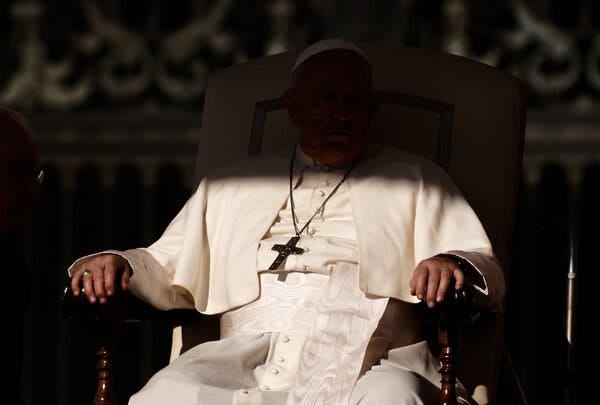
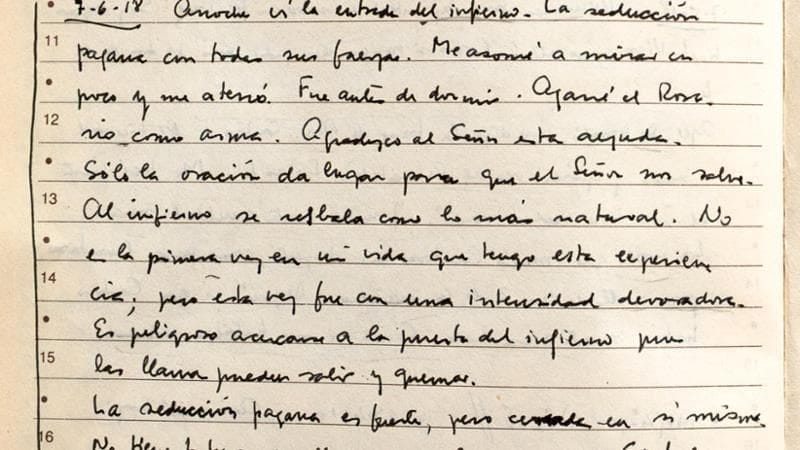
On June 7, 2018, Pope Francis opened his planner and wrote, “Last night I saw the entrance to hell.” He had peeked in, it terrified him, and he grabbed his Rosary “as a weapon.” Five months later, he wrote, “I clearly heard the voice of the devil.”
The next spring, Steve Bannon and Jeffrey Epstein went after Francis by text. In April 2019, Epstein sent Bannon an article titled “Pope Francis or Steve Bannon? Catholics must choose,” and Bannon answered, “Easy choice.”
On June 18, 2019, as I reported in February, Bannon pitched Epstein on a film about Vatican secrets: “Will take down Francis. The Clintons, Xi, Francis, EU — come on brother.” Three weeks later, Epstein was arrested.
The diary never names either man, and Francis tied those entries to the abuse crisis in Chile and to his own hunger for control. Its pages still show what the pope was fighting in private during the years his enemies organized in public.
One afternoon at Casa Santa Marta, Pope Francis showed Cardinal Víctor Manuel Fernández an old agenda book with a leather cover, its pages filled with his small, slanted handwriting. “From this, you will all see,” he said.
Jorge Mario Bergoglio started writing in it on Dec. 20, 1992, the year John Paul II made him an auxiliary bishop of Buenos Aires, using a planner for a year that had nearly run out. He filled 86 pages in Argentina and 55 more as pope. The last entry is dated Aug. 18, 2024, eight months before he died on Easter Monday.
Fernández, the Argentine theologian who leads the Dicastery for the Doctrine of the Faith, published those pages today as The Private Diary of Pope Francis, in five languages across 94 countries.
I spent the past few nights reading it.
The most confidential entries are written in a code that Fernández says he “cannot and should not” decipher, and what survives is the record of a man who spent three decades afraid of what power could do to his soul.
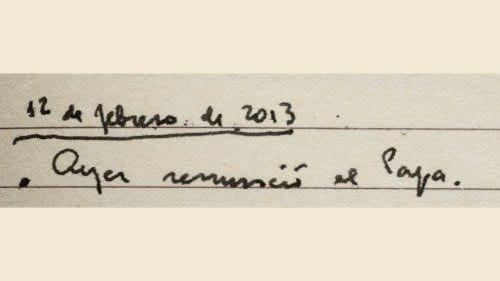
“The temptation he feared most,” Fernández told Elisabetta Piqué in an interview published this morning, was “to feel omnipotent and take the place of the true and only God.”
The puppeteer
The most revealing scene in the book is one Fernández saw for himself. A bishop asked Francis why he had not yet fired a Curia official who had been speaking badly of him in public and pushing a personal agenda at odds with the pope’s.
Francis said nothing. The bishop pressed him: “You’ve kept him on so he can work against you.” The pope’s face went serious.
After what Fernández calls “an interminable silence,” Francis explained that he felt strongly in his heart that God did not want him to become “a puppeteer who uses and manipulates people according to his own convenience.”
The official kept his job.
Francis knew where that temptation could lead, because he had already lived it.
In his first long interview as pope, in 2013, he admitted that as a young Jesuit provincial, “my authoritarian and quick manner of making decisions led me to have serious problems and to be accused of being ultraconservative.”
In 2017, a traditionalist critic writing under a pseudonym published a book titled The Dictator Pope.
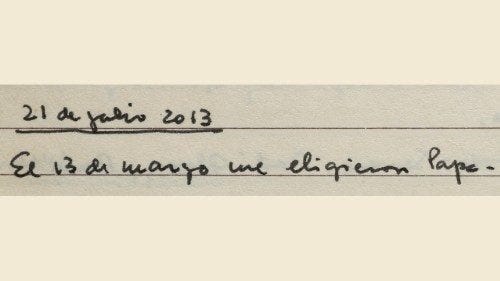
The diary shows a man fighting that temptation through prayer, long before anyone wrote it down. On Jan. 24, 2021, he wrote of “the image of the puppeteer who knows his profession well.” On Dec. 30, 2022, he renounced the role of someone “who uses others like puppets,” and he lamented “the proud, self-sufficient, cynical, self-deceptive Jorge.”
Francis also called papal “majesty” or “glory” the worst spiritual worldliness imaginable, Fernández writes, and he tried to dismantle every symbol of it.
Two years in the dark
That struggle peaked in a crisis that ran from January 2021 to the last day of 2022. An intestinal problem made one week “almost insupportable,” Francis wrote, and in July 2021 surgeons removed 33 centimeters of his colon. In September 2020, he had fired Cardinal Angelo Becciu amid the Vatican’s financial investigation.
“It was all mixed with governance issues, pressure regarding decisions to make, and aridity and desolation,” Francis wrote. Fernández names the deeper wound a “reductive curiosity,” the urge to know what it would be like to be like God, and he describes it plainly as “a temptation connected to power.”
The diary treats that urge as the devil’s own work. On Nov. 25, 2018, Francis confessed to “not knowing how to say ‘no,’ taking on matters and problems as if I’m omnipotent” in the same entry where he heard the devil’s voice.
After the 2018 Chile trip, where he wrongly dismissed abuse victims, he admitted, “It was hard for me to admit what happened in Chile; I didn’t think it was so serious.”
When the darkness lifted, it produced the two documents Fernández says sum up Francis’s final years: C’est la confiance, on trusting God like St. Thérèse of Lisieux, and the encyclical Dilexit Nos.
To guard against relapse, Francis resolved in his last two years to trust his collaborators and to delegate without demanding many explanations.
A Jesuit’s examen
Every page of the diary is Ignatian. Fernández writes that Bergoglio inherited from St. Ignatius of Loyola a concern for the “discernment of spirits,” and the entries read like a Jesuit’s daily examen, sorting the movements of the heart that came from God from those that did not. When Francis called his crisis a time of “aridity and desolation,” he was speaking Ignatius’s own language.
His great temptation follows a path Ignatius mapped in the Spiritual Exercises, where the enemy leads a soul from riches to honor and from honor to pride. Francis gave up riches as a young man, so the fight he recorded at Santa Marta was over the second and third steps.
Antonio Spadaro, the Jesuit who conducted that 2013 interview, read the diary this morning as a record of “the wonder and the smile of God.” The phrase comes straight from its pages.
On Jan. 3, 1999, Francis confessed in chapel that he had fled the Lord’s presence by getting distracted.
“He smiled,” Francis wrote. Twenty years later, on April 28, 2019, he wrote, “I felt the merciful gaze of Jesus and was moved to prayer.”
That gaze is the heart of his motto, miserando atque eligendo (“having had mercy, he chose him”), which comes from St. Bede’s commentary on the calling of Matthew.
Francis kept a copy of Caravaggio’s painting of that scene on his wall at Santa Marta, and the diary returns to the motto again and again. “My whole life was one of miserando atque eligendo,” he wrote on Nov. 28, 1998.
What Leo kept out
Pope Leo XIV is all over this book. Fernández raised the diary with Leo a few weeks after the conclave, and Leo sent him the cardboard box of Bergoglio’s papers. Fernández also recalls Francis describing Robert Prevost as “a great pastor, a generous missionary, and an irreproachable man.”
Leo did more than bless the project. He asked Fernández to cut some confusing passages about living people and to strip out certain surnames. “Clearly, he did not want those paragraphs published,” Fernández told Piqué, adding that Leo has not yet read the final version.
Francis refused to treat the Curia as a puppet theater. Leo brought the same care to the diary itself, keeping people still living out of the line of fire.
A pope who feared a throne
Read against this year’s politics, the book lands hard. Our own president told 60 Minutes this month that he hates some of his enemies and cannot forgive them, even before God. Francis kept a man who worked against him because he feared what firing him would do to his own soul.
The Gospel saw this coming. In the desert, Jesus refused the kingdoms of the world when the devil offered them at the price of worship. Francis spent his papacy taking that refusal seriously.
In his final entry, Francis recalled the times he had seen the devil, and he ended with one plea: “I beg the Virgin to protect and help me.” After that, Fernández writes, he no longer felt the need to add anything.
A reminder: anyone who purchases a yearly subscription to Letters from Leo or donates $80 or more from this post will receive a free copy of The Private Diary of Pope Francis. The offer runs through tonight, Tuesday, November 24, at 11:59 PM PST.
At Letters from Leo, we stand with Pope Francis, who begged God to keep him from becoming a puppeteer, and with Pope Leo XIV, who still guards the people that power would rather use.
Ours is a faith that measures authority by service, and that reads a pope’s fear of his own power as a sign of health. In an age that crowns strongmen, that conviction has become countercultural.
This is the fastest-growing Catholic community in the country because people are hungry for leaders who kneel before they rule. They are tired of a politics that treats enemies as targets, and they want a Church that looks like the one Francis prayed for in the pages of an old planner.
If you believe this movement matters, Catholics and people of goodwill choosing mercy over domination, I am asking you to join us.
If you’d like to invest in our mission, here are three ways you can help:
Subscribe as a paid member to receive exclusive posts about the life and formation of Pope Leo and help sustain this newsletter.
Donate with a one-time gift to fuel this project’s mission.
Share this post (and Letters from Leo) with a friend who might enjoy it.
Paid subscribers receive our full series on Pope Leo’s Life & Formation, our Sunday Scripture Reflection Series, and every investigation we publish, including The Epstein-Bannon Investigation.
Whether you give $0, $5, $50, $500, $1,000, or more, your presence here matters — no matter your faith or your politics.
Thank you for reading. I’ll see you on the road.
