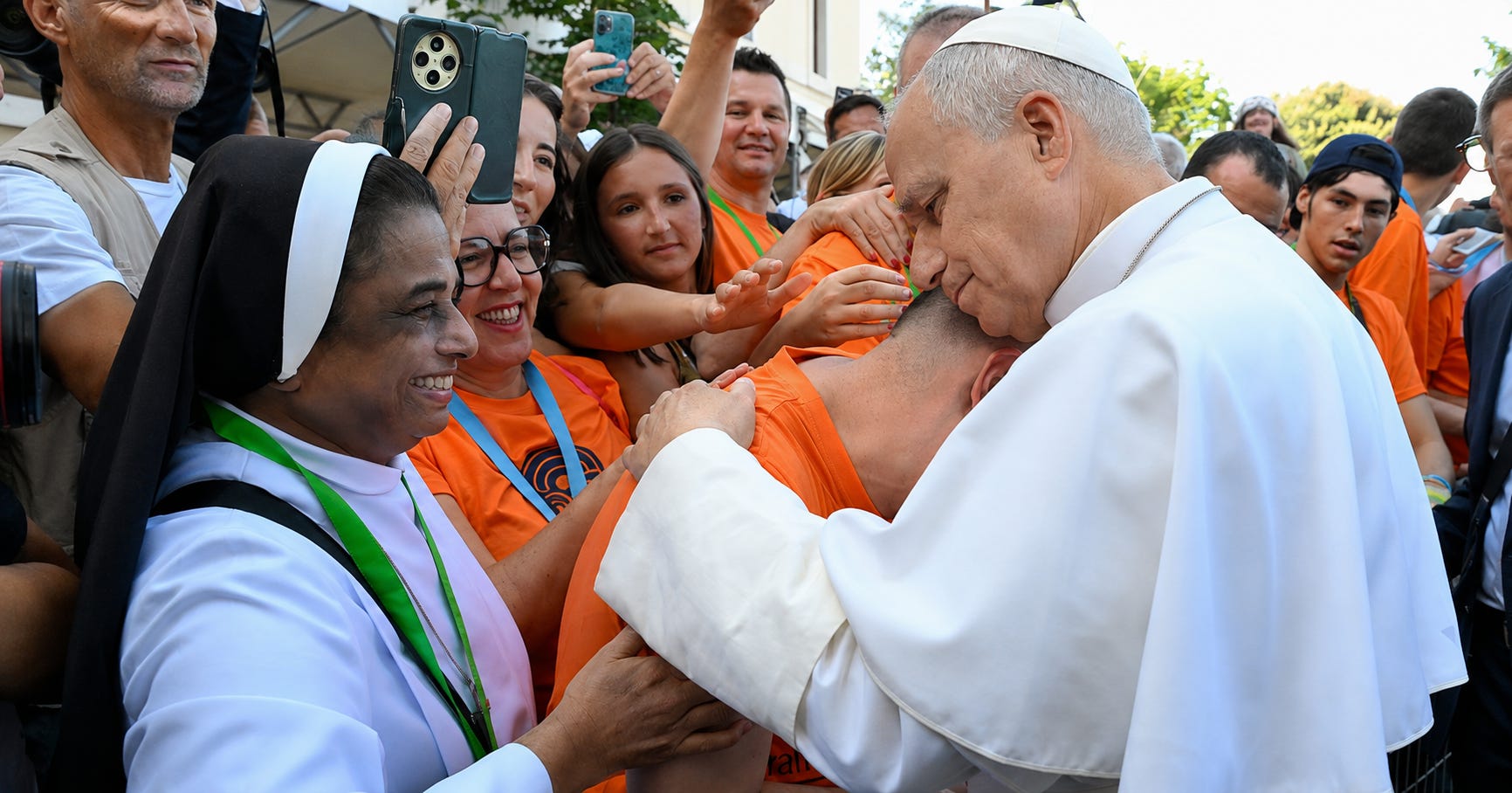
In Assisi, Pope Leo XIV Tells Young People to Tear Down “Walls Built By Prejudice”
The first American pope stood where Francis gathered his first friars 800 years ago and told 2,500 young pilgrims what the Gospel does to walls. In Washington, the walls are winning.

Thank you for reading! Letters from Leo is a reader-supported publication and the fastest-growing Catholic community in the country. To receive new posts and support this movement, consider becoming a free or paid subscriber.
Pope Leo XIV boarded a helicopter at the Vatican just after eight on Thursday morning, landed on a sports field in Assisi half an hour later, and prayed privately inside the Porziuncola, the stone chapel Saint Francis repaired with his own hands eight centuries ago.
When he stepped out to face the crowd in the piazza of Santa Maria degli Angeli, more than 2,000 young people between the ages of 18 and 33, believers and skeptics together, he talked about walls.
“Being witnesses to Christ, therefore, is both captivating and demanding,” the pope told them. “It enlarges our minds and hearts, freeing us from artificial boundaries, from the fears created by misinformation and from walls built by prejudice. Rejecting the culture of power and building a civilization of love are choices that are not immediately understood or accepted.”
The visit closed the GO! Franciscan Youth Meeting, a four-day gathering held during the Holy Year marking 800 years since the death of Saint Francis, on a morning when the Church celebrated the feast of the Transfiguration. The feast suited the occasion better than any planner could have intended: Peter wanted to build three shelters on Tabor and stay up there, and Jesus, having none of it, led him back down the mountain toward the crowds and the road to Jerusalem.
Leo answered questions from three young pilgrims, Karolina of Zagreb, Giovanni of Bologna and Luigi of Paternò, and it was Luigi who asked the hardest one of the morning: how do you keep loving a Church so full of contradictions?
The pope’s answers kept circling back to the barriers people build against one another. “Around Jesus, men and women became brothers and sisters who otherwise would never have met,” he said.
“Whenever this miracle continues to take place in the Church — and thanks to God, it still does — it remains something extraordinary, even in our cities, where so many invisible walls continue to separate people from one another. How many forms of discrimination and inequality disappear the moment we begin to recognize one another as brothers and sisters!”

He also asked the crowd to imagine the same countryside in the thirteenth century, when hundreds of young friars from across Europe camped around Francis in the open air. Quoting the Little Flowers of Saint Francis, he described them “all employed in speaking of God, in prayers, in tears and in exercises of charity, behaving themselves with so great silence and with such sobriety that no clamor was heard there.”
“That silence stands in stark contrast to war,” he said, “with its violence, clamor and cruelty.”
At the Mass that followed inside the Basilica of Santa Maria degli Angeli, Leo turned the gathering’s name into a commission.
“The title of your gathering, Go!, is a mission,” he preached, “a sending forth onto paths for which we have no maps.” He told the crowd to “embrace Sister Poverty!” and, quoting Pope Francis’s Evangelii Gaudium, warned against becoming “that kind of Christian who keeps the Lord’s wounds at arm’s length. Yet Jesus wants us to touch human misery, to touch the suffering flesh of others.”
“Let’s go to the margins,” he said, “where the injustice and arrogance of a few deny the dignity and dreams of many, of far too many sons and daughters of God.”
“Breaking free from the culture of power, and tearing down the walls that separate human beings from one another, is never a betrayal of our families, towns or traditions,” Leo told them. “Instead, it means freeing them from their ghosts, from enemies invented out of fear or ignorance and from the violence with which people seek to impose their own limited order on a reality that surpasses us on every side.”
To trust in God, he said, is to rediscover “a world of brothers and sisters to cherish and serve, not to exploit and dominate. Not a world to defend, but to embrace.” He asked the young people to commit themselves to “the civilization of love,” uniting “the best energies of your magnificent humanity: your studies, skills, work, friendships, love and prayer.”
An American pope cannot say these things abstractly. He said them on August 6, eighty-one years to the day after an American bomb destroyed Hiroshima, with his native country’s deportation campaign fresh from killing two Catholic men six days apart in July.
In Houston on the morning of July 7, an ICE agent shot Lorenzo Salgado Araujo through the abdomen as the 52-year-old drove his construction crew to a job site. The government claimed he “weaponized his vehicle.” The three passengers riding with him dispute that account, no body-camera or dashcam footage of the shooting has surfaced, and Salgado, a man with no criminal record, sponsored for legal status by a son who is a U.S. citizen, is dead.

Six days later, in Biddeford, Maine, an ICE officer fired five shots into a white Kia sedan at 7:17 in the morning. Johan Sebastián Durán Guerrero, a 25-year-old delivery driver with a wife and a young daughter, died at the scene; security footage shows agents handcuffing him after he had been shot in the head. Law enforcement sources told CBS News he was not the target of the operation.
I wrote about both killings when they happened. The American bishops answered on July 20, when the chairmen of their migration and racial-justice committees declared that “acts that diminish or disregard the dignity of any person or group of people should never be normalized in our society.”

Then there is the war. The United States and Israel have been striking Iran since late February; the ceasefire reached in June collapsed last month, when Donald Trump declared it over and reignited the bombing. Iran fired missiles at an American base in Jordan late last month, and the United States retaliated on July 30 with a new wave of heavy strikes; the State Department has since warned Americans across the Middle East. Washington and Tehran opened a new round of talks this week in the shadow of all of it.
Leo has opposed this war from its opening weeks. “On behalf of the Christians of the Middle East, and of all women and men of good will, I appeal to those responsible for this conflict: cease fire!” he said at his March 15 Angelus, mourning attacks “which have struck schools, hospitals and residential areas.” He added a warning the White House has ignored ever since: “Violence can never lead to the justice, stability and peace for which the peoples are waiting.”
Thursday’s address belongs to a pattern I have watched Leo keep all year, in Rome and from afar. On the Fourth of July, America’s 250th birthday, he celebrated Mass on Lampedusa, the Mediterranean island where thousands of migrants have drowned within sight of Europe, and preached that “where there were walls of separation, Christ broke them down.” Last week, he told NBC News that immigrants are one of America’s “greatest wealths.” He keeps carrying this message to new places because no one with the power to act on it has listened yet.
Before leaving the piazza, Leo looked ahead to what this generation of Christians will face. “Increasingly, Christians will be called to become artisans of peace,” he said, “within societies that are tempted to place religion at the service of competing identities.” Saint Francis, he told the crowd, teaches that the radicalism of the Gospel “is the very opposite of fundamentalism.”
He was describing Europe, but those sentences land harder in Washington, where an administration that wraps its raids in Christian language spent last week bombing Iran and defending the agents who killed Lorenzo and Johan. American Catholics should carry those words into the pews this Sunday.
The Porziuncola where Leo prayed on Thursday still stands, sheltered for eight centuries inside a basilica raised for no purpose except to protect it — the same basilica where he celebrated Mass before flying home. From Assisi, the pope asked a generation to build the way Francis built. His own country’s government, funded beyond anything the poor man of Assisi could have dreamed, keeps building the other kind of wall.
At Letters from Leo, we stand with the young people of that piazza and with the families of Lorenzo Salgado Araujo and Johan Sebastián Durán Guerrero. We believe what the pope preached in Assisi: the Gospel frees us from walls built by prejudice, and a civilization of love is worth what it costs to build.
This is the fastest-growing Catholic community in the country because readers are hungry for a faith that refuses to bless cruelty, whether it wears a federal badge in Houston or falls from the sky over Tehran.
If you believe this movement matters — Catholics and people of goodwill standing for human dignity through an age of raids and war — I am asking you to join us.
If you’d like to invest in our mission, here are three ways you can help during this critical time:
Subscribe as a paid member to receive exclusive posts about the life and formation of Pope Leo and help sustain this newsletter.
Donate with a one-time gift to fuel this project’s mission.
Share this post (and Letters from Leo) with a friend who might enjoy it.
Paid subscribers receive the full biographical series on Pope Leo’s life and formation, every installment of the Epstein-Bannon investigation, and the Sunday scripture reflections that carry this community through the week.
Whether you give $0, $5, $50, $500, $1,000, or more, your presence here matters — no matter your faith or your politics.
Thank you for reading. I’ll see you on the road.


What the world needs is peace and justice. Not constant might is right philosophy. Time for all religious leaders to stand together and state their abhorrence of war. Otherwise it’s the same old roller coaster ride.
The leader the world needs right now!
God bless Pope Leo XIV 🙏
