


Thank you for reading! Letters from Leo is a reader-supported publication and the fastest-growing Catholic community in the country. To receive new posts and support this movement, consider becoming a free or paid subscriber.
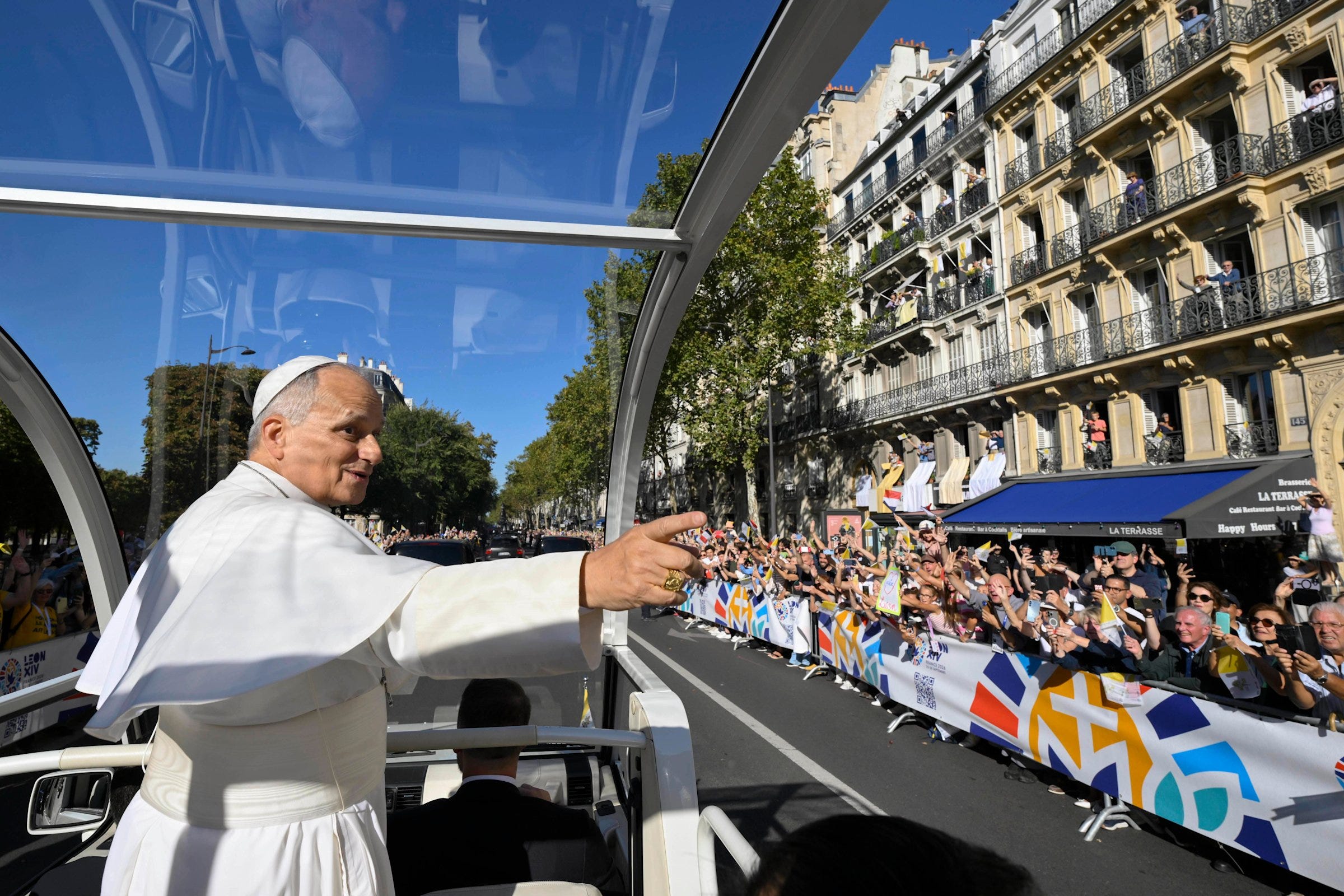
Pope Leo XIV spent his first day in France on Friday moving through crowds that the country’s own statistics say should not exist. Local authorities estimated that 300,000 people lined his route from UNESCO headquarters to Notre-Dame de Paris, where he prayed vespers with about 2,000 bishops, priests, deacons, religious and seminarians beneath vaults that were on fire on live television seven years ago.
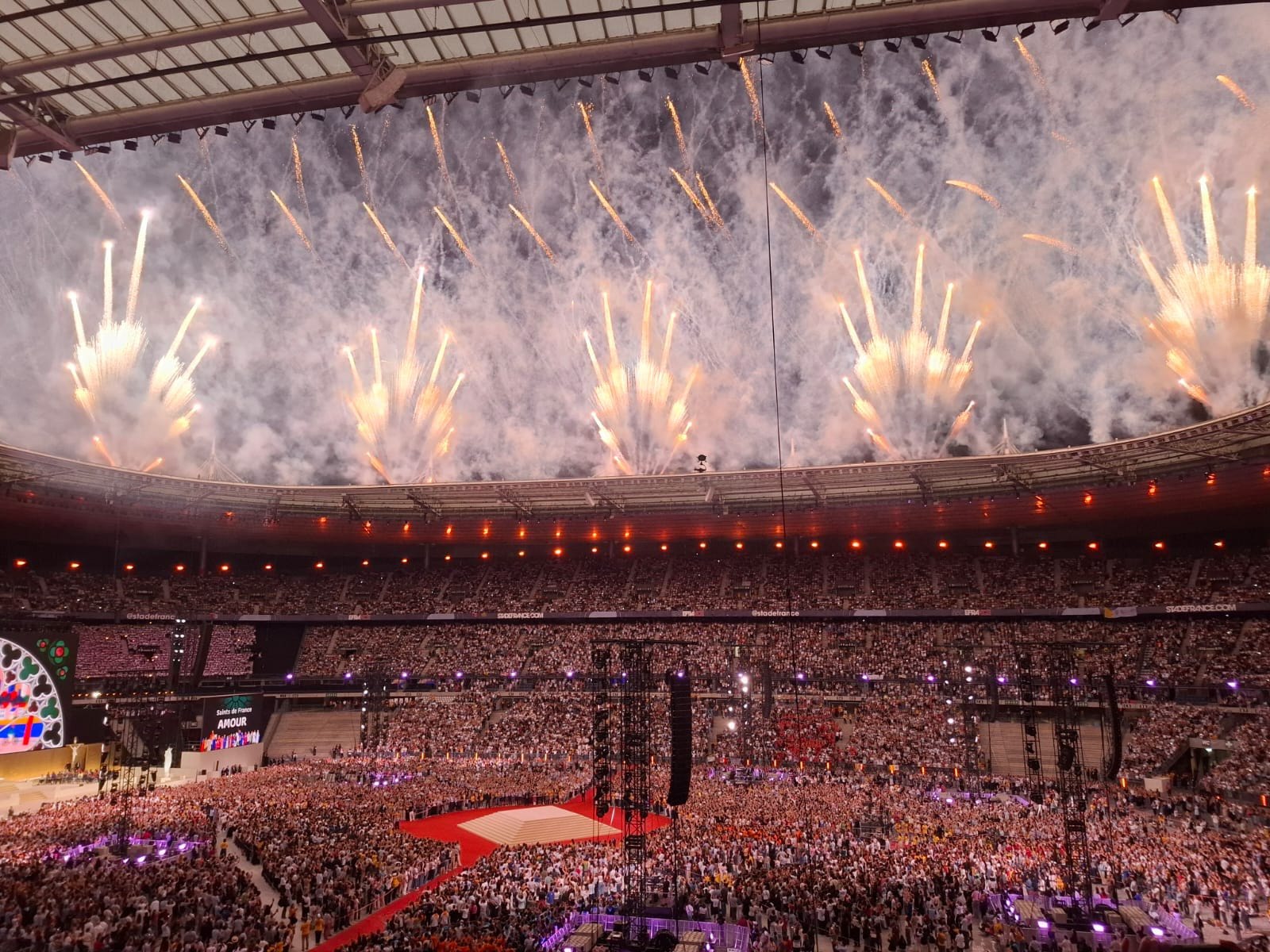
By nightfall he was at the Stade de France in Saint-Denis, where all 80,000 places for the youth vigil were claimed within hours of opening. Nearly 600,000 people registered for Saturday’s Mass on the Champs-Élysées before organizers closed sign-ups on Sept. 16 and widened the security perimeter.
This is France, the republic that invented laïcité and that pollsters rank among the most secular societies on earth. An IFOP survey published last year found that 41 percent of French adults believe in God, and that among the people who still call themselves Catholic, 2 percent go to Mass every Sunday. Leo’s trip is the first papal state visit to the country since Benedict XVI came to Paris and Lourdes in September 2008.
Something is moving underneath those numbers. This past Easter the French bishops recorded more than 13,200 adult baptisms and 8,100 adolescent baptisms, over 21,000 in all, a record for the modern Church in France, and the Archdiocese of Paris alone baptized 786 adults, up from a 2025 figure that had itself been a record. Friday’s crowds are what those baptismal registers look like when they stand up and walk into the street.
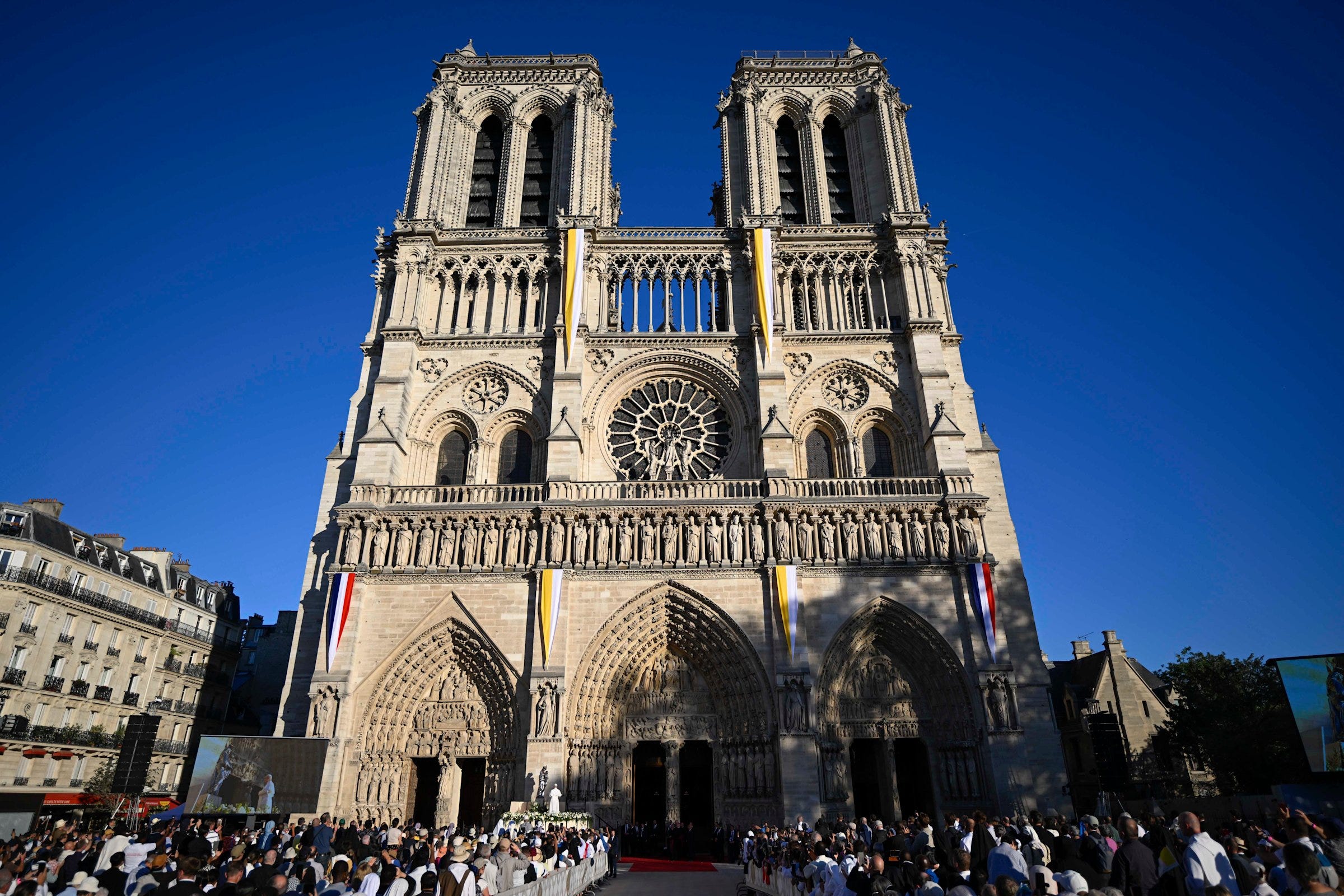
I wrote earlier today about the first half of the day, when the pope addressed Emmanuel Macron and the French political class at the Élysée and then spoke at UNESCO about war and the press. This second dispatch is given over to Leo’s encounters with the Church itself, the clergy gathered in Notre-Dame and the young people who filled Saint-Denis after dark.
“Not a refuge into which we withdraw”
Inside Notre-Dame, Leo preached on the line from Galatians the assembly had just heard, “God sent forth his Son,” and drew from it a definition of the Church that has no room for a fortress.
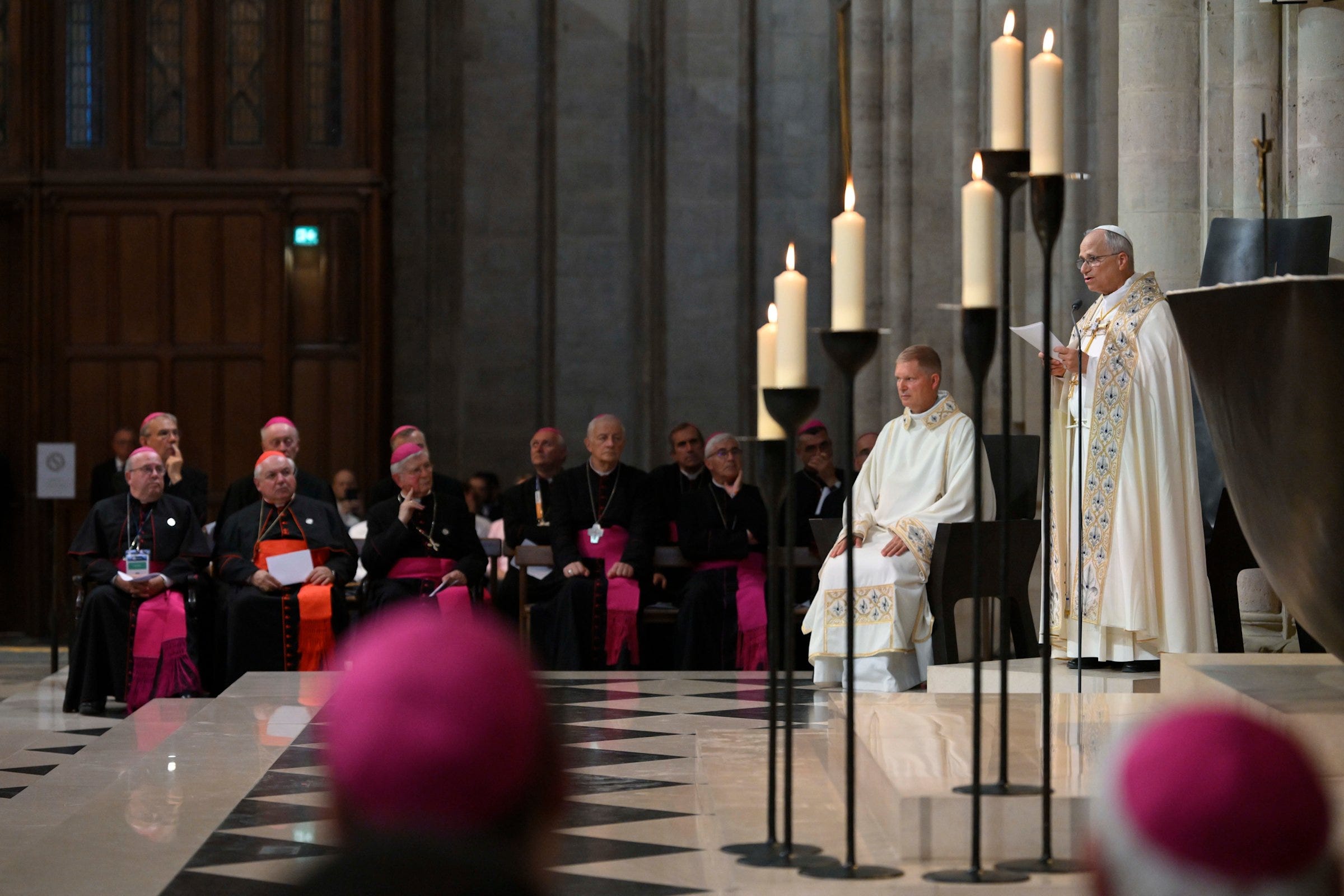
“As disciples of Christ, you know well that the Christian community is not a refuge into which we withdraw in order to protect ourselves from our age. On the contrary, like the cathedrals of old, the Church is a place of welcome, respect, revelation and meaning for everyone.”
He told the bishops and priests to make the missionary conversion of Pope Francis’s Evangelii Gaudium their priority, and he pointed at the building around them as proof of what happens when the Church opens its doors.
The rebuilding, he said, “expanded horizons of welcome and participation beyond the boundaries of ecclesial affiliation.” (The baptismal font now stands at the cathedral’s entrance, which the pope called “a blessing and an invitation.”)
Then he turned to the liturgy. Leo asked the clergy to celebrate Mass “with dignity and reverence, even where smaller communities gather,” and to be “conscious heirs of the Church Fathers and saints” who handed down its beauty. He named the council whose reform of the Mass a small but loud faction of the Church has spent six decades refusing.
“The Second Vatican Council, whose richness owes much to France, gathered up and deepened this heritage in an eminent way, recognizing the liturgy’s central role in the life of the Church. I therefore exhort all of you, bishops, priests, deacons and consecrated persons, to cultivate an authentic love for the liturgy. […] Therefore, place communion with the successor of Peter and with the Church before your personal preferences, so as to foster the unity of God’s people.”
The context for that last sentence sits in the Swiss Valais.
On July 1, the Society of St. Pius X consecrated four bishops at Écône without a papal mandate, two days after Leo had written to the society calling the act “a sin of extreme gravity” and pleading with its leaders, “please turn back!”
The Vatican declared the society’s bishops, priests and formally adherent faithful excommunicated the next day. Two of the four new bishops, Michel Poinsinet de Sivry and Marc Hanappier, are French, as was the society’s founder, Archbishop Marcel Lefebvre, and the country remains the heartland of its resistance to the Council.
So when the pope stood in the cathedral of Paris and asked the French clergy for a reverent Vatican II liturgy and for communion with Peter over preference, he was answering the schism on its home ground, just as he had in June, when he told reporters that the society refuses “various points of the Second Vatican Council” and that “we must move forward.”
“The Lord is not indifferent to us”
At the Stade de France the tone changed. Leo opened by thanking the young people “for your courage, for your presence, for your faith,” and then told 80,000 of them, “You are the saints of France!”
A 25-year-old pharmacology student named Chloé, who organizes adoration nights in the working-class neighborhoods of Île-de-France, asked him how to proclaim Christ in a society that “sometimes even seems to have no regard for the question of God.” Leo accepted her description of the country.
“It is true, as you say, that the society in which we live seems indifferent to God,” he said. “But the Lord is not indifferent to us! This is what matters, and what always gives us hope.” A few sentences later he put it more bluntly: “Humanity goes astray when it claims that God is dead.”
François Bigot, an agronomy student from rural Burgundy, asked how his generation could discern a vocation while “anxiety and uncertainty often undermine the enthusiasm of our youth.”
The pope named screen fatigue, climate anxiety and “the international situation” as the weights his listeners carry, and then he spoke directly to those in the stands weighing priesthood or religious life.
“The Church in France needs you! She prays for you; she awaits you,” he said. “Do not be afraid of this call. Be bold.” He had the whole stadium say the words with him: “Here I am, Lord!”
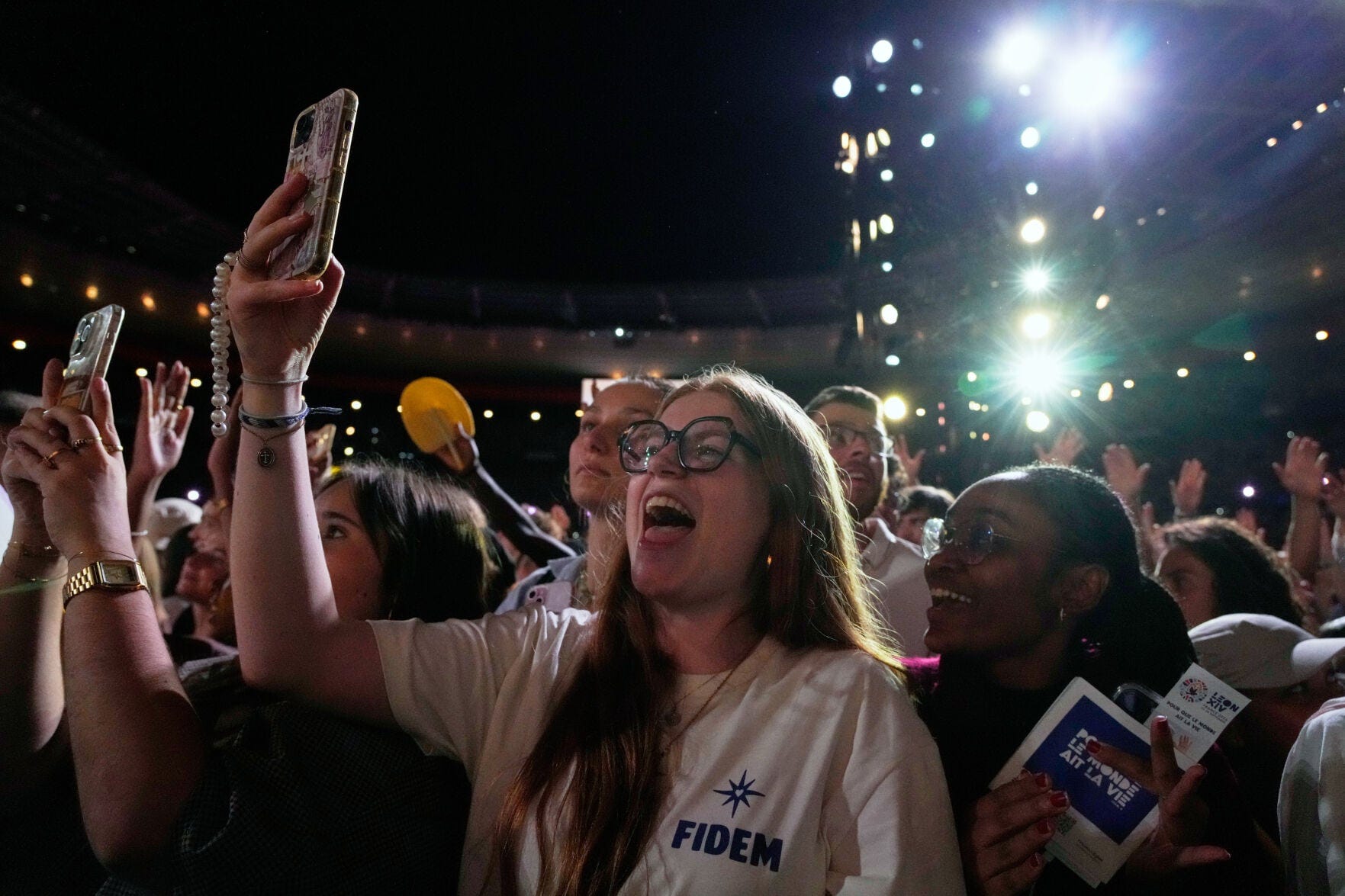
Near the end of the night, after the fireworks, the stadium sang the Salve Regina. Readers who know me only through my politics may not expect this, but in the liturgy I consider myself a traditional Catholic like so many of my millennial peers.
So I will admit that I was moved to tears hearing 80,000 children of God sing the ancient hymn to Mary, in Latin, words that reach back to the eleventh century.
The Salve Regina is the hymn the Church sings at Compline, the last prayer of the day, and it comes right after the words we say before sleep: “Protect us, Lord, as we stay awake; watch over us as we sleep, that awake, we may keep watch with Christ, and asleep, rest in his peace.”
That is what a stadium in Saint-Denis sounded like on Friday night. Eighty thousand young people in secular France, keeping watch with Christ.
An altar at the center, a font at the door
Read the two addresses together and the argument of the day comes into focus. The traditionalists who walked out in July wanted a Church walled off from the modern world, and on Friday the pope told the clergy of France that no such Church exists in the Gospel.
In Saint-Denis, meanwhile, young Catholics who live in one of the most secular societies in Europe have chosen, in record numbers, to be baptized into it anyway.
Leo’s answer to both was the building he had just left: an altar at the center and a font at the threshold, with the doors open to the 300,000 outside. On Saturday that Church will fill the Champs-Élysées, and six young people with Down syndrome will serve at the altar.
At Letters from Leo, we stand with the saints of France and with the 21,000 people baptized there this Easter, alongside the countless others of goodwill who refuse to believe that the age of faith is behind us.
A pope from Chicago walked into one of the most secular capitals in the West on Friday and 300,000 people came out to meet him, which tells you something about what people are hungry for.
They are hungry for a Church that will not hide from its age, and that can look at a stadium full of anxious young people and tell them, “Be bold.” That hunger is why this community has become the fastest-growing Catholic movement in the country.
If you believe this movement matters — Catholics and people of goodwill standing for a Church that goes out into the world rather than retreating from it — I am asking you to join us.
If you’d like to invest in our mission, here are three ways you can help:
Subscribe as a paid member to receive exclusive posts about the life and formation of Pope Leo and help sustain this newsletter.
Donate with a one-time gift to fuel this project’s mission.
Share this post (and Letters from Leo) with a friend who might enjoy it.
Paid subscribers receive our biographical series on Pope Leo’s life and formation, our exclusive investigations, and the Sunday Scripture Reflection Series.
Whether you give $0, $5, $50, $500, $1,000, or more, your presence here matters — no matter your faith or your politics.
Thank you for reading. I’ll see you on the road.

It makes me weep with an I don’t know feeling of the presence of holy mystery and humanity - and using the hours of the day, vespers, compline.
Yes “be bold”
People are thirsting for spiritual fulfillment. They are starving inside amid relative plenty. Pope Leo XIV seeks to implant the reach for the sacred within the rising generation. The sincerity is paying off.