


Thank you for reading! Letters from Leo is a reader-supported publication and the fastest-growing Catholic community in the country. To receive new posts and support this movement, consider becoming a free or paid subscriber.
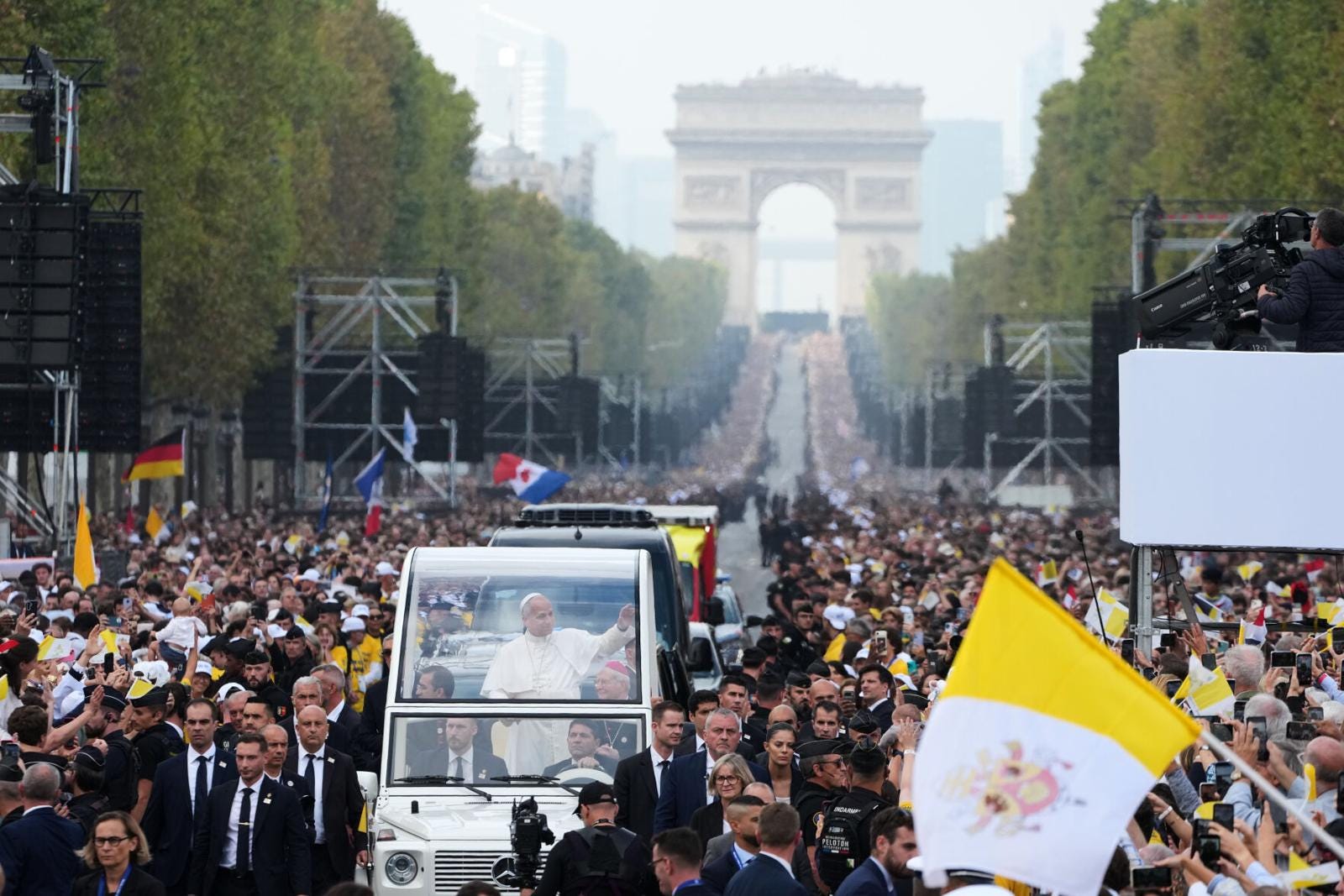
Pope Leo XIV rode down the Champs-Élysées on Saturday morning with the Arc de Triomphe at his back, and Paris came out to meet him.
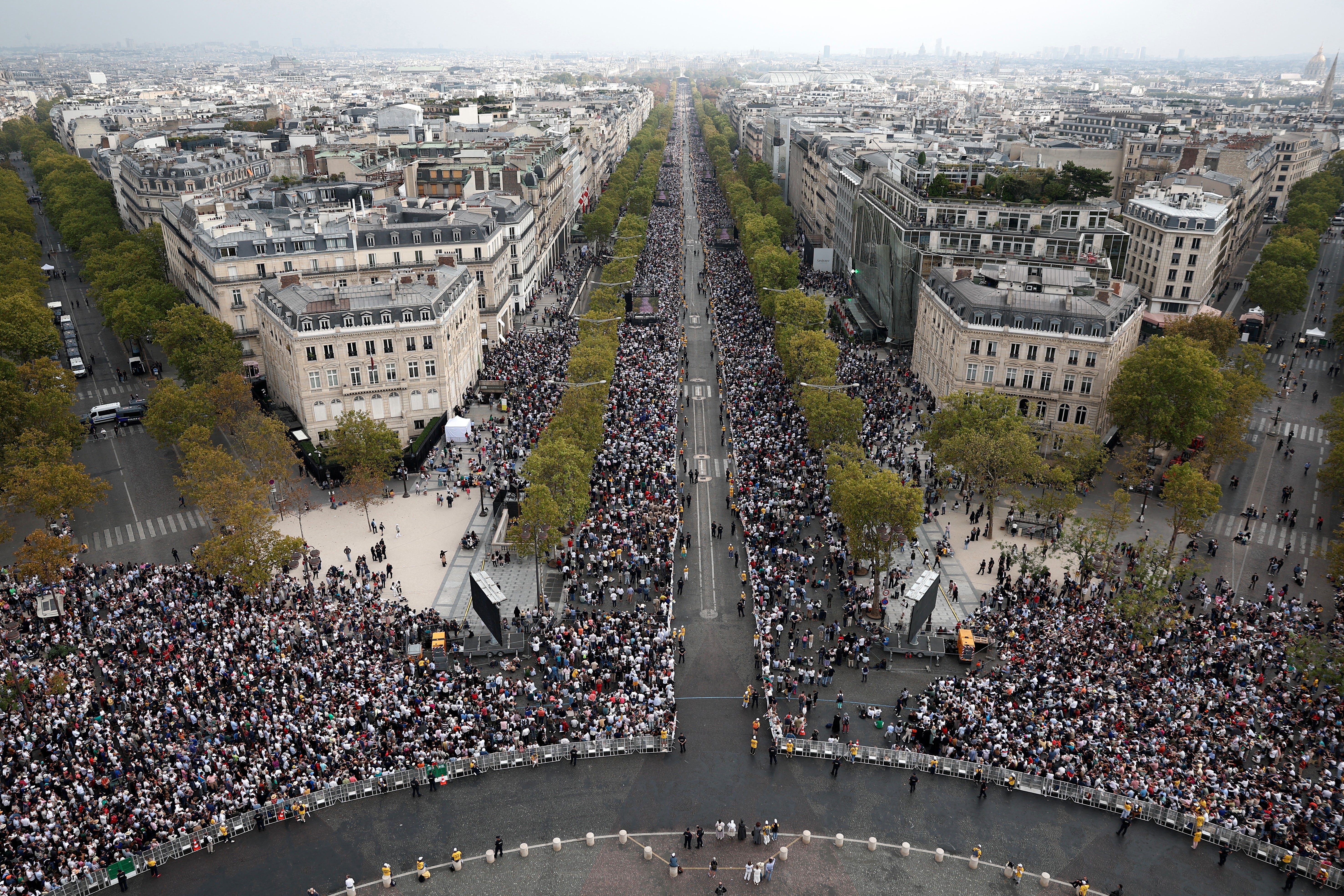
The Vatican put the crowd at 800,000, roughly 200,000 more people than had registered for his Mass at the Place de la Concorde. The popemobile stopped again and again along the route so he could bless babies, children, and people with disabilities lifted up to him.
CNN’s Melissa Bell, reporting from the avenue, said the crowd ran “all the way up the Champs-Élysées towards the Etoile.” A Catholic Arena video of that morning spread across social media over the weekend, and one minute of it shows why.
The welcome had been building since Friday, when an estimated 300,000 people lined his route to Notre-Dame and some 80,000 young people filled the Stade de France that night to pray with him. No other American alive could draw crowds like that in a country as secular as France.
On Saturday evening, I posted the modern-day pieta of him holding a young girl with special needs on X with the caption: “The leader of the free world.” Nearly half a million people saw it, and it drew a lot of attention, both positive and negative. I stand by it, and I don’t mean it as a figure of speech.


The phrase has a history worth knowing. “Free world” entered wide use in 1940, after Hitler’s armies overran Belgium, the Netherlands, and France, as a name for the democracies still standing against him. Franklin Roosevelt used it in 1941 while asking Congress to arm them.
During the Cold War, Americans handed “leader of the free world” to their presidents, because Washington held the alliance together. The title always followed the work, though. In 2016, commentators gave it to Angela Merkel (who waved it away) once they doubted an American president would keep doing that job.
It was never a political word. It was moral in its dimensions.
Our government has since walked away from much of that work. The State Department announced in July 2025 that the United States would quit UNESCO, for the third time in the agency’s history, effective at the end of this year.
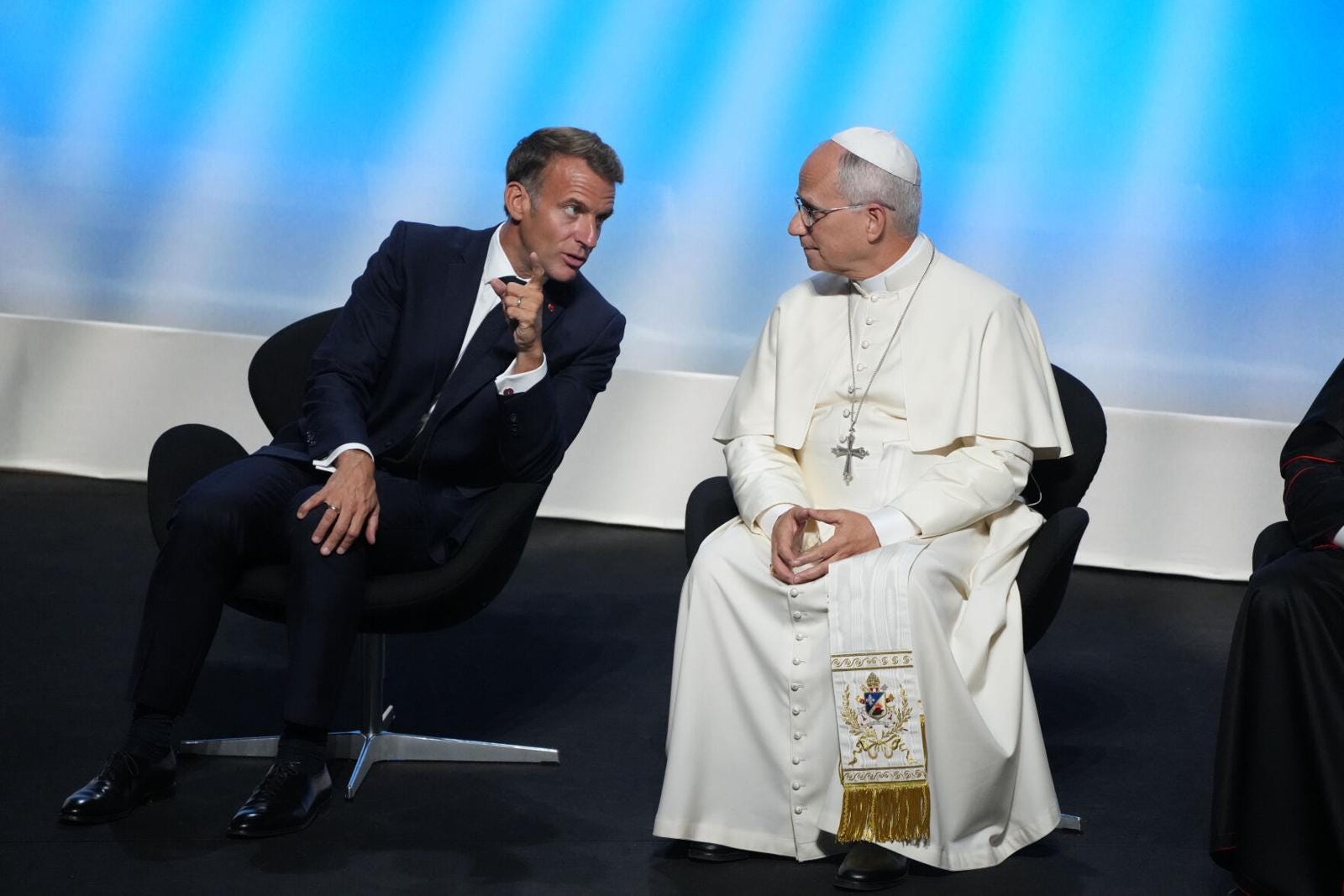
On Sept. 25, the American pope stood at UNESCO headquarters in Paris and defended the multilateral institutions his home country is leaving. No one appointed him to the vacancy, and he stepped into it anyway.
Leo knows what the free world cost. His father, Louis Marius Prevost, was a young Navy officer who served as executive officer of a tank landing ship and took part in the D-Day landings at Normandy on June 6, 1944.
That August, he joined the Allied landings in southern France, and I wrote in June about the quiet D-Day father who kept his son on the road to the priesthood.
As a young man, I first came to understand Normandy, and all its power, through Andy Rooney’s famous monologue at the end of 60 Minutes in 2004. His words still ring in my ears:
“If you think the world is selfish and rotten, go to the cemetery at Colleville-sur-Mer overlooking Omaha Beach. See what one group of men did for another on D-Day, June 6th, 1944.”
In Metz on Monday, the son spoke about that inheritance himself. French President Emmanuel Macron posted the moment on X.
“My father was in Normandy during the Second World War,” Leo said. “I grew up with the ideas of Liberation and unification.” He told his hosts he was glad “to help promote a strong and united Europe.”
He meant it as a program and a priority for his pontificate.
Metz sits in Lorraine, a region France and Germany fought over for generations, and Robert Schuman, the devout Catholic statesman who helped found the European project after the war, made his home just outside the city. Leo spoke at the convention center that carries Schuman’s name.
“Today, sadly, war has returned, even to Europe,” he told the religious and civic leaders there, calling it “a new ‘senseless slaughter,’ claiming countless civilian lives every day.” Dialogue and multilateralism, he said, “remain the best antidote to the desire for domination, which lies at the root of every conflict.”
At Mass in Metz Cathedral, he spoke to the children of a land “torn apart in the past by fratricidal conflicts.”
“It is not true that those who seek revenge are stronger than those who forgive,” he told them. A sentence like that, from the son of a D-Day sailor, is the moral case for the free world in miniature.
Robert Prevost has been pope for not quite seventeen months. His four days in France took him from the Élysée and UNESCO to the grotto at Lourdes, then east to Metz, where he asked a continent to hold together.
At the Élysée on Friday, he reminded France that liberty, equality, and fraternity “are not simply words emblazoned on the front of your public buildings; they refer to universal ethical imperatives.” That is a bold thing for an American, much less a pope of the universal Catholic Church, to say inside the French president’s own palace.
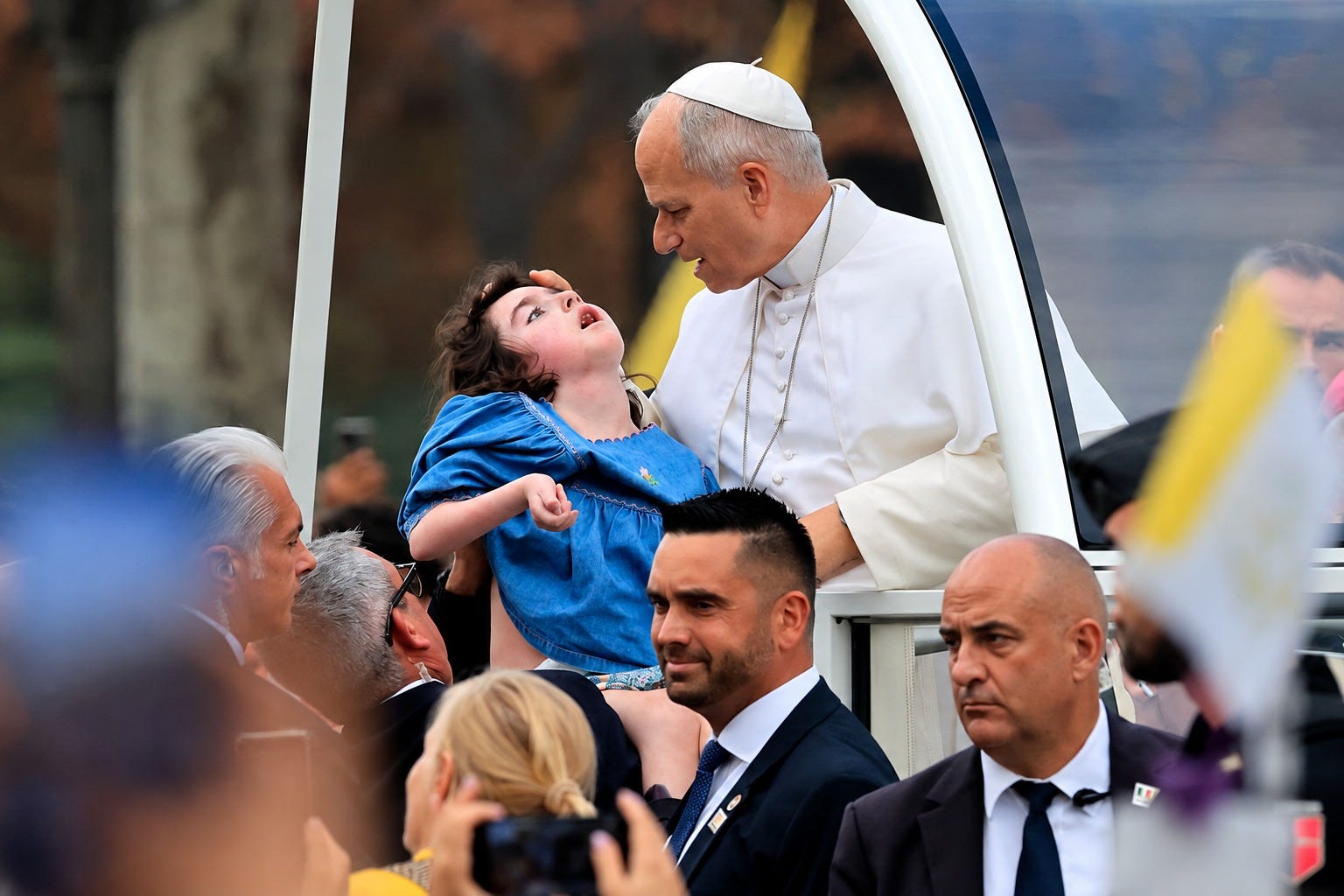
I have stared at this photograph more times than I can count over the past few days. Every time, I look at the man in the white cassock and say, with gut instinct and intellectual certainty both, Tu es Petrus.
You are Peter, and upon this rock Christ builds the Church.
Catholics believe the pope is the vicar of Christ, the Successor of Peter who acts and ministers in Jesus’s name.
With every passing day, this 71-year-old American, born Robert Francis Prevost, reminds me of Jesus. Then again, I guess that’s the point.
It is rare that I share a Wall Street Journal op-ed with you, but Gerard Baker, the paper’s editor at large, and I agree here:
He is the one man in the world most of us can look up to. Everywhere we look, we are led by a cartoon parade of the grotesque, the inept, the forgettable: political leaders of towering vanity and vapidity, a business leadership class that helps itself to greater riches even as it gets preachier with the rest of us, influencers and pop stars and celebrities, a galloping gallimaufry of narcissistic nobodies all desperately squeezing their last little crumb of manna from us.
Baker has no patience for the pope’s detractors at home either:
God knows, this pope has his critics. Nowhere more so than in his own land (as Jesus could have told him, that’s usually the way). In keeping with the simplistic tropes in which much American political discourse is now conducted, he is decried as “woke,” “liberal,” even a “communist.” It says a terrifying amount about what has happened to the American right that this man who urges governments to respect the sanctity of human life, desist from war, and observe the Christian gospel of charity for all is viewed as merely a lefty Chicago pol.
After recounting Peter Thiel’s charge that Leo is a “useful idiot” for the Chinese Communist Party, Baker closes this way:
I laughed out loud when I heard that. I thought about all those who had denounced the popes and the church they headed before him: the sans culottes, the guillotinists, the tricoteuses; all the rationalists, the Marxists, the humanists. I suspect popes will be inspiring men and women to simple human goodness long after our politicians and the tech oligarchs who seek to rule us have given up trying to perfect whatever it is they were put on earth to do.
It is one of the most beautiful pieces of writing about the office of the papacy, and about Leo himself, that I have ever read.
Some readers will object that a pope commands no army. The free world was never only an army, though. At its best it was a promise that free peoples would stand together for human dignity, and right now the man keeping that promise wears white.
Catholics in this country carry a particular duty here. You and I are called to widen the free world as well as defend it, and that work happens every day, in our parishes and at the ballot box five weeks from now. So let’s fight for it, and let’s honor Leo and the faith he leads by doing it.
Later, I’ll bring you a rundown of the new things we learned about Leo on this trip. For now, I simply want to give thanks for his journey to France and for the gift of his pontificate.
At Letters from Leo, we stand with Pope Leo XIV and with every Catholic, and every person of goodwill, who believes that the freedom our grandparents bled for on the beaches of Normandy belongs to the whole human family.
That freedom was never a possession to hoard. It was built on the dignity of every person made in the image of God, and it survives only when people choose each other across borders, the way France and Germany did in Metz when Robert Schuman turned old enemies into neighbors.
This is the fastest-growing Catholic community in the country because people are hungry for a Church that shows up for the common good. They see it in an American pope blessing a child on the Champs-Élysées, and they want to be part of it.
If you believe this movement matters, Catholics and people of goodwill standing together for human dignity and a world that stays free, I am asking you to join us.
If you’d like to invest in our mission, here are three ways you can help:
Subscribe as a paid member to receive exclusive posts about the life and formation of Pope Leo and help sustain this newsletter.
Donate with a one-time gift to fuel this project’s mission.
Share this post (and Letters from Leo) with a friend who might enjoy it.
Paid subscribers get our series on Pope Leo’s Life & Formation, including the story of the D-Day father who shaped him, along with our Sunday Scripture Reflection Series and the investigations you won’t read anywhere else.
Whether you give $0, $5, $50, $500, $1,000, or more, your presence here matters — no matter your faith or your politics.
Thank you for reading. I’ll see you on the road.

I had seen the picture of Pope Leo and Marie-Garance Noël (the 11-year-old girl with special needs) before I saw it here, but it is here, while reading this magnificent article, that I really looked at the picture -- and I wept. This is no politician kissing a baby; this is the pastor of the Universal Church being the face of Christ for one of his most precious children. They are in the midst of thousands of people, but for Leo there is only Maria-Garance, and for her, there is only Leo. This is what it means to be the Vicar of Christ.
I too cried when seeing this magnificent simple picture and said a small prayer for our Pope and all the special needs children on this earth. Let us care for them, love them, and help them through life, as they can speak volumes to all of us.