


Thank you for reading! Letters from Leo is a reader-supported publication and the fastest-growing Catholic community in the country. To receive new posts and support this movement, consider becoming a free or paid subscriber.
Dear friends —
Before you read today’s essay, one important note:
Anyone who purchases a yearly subscription to Letters from Leo or donates $80 or more from this post will receive a free copy of Armando Jesús Lovera Vásquez’s From Robert to Pope Leo: Our Friendship, His Mission, the memoir of the man Pope Leo XIV calls a soul friend.
This offer is available through Sunday, November 22, at 11:59 PM PST.
We have done this five times now, with Gerard O’Connell and Elisabetta Piqué’s conclave book, Christopher Lamb’s American Hope, Elise Ann Allen’s biography, Leo’s own Freedom Under Grace, and NPR’s American Pope. Many of you joined this community through those books. You can read the story of Lovera’s friendship with the pope here.
John F. Kennedy heard his last Mass in Washington at Holy Trinity Church in Georgetown on Nov. 1, 1963, the Feast of All Saints. He had walked to that parish from his Georgetown home in the years before the White House, and he went to Mass there on the morning of his inauguration.
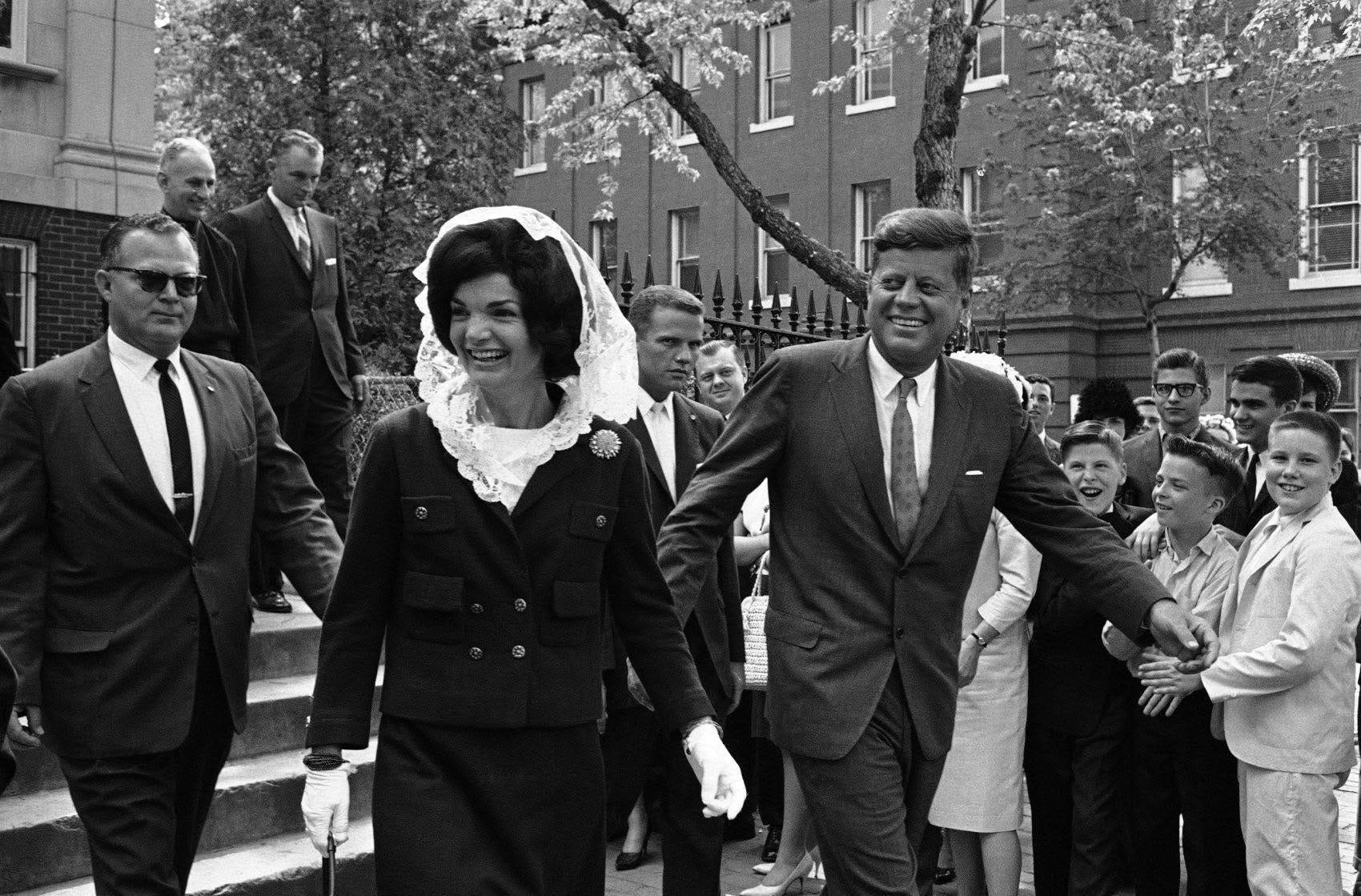
His final Sundays took him out of the capital. On Nov. 10, the president brought Jacqueline and the children to St. Stephen the Martyr in Middleburg, Virginia, a country parish finished with him in mind. A week later, on Nov. 17, he knelt at St. Ann Catholic Church in West Palm Beach, Florida.
Five days after that, he was dead in Dallas.
Sixty-three years ago today, on a Friday in late November, the country lost its first Catholic president. Over the next four days, Americans who had spent the 1960 campaign asking whether a Catholic could be trusted with the presidency watched his Church bury him, one rite at a time, on live television. For many of them it was the first Mass they had ever seen.
In New Orleans that afternoon, a local television crew found a Catholic nun and her schoolgirls trying to absorb the news.
A prayer in Fort Worth
The last public prayer offered in Kennedy’s presence came over breakfast. In the ballroom of the Hotel Texas in Fort Worth on the morning of Nov. 22, Chamber of Commerce president Raymond Buck introduced Monsignor Vincent J. Wolf, a local Catholic pastor, to give the invocation.
A Fort Worth Star-Telegram photographer caught the head table at prayer, with the president bowed beside Vice President Lyndon Johnson, Lady Bird Johnson, and Gov. John Connally and his wife, Nellie. Jacqueline Kennedy had not yet come down to the ballroom; she made her entrance later in the program. Less than two hours after the breakfast, the motorcade turned onto Elm Street in Dallas.
The last rites at Parkland
Father Oscar Huber, a Vincentian from Perryville, Missouri, was pastor of a different Holy Trinity, the parish of that name in Dallas. He had walked a few blocks from his rectory that morning to watch the president pass. His associate, Father James Thompson, saw the news of the shooting on television, and the two priests drove to Parkland Memorial Hospital.
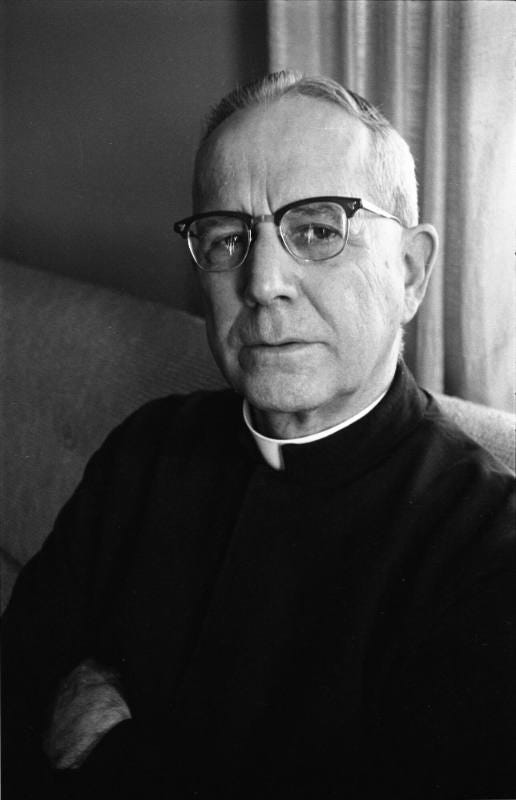
By the time Huber reached the emergency room, there was nothing left for the doctors to do. He drew back the sheet from Kennedy’s face, anointed his forehead with oil, and gave the Church’s absolution and extreme unction conditionally (the form a priest uses when he cannot know whether the soul has already left the body).
The words were Latin.
Mrs. Kennedy and the others in the room joined him in the Our Father and the Hail Mary.
Huber later told the National Catholic Welfare Conference’s news service that the first lady “graciously thanked me and asked me to pray for the president.”
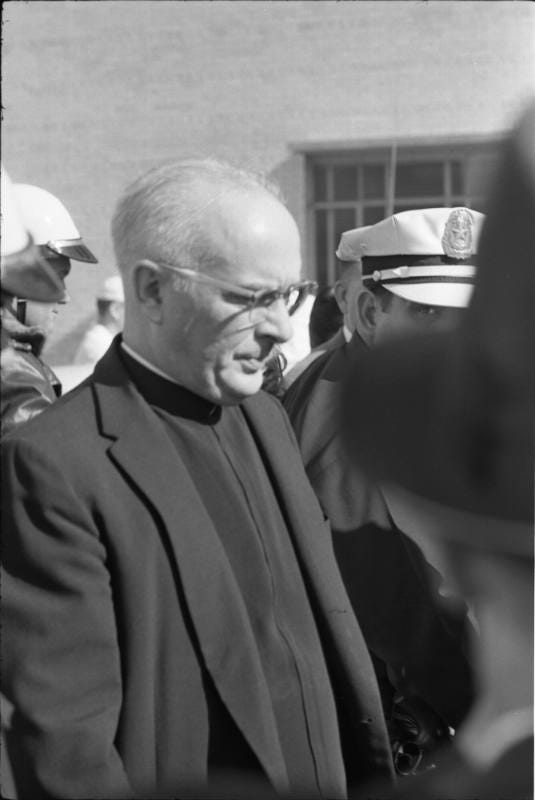
Then the priests walked out into a hallway full of reporters, and it was through them that the first word of the president’s death reached the wires.
An Associated Press bulletin reported that two priests had stepped out of Parkland’s emergency ward and “said President Kennedy died of his bullet wounds.” When a reporter asked Huber whether the president was dead, the AP quoted his answer: “He’s dead all right.” The White House had not yet made its formal announcement.
Minutes later, NBC newsman Bill Ryan broke in on Chet Huntley to read the flash on the air.
About an hour after the priests spoke to reporters, Lyndon Johnson took the presidential oath in the conference room of Air Force One at Love Field. Aides could not find a Bible on board. The book Judge Sarah T. Hughes held for him was a Catholic missal taken from a side table in Kennedy’s bedroom on the plane, mistaken in the rush for a Bible.
In New York, crowds streamed into St. Patrick’s Cathedral that November to pray and light candles for the president.
Over the next three days, Cardinal Cushing would bury his friend in a Latin rite most Americans had never seen, while a young priest hidden beneath the altar told the nation what it was watching.
