


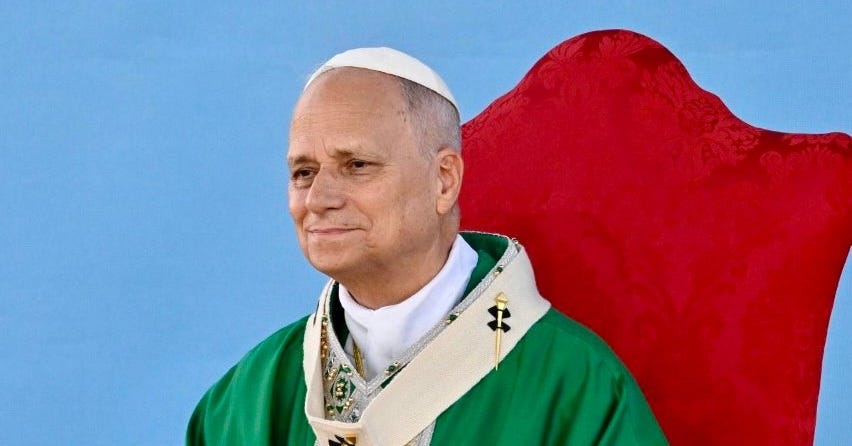
Thank you for reading! Letters from Leo is a reader-supported publication and the fastest-growing Catholic community in the country. To receive new posts and support this movement, consider becoming a free or paid subscriber.
In Rimini on Saturday afternoon, Pope Leo XIV became the first pope to visit the Meeting for Friendship Among Peoples since John Paul II came in 1982.
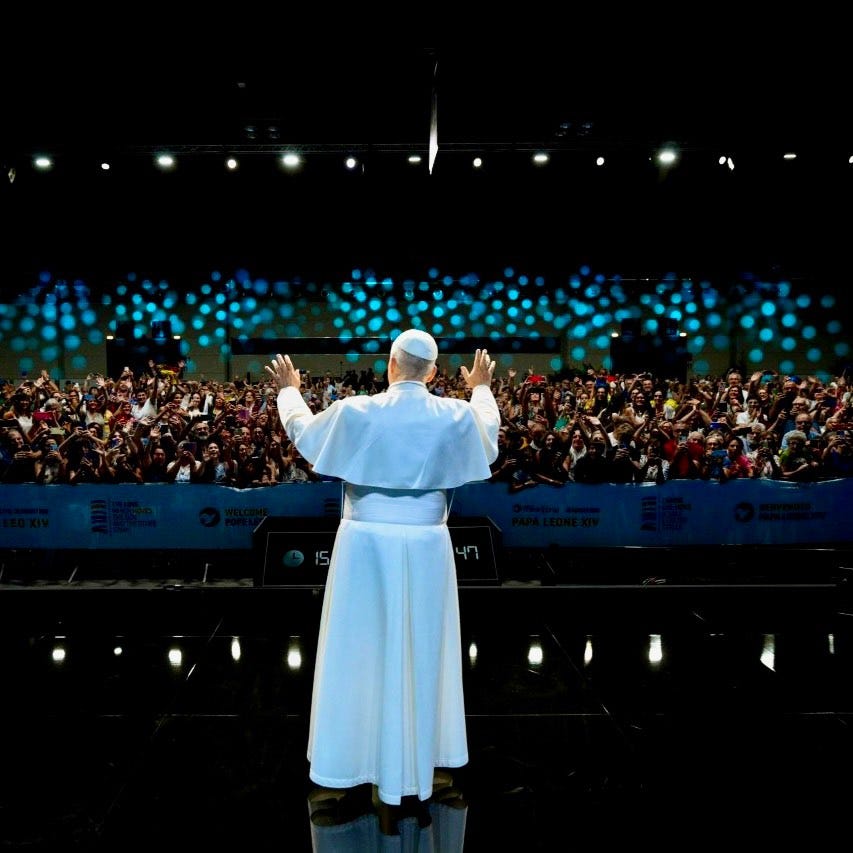
Around 60,000 people attended the annual event, a mini-regional World Youth Day of sorts. The pope spent the morning in the tiny nation of San Marino, where Leo XIV pulled apart the case for JD Vance’s postliberal Catholicism in the world’s oldest republic (I wrote about that address on Saturday night).
He spent the rest of the day with the young people at the festival, and he ended it with a homily at the city’s seaside port that deserves a lot more airtime stateside.
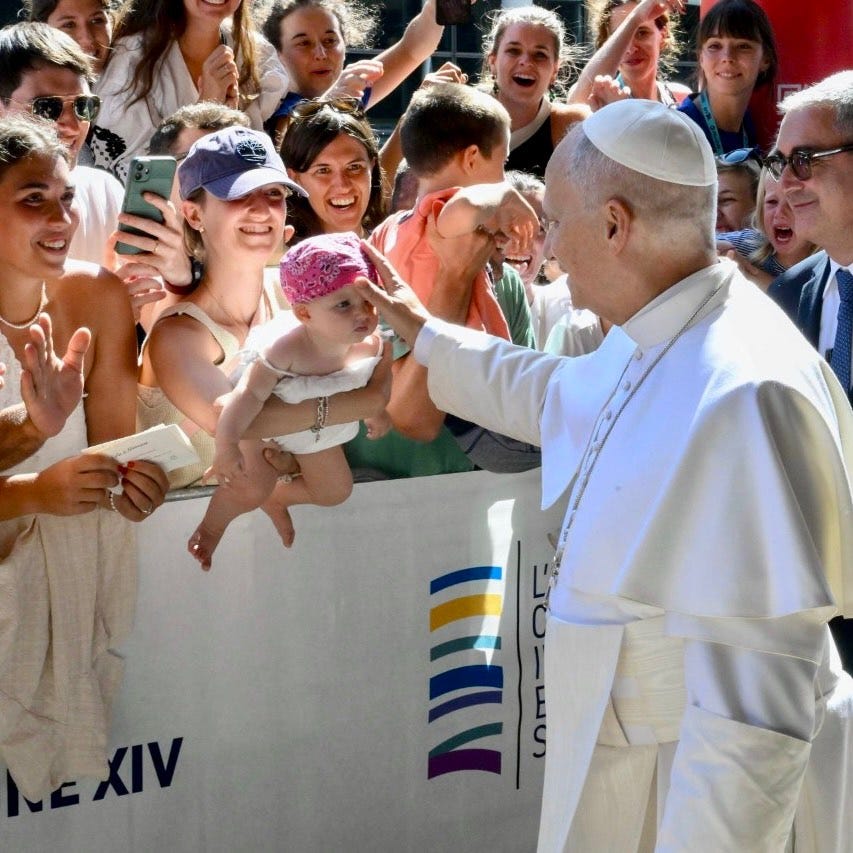
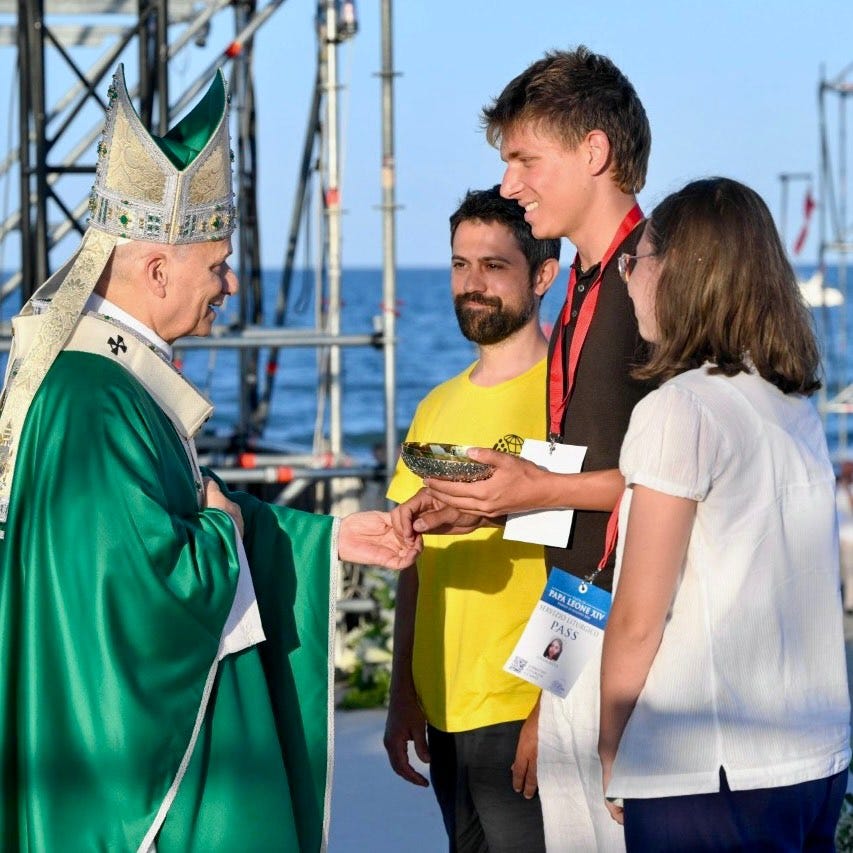
He went first to the meeting’s youth village, where the children and teenagers met him with stadium chants. “The world needs you,” he told them, “your enthusiasm, your charity, your faithfulness.”
In off-the-cuff comments, he gave them what became a consistent motto for the day: “Our hearts, so big and capable of loving, should never be closed. Let’s find the way together to build a world of peace and love.”
Later in his prepared address, Leo said “Before borders, definitions, and institutions, there are always persons.” That beautiful line strikes me as a core thesis of the Leonine pontificate itself.
Citing his predecessor Francis’s 2020 encyclical Fratelli Tutti, Leo said that social friendship is “the public, dynamic and concrete expression of fraternity,” and when we recognize one another as children of God “we come into contact with that which fundamentally unites human beings, beyond every difference, division or conflict.”
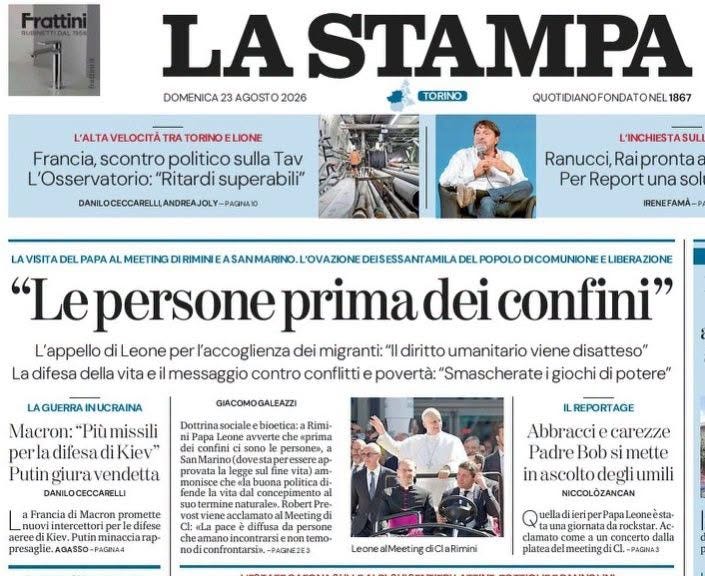
La Stampa ran Leo’s memorable sentence as its headline: Le persone prima dei confini.
People come before borders.
Compare that statement with what JD Vance told the Claremont Institute last year:
“America is not just an idea,” Vance said. “We’re a particular place, with a particular people, and a particular set of beliefs and way of life.” Defining Americans by their agreement with the founding principles, he argued, gives you “a definition that is way over-inclusive and under-inclusive.”
What does define America in the Catholic convert’s mind?
“For one, I think it has to mean sovereignty. More precisely, American citizenship must mean belonging to a nation that guards the sovereignty of its people, especially from a modern world that’s hell-bent on dissolving borders and differences in national character.”
Leo XIV offers a different path.
“Today, Catholic culture must counter the false realism that rearms minds, words, and nations with the realism of mercy which recognizes that there can be no enemies, and that everyone, even those who oppose us, is a brother or sister to be looked in the eye and encountered in truth.”
That love asks us to purify “our thoughts, interests, habits, associations, plans and investments” from “all that the culture of power has tainted.” We must “free our lives from suspicion, culture from arrogance, education from ideology, work from the idolatry of profit, and technology and finance from the business of death.”
He chose the verb “rearms” in an era when the West has made rearmament its top organizing principle. NATO’s members promised in June 2025 to commit five percent of their domestic GDP on defense by 2035, and the European Commission gave its own spending plan the unimaginative name of ReArm Europe.
The American version of rearmed minds and words runs through the tyrannical immigration enforcement regime under the Trump-Vance White House.
The Deportation Data Project found that ICE arrests of people with no criminal conviction ran more than eight times higher this January than in the six months before Trump took office, while detention beds in use climbed from about 14,000 a day to about 57,000. On Friday, a federal court vacated the Administration’s suspension of immigrant visas from 75 countries, calling it “contrary to law and in excess of statutory authority.
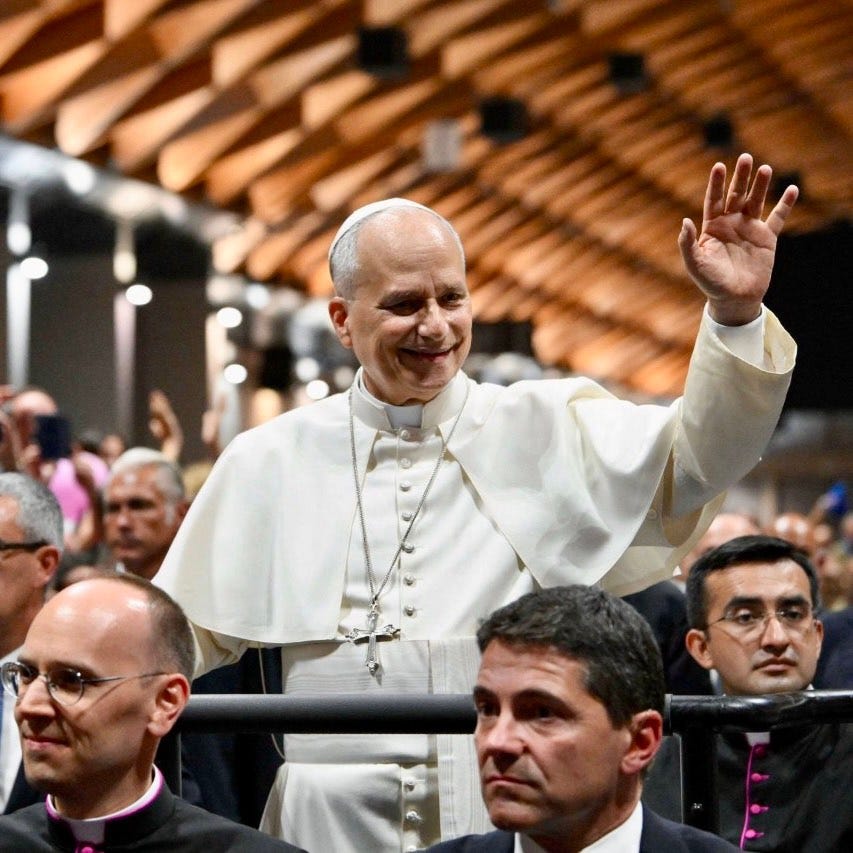
In an era where many MAGA nationalists are trying to rewrite the faith to fit their own ideology, Leo told young people to reject that: “Open yourselves to a truly catholic spirit, broadening your networks beyond every overly narrow sense of belonging.” He asked them to “resist whatever would separate you from brothers and sisters of different cultures, sensibilities and backgrounds, especially the poorest among them.”
The command was simple: “go forth to meet everyone!”
Vance infamously said a week into his term that a Christian must love their family first, then their neighbor, then their community, then their fellow citizens, and only afterward “the rest of the world.”
Two popes have already corrected him on his misapplication of ordo amoris. Leo returned to it on Saturday without using the name, telling those gathered to widen belonging rather than rank it, and he closed the thought with a definition of love that leaves no room for a loyalty test:
“In love, there is never coercion or indoctrination, nor manipulation, deception or recruitment. Love exists only in freedom, in genuine encounter and in the generous gift of self.”
The final event of the day was a vigil Mass with 25,000 people along the Rimini waterfront.
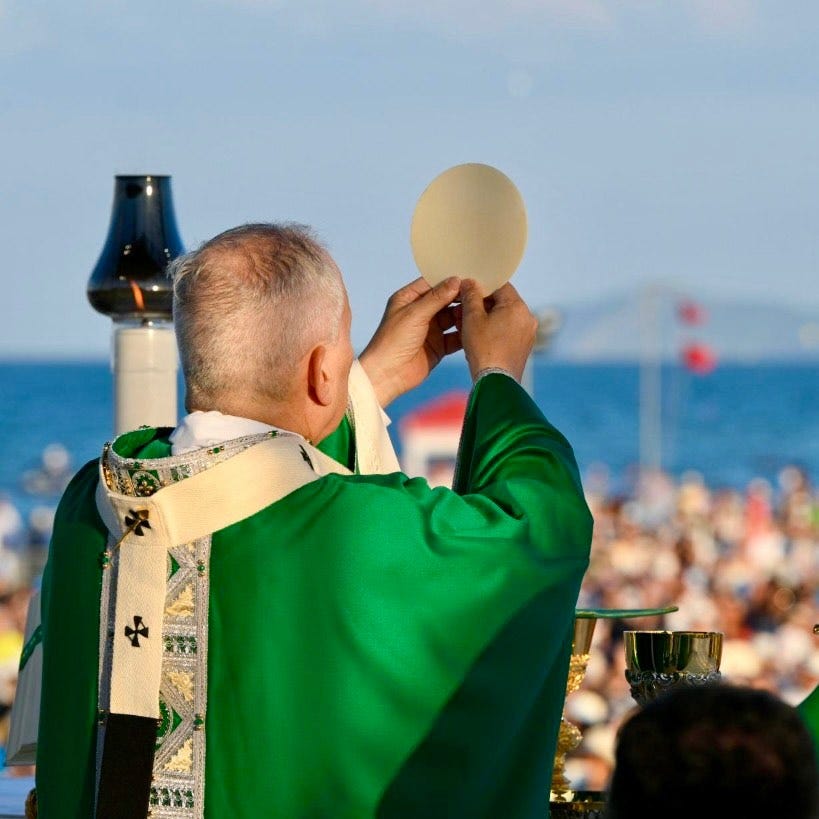
Accenting the simple altar was the city’s ferris wheel and the icon of the Madonna della Misericordia. Cardinal Matteo Zuppi — Leo XIV’s envoy to Ukraine — concelebrated. The Gospel was Peter’s confession at Caesarea Philippi, and the pope took this reading that’s usually understood as a reflection on the papacy itself and turned into a call for universal responsibility for building up the people of God:
“In the Church, at every level, authority is service,” he said.
The power to bind and loose that Jesus gave to Peter belongs to everyone, Leo said.
It’s “a style and a task that pertain to every baptized person,” which he spelled out as the work of embracing, bringing together, welcoming, freeing, and forgiving whoever is a prisoner of death and destruction.
He spoke at length about the first reading too — Isaiah’s oracle against Shebna, the palace steward who carved himself a grand tomb with public money and rightly lost his office, and with it the key of the house of David. Whoever holds delegated authority and wields it “out of ambition and greed,” Leo said, has forgotten that the office exists for the renewal of the whole community and never for private gain.
Then he finally made a plea to the local community. Romagna, a region known for its party and its beaches, should be welcoming “for the spirit as well” as for rest and entertainment, and it should give the samecare to two kinds of arrival: the worker who comes for a week off after a year of labor, and “those wounded in body and spirit, who ask for refuge, food and assistance far from their own land.”
Bishop Nicolò Anselmi of Rimini announced three commitments from the diocese in response to the visit. The prison will get a turf soccer field, and the diocese will support a project for medical care in Gaza, and the community will double down on its efforts to welcome the foreign workers Romagna’s hotels depend on.
Read the homily and those concrete actions against the past nineteen months in America.
Last Tuesday an anti-Islam rally brought swastikas into the streets of Dearborn, and Archbishop Edward Weisenburger of Detroit stood against it. A Catholic vice president has spent his time in office explaining that the Gospel sorts people by both proximity and passport.
On Saturday, in front of tens of thousands, the American pope gave us the authentic vision of the Gospel: the person comes first and nobody is an enemy.
Whoever holds power, he argued, holds it only to serve others.
Shebna lost his office because he built a monument to himself with authority he had been lent. Should not the same thing happen here in the United States?
Leo told the crowd at the port that this is what “ambition and greed” do to delegated power.
It is a homily about a palace steward in the eighth century before Christ, preached on a beach in Italy, but God-willing, we’ll make it land on every official in Washington who has treated their public office as a personal possession.
At Letters from Leo, we stand with the young people in Rimini, with Bishop Anselmi and the foreign workers his diocese has promised to welcome, and with every Catholic in America who believes that before borders and definitions there are always persons.
In a season when the West is rearming its budgets and locking out strangers, we remain rooted in a faith that recognizes no enemies, only brothers and sisters to be looked in the eye.
This is the fastest-growing Catholic community in the country because people are hungry for something deeper than a loyalty test.
They are looking for the realism of mercy, and right now, with 57,000 detention beds in use and a vice president ranking whom Christians may love, that hunger is urgent.
If you beli eve this movement matters — Catholics and people of goodwill standing for human dignity against a politics that puts the border before the person — I am asking you to join us.
If you’d like to invest in our mission, here are three ways you can help:
Subscribe as a paid member to receive exclusive posts about the life and formation of Pope Leo and help sustain this newsletter.
Donate with a one-time gift to fuel this project’s mission.
Share this post (and Letters from Leo) with a friend who might enjoy it.
Paid subscribers receive the full series on Pope Leo’s life and formation, from Dolton to Chiclayo, along with the Epstein-Bannon investigation and the Sunday Scripture Reflection Series, which took up this same Gospel of Peter’s confession yesterday.
Whether you give $0, $5, $50, $500, $1,000, or more, your presence here matters — no matter your faith or your politics.
Thank you for reading. I’ll see you on the road.

“go forth to meet everyone!” -- what a wonderful command, I am all for doing this! Thank you, Pope Leo!
Do justice, love mercy, walk humbly; does your immigration policy reflect that, O Mortal?