Thank you for reading! Letters from Leo is a reader-supported publication and the fastest-growing Catholic community in the country. To receive new posts and support this movement, consider becoming a free or paid subscriber.
Dear friends,
I apologize for adding one more 9/11 story after closing the series last night.
Over five days I wrote about the end of my childhood, Welles Crowther, Mayor Mamdani’s invitation to St. Patrick’s, Father Mychal Judge, the memorial Mass that Trump and Vance skipped, George W. Bush at the Islamic Center, Father Robert Prevost’s homily ten days after the attacks, the jumpers, and finally the 9/12 generation.
I meant that last one as the end, but one anecdote should not be withheld from you, my loyal readers — it explains how the last pontificate began and why this one looks the way it does.
I first heard it recounted by Cardinal Edward Egan, the retired archbishop of New York, in the hours after Jorge Mario Bergoglio stepped onto the loggia of St. Peter’s as Pope Francis on March 13, 2013.
Egan had received his red hat alongside Bergoglio in February 2001, and the man he described that day was a cardinal he had met twelve years earlier, during the worst month of his own life. Rocco Palmo later wrote the definitive account at Whispers in the Loggia, and much of what follows draws on his reporting.
A year before the attacks, John Paul II had named Egan relator general of the Tenth Ordinary General Assembly of the Synod of Bishops, scheduled for Sept. 30 to Oct. 27, 2001, on the theme “The Bishop: Servant of the Gospel of Jesus Christ for the Hope of the World.” The relator general opens the assembly with a report in Latin, and after every bishop has spoken he hands them the synthesis they will vote on; few jobs in the hall carry more weight.
Then the planes hit.
Egan spent the morning of Sept. 11 in scrubs at St. Vincent’s Hospital, ministering to the wounded and the first responders. Before the month was out he flew to Rome anyway and read his opening report on Oct. 1, and New Yorkers, still pulling bodies from the pile, wanted to know why their archbishop was in Italy.
The questioning of his loyalty to the city was, he told the Associated Press in 2011, “the worst thing that ever happened to me in my life.”
On Oct. 4, the feast of St. Francis of Assisi, Cardinal Jan Schotte, the synod’s general secretary, rose in the hall with an announcement. The Vatican’s own bulletin records it. The thirtieth day after the attacks fell on Oct. 11, and Egan was “eagerly expected by his people for this thirtieth day celebration in his cathedral.”
He would go home.
Schotte then read the second half of the communication: “so that our work can continue without any changes, the Holy Father, after having consulted the presidency of our assembly, appointed a Deputy General Relator in the person of H. Em. Card. Jorge Mario Bergoglio, S.J., Archbishop of Buenos Aires. I now invite H. Em. Card. Bergoglio to take his place at the table of the presidency.”

Bergoglio was 64 and had worn a red hat for seven months. He had never studied or worked in Rome (Palmo notes that he avoided the place unless summoned), and now he had eight days to absorb the interventions of more than 230 bishops and produce, in Latin, the Relatio post disceptationem that would steer the assembly’s final weeks. Gerard O’Connell of America puts it plainly: Egan had given the keynote, and Bergoglio “had to do everything else with the help of a team of theologians.”

The bishops rendered their verdict at the election of the twelve members of the post-synodal council: his brother bishops, the Vatican journalist Sandro Magister reported, chose him “with the highest vote possible.”
Elisabetta Piqué, the Argentine journalist who became his biographer, told the National Catholic Reporter that he “worked so well as relator, replacing Egan, that he started being known and noticed in Rome as someone papabile.”
When his name was floated for a Vatican post, he answered, according to Magister, “Please, I would die in the Curia.”
Egan told the story himself in a television interview with Richard French five days after the election, and his version carries details no bulletin records.
“When I arrived in Rome I gave the opening address, and I think anyone could look at me and see that I was not at the top of my game,” he said.
“And a man whom I had never met, Jorge Bergoglio, a cardinal who had become a cardinal with me, rolled up his sleeves” and “just became part of our team. We worked from morning to night.”
The work was brutal.
“There were six different language sections, and by 7:30 at night you had to have a résumé of all six ready for the next morning,” Egan recalled.
“I could handle everything but German, and Cardinal Bergoglio found a bishop to come in and give us a hand, and we became a team.”
The Argentine, he said, behaved like “someone that I had met on the street, just out of the goodness of his heart, because he, I think, looked at me and saw that my hands were filled.”
“Right from that time,” Egan said, “I would have to say I had immense admiration and even affection for this man.” He told Catholic New York after the election that Bergoglio “responded generously, kindly and very competently. He was simply wonderful.”
The rest you know in outline.
When John Paul II died in April 2005, Bergoglio entered the conclave as the main challenger to Joseph Ratzinger; an anonymous cardinal’s diary, reported by John Allen, had him at 40 votes on the third ballot before Ratzinger crossed the two-thirds line. He went home to Buenos Aires, turned 75, and submitted his resignation as archbishop.
Then Benedict XVI announced on Feb. 11, 2013, that he would resign at the end of the month, the first pope to walk away from the office in nearly six centuries, and the papal biographer Austen Ivereigh describes what happened next: “the Europeans and Latin Americans who knew him suggested Bergoglio to the rest of the college of cardinals who had barely any knowledge of him.”
The men who knew him had learned his name in October 2001.
Palmo, writing on the twelfth anniversary of the attacks, argued that a Bergoglio who never sat in that chair would have been a non-starter in 2005, and that his election in 2013 “simply never would’ve happened” without the earlier showing.
The chair taught him something too.
Asked about collegiality at his first press conference as relator, with Schotte seated beside him, he answered that a proper discussion of it “exceeds the specific limits of this synod.”
Piqué says he came away convinced that those meetings were “already pre-fabricated.”
Thirteen years later, as pope, he told La Nación: “I was the rapporteur of the 2001 synod, and there was a cardinal who told us what should be discussed and what should not. That will not happen now.”
It did not.
Synodality became the hallmark project of the Francis pontificate. He opened a worldwide consultation in October 2021, presided over two Roman assemblies (the second closed on Oct. 26, 2024), and then adopted the final document as his own teaching rather than writing an exhortation of his own.
On May 8, 2025, standing on the same loggia where Francis had first appeared, Pope Leo XIV told the world, “we want to be a synodal Church, a Church that moves forward.”
He has kept that promise. He put listening and the laity at the center of his consistories, and from June 23 to 25 of this year he sat down with the heads of the synod’s continental bodies to plan the road to the 2027 assemblies and an ecclesial assembly in Rome in October 2028.
When synodal teams gathered in Rome on Oct. 24, 2025, he told them that among hesitant clergy “the resistances come out of fear and the lack of knowledge.”
So the grief of one city rearranged the Church for a generation or more.
An archbishop who could not bear to be away from his people gave up the chair he had waited a year to fill, and the Jesuit who sat down in it on the feast of St. Francis had spent his career avoiding Rome.
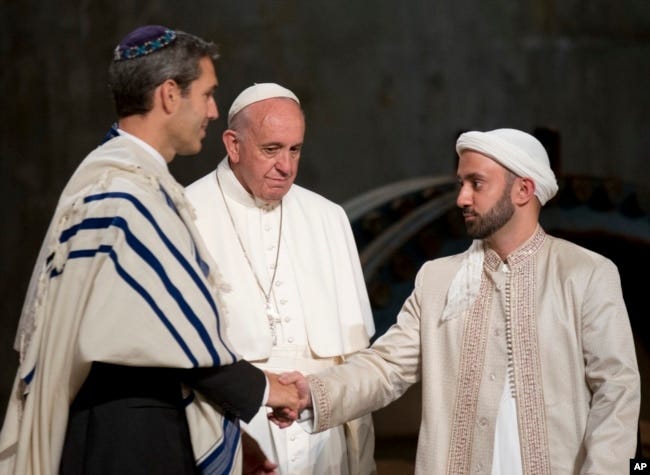
Egan died on March 5, 2015. On Sept. 25 of that year, Pope Francis stood at the 9/11 Memorial and prayed for the dead of the morning that had, in ways nobody in that synod hall could have imagined, set him on the road to Peter’s chair.
At Letters from Leo, we believe the Church is built out of moments like that one: a pastor choosing his grieving flock over a post in Rome, and the stranger who then did the unglamorous work well.
This week we remembered the priests, firefighters, office workers, and bond traders who did the same in the stairwells of the World Trade Center, and a Church that walks together (which is all the word synodality means) is what those people were on the morning of September 11, 2001.
This is the fastest-growing Catholic community in the country, and it exists for people who want a faith that takes both memory and mission seriously. If you believe that kind of Church is worth building, and that Catholics and people of goodwill have a role to play in building it, I am asking you to join us.
If you’d like to invest in our mission, here are three ways you can help:
Subscribe as a paid member to receive exclusive posts about the life and formation of Pope Leo and help sustain this newsletter.
Donate with a one-time gift to fuel this project’s mission.
Share this post (and Letters from Leo) with a friend who might enjoy it.
Paid members receive the full biographical series on Pope Leo’s life and formation, including the story of his friendship with Francis, along with the Sunday Scripture Reflection Series and our investigations into the people trying to break this pope.
Whether you give $0, $5, $50, $500, $1,000, or more, your presence here matters — no matter your faith or your politics.
Thank you for reading. I’ll see you on the road.


This is a great example of God drawing straight with crooked lines. While I don't believe that it was God's will that 9/11 would happen, he definitely brought a lot of good things out of the tragedy.
Beautiful story of Pope Francis and the work of the Holy Spirit to move him in the right direction. Thank you Chris