Thank you for reading! Letters from Leo is a reader-supported publication and the fastest-growing Catholic community in the country. To receive new posts and support this movement, consider becoming a free or paid subscriber.
JD Vance defended Donald Trump’s mockery of Christ on Monday.
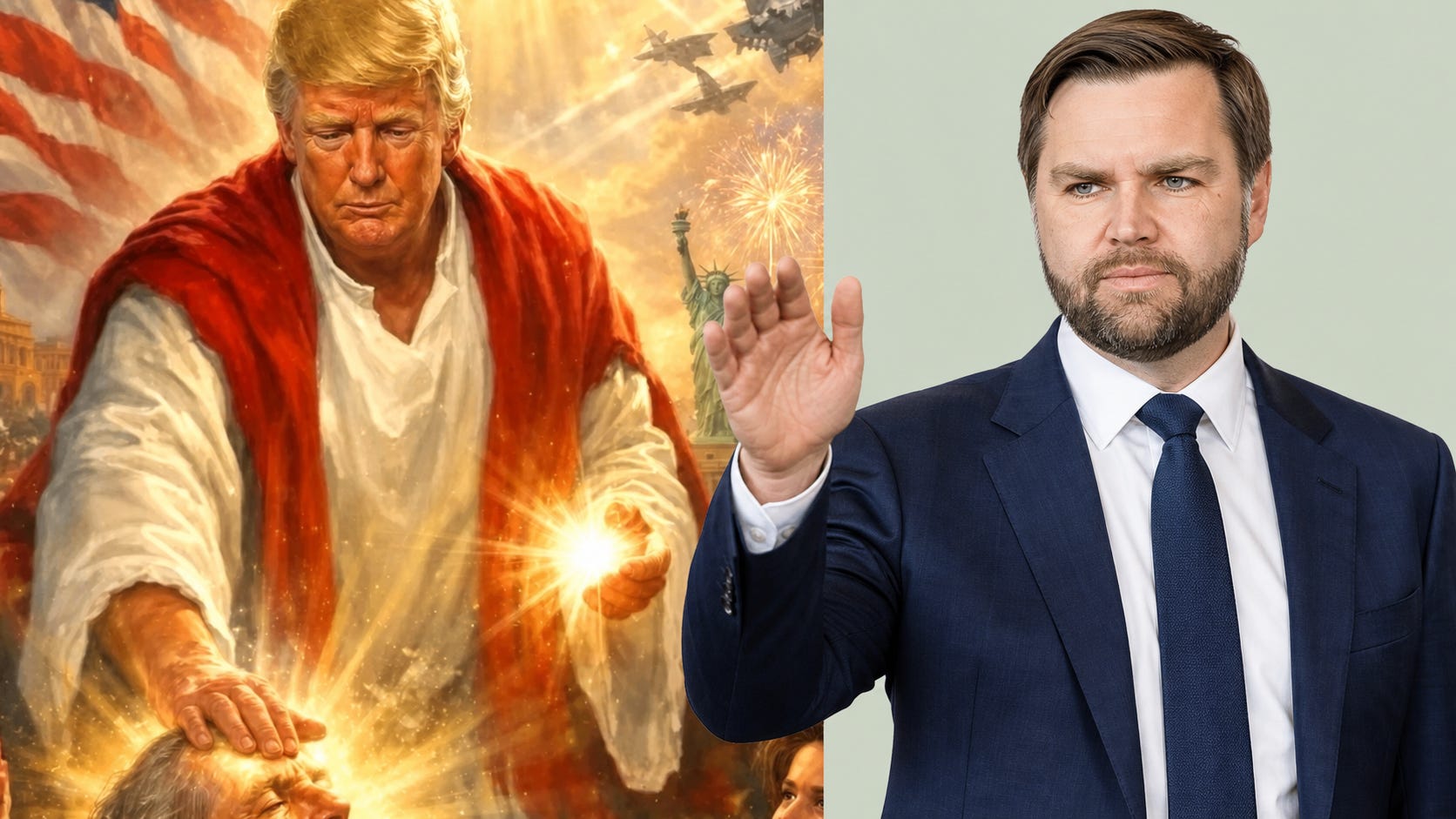
Asked by the evangelical podcaster Bryce Crawford about the April image of the president in white and red robes, a glowing hand extended over a sick man as four figures venerated him, the vice president answered: “Did Donald Trump mean to post a meme of himself as God? No.”
The president, he explained, is “a backslapper” who “just likes to have a good time,” and the fault lies with a press that keeps “treating things that the president does as humorous and saying this is him being serious.”
The image he was defending went up 46 minutes after a 330-word attack calling Pope Leo XIV “WEAK on Crime, and terrible for Foreign Policy.” The next day the picture came down, with an explanation from the president that he had thought it showed him “as a doctor.”

Even Trump ally Bishop Robert Barron said the president owed the pope an apology for the attack. Cardinal Joseph Tobin called Trump’s words a “grave misunderstanding” of what a pope is for.
Crawford, who told Vance he has “so much respect for all of our leaders,” said the picture upset him as a Christian, and he pressed the point. Somebody had brought Trump the picture, Vance said, and the president laughed and had it posted. That, in the vice president’s telling, was the whole story.
Twenty-seven minutes earlier in the same interview, recorded at the vice president’s home and posted to YouTube on Aug. 31, Vance had told the story of the golden calf: “You literally saw Moses part the Red Sea and what, like three weeks later, you guys are worshiping the golden calf.” He called it “the craziness of human nature,” and he meant it as a warning about the heart, his own included.
Vance later told Crawford he would be “not shocked if the antichrist was walking among us.” The line echoes Peter Thiel, the billionaire who bankrolled Vance’s Senate campaign and shaped his conversion, who spent last fall lecturing San Francisco on the Antichrist and has since suggested that Pope Leo himself is the Antichrist’s instrument.
Vance then produced the line that traveled fastest on the internet today: “What I’m trying to focus on is doing as much of God’s work as possible right now. And if that leads to the end times, okay.” The clip that circulated cut him off there.
He went on to say that a world that “thrives and survives for a very long time after I’m gone” would be “great, too,” and a few sentences earlier he had given the Catholic answer to end-times panic: that we are commanded to “make the world the kind of world that God wants it to be.”
The full quote is modestly fairer to him than the clip, but it is still an odd thing for the vice president of a nuclear power to say out loud. The Second Vatican Council taught in Gaudium et Spes that the expectation of a new earth “must not weaken but rather stimulate our concern for cultivating this one.”
Vance’s vocabulary about Armageddon is more evangelical than Catholic in origin, and Vance told Crawford where he learned it.
His first Bible, he said, was the John Hagee Prophecy Study Bible, handed to him at 10 or 11 at the height of the Left Behind years, and his grandmother’s faith came through TBN and the 700 Club far more than through any parish.
The Catholic tradition, of course, keeps the Antichrist at arm’s length. The Catechism gives him three paragraphs, leaves the hour unknown, and says the Church has rejected “even modified forms of this falsification of the kingdom to come under the name of millenarianism.”
Augustine, whose name Vance took at baptism, wrote much of The City of God to stop Christians from reading the end of the world off the sack of Rome. A Catholic vice president trading in Antichrist sightings is speaking his donor’s dialect, and his grandmother’s, more than his Church’s.
Vance said that in meetings with world leaders, “somebody will say something or somebody will make an observation,” and he will “feel a certain darkness about it,” something that “sets off every spiritual alarm bell in my body.”
That is the vocabulary of Ignatian discernment, and the Church has spent five centuries teaching what to do with it. St. Ignatius wrote his rules for discerning spirits for a person examining his own heart first, which is why the Jesuit examen opens with gratitude and moves through one’s own faults before it ever reaches anyone else’s.
A spiritual alarm that goes off around foreign leaders but never around the man who posts pictures of himself as Jesus Christ healing the sick is a conscience in need of a deeper conversion.
On artificial intelligence, by contrast, Vance’s discernment worked fine. Some AI companies carry “some really, really weird spiritual dark energy,” he said, and he described a firm holding “a burial ceremony” for a retired model at which “the employees apparently will cry.” (The event he seems to mean took place on Aug. 2 of last year in a San Francisco warehouse, staged by fans rather than the company, with eulogies and a shrouded mannequin.)
A friend’s wife, he went on, had been using a chatbot as a marriage counselor until she realized it was “the worst marital counselor ever because it just tells me that I’m right all the time.” Vance called that “kind of satanic.”
He is not wrong. Pope Leo told a Vatican conference in May that chatbots exploit our need for human relationships, and Magnifica Humanitas makes the case at encyclical length.
A counselor who tells the powerful they are right all the time is a spiritual hazard, whether it runs on silicon or draws a government salary — and since April, that has been the vice president’s job description.
Days after the image appeared in April, Vance told a crowd in Athens, Georgia, that “it’s very important for the pope to be careful” with theology, having already told Fox that the Vatican should “stick to matters of morality.” In August, Leo used a speech in San Marino to gut the postliberal project Vance has championed.
The Catechism defines idolatry as honoring “a creature in place of God,” and it names the creatures — “power, pleasure, race, ancestors, the state, money.” It does not exempt a creature with a good sense of humor.
Later this week I will publish an analysis of Vance’s softball interview with Bishop Barron, which covered much of this same ground with a gentler hand on the questions.
The story of the calf is one Vice President Vance knows by heart. What the interview leaves behind is the question of which character he is playing.
At Letters from Leo, we stand with the millions of American Catholics (and countless others of goodwill) who believe the first commandment still binds presidents. Power earns no man our worship, whatever jokes he tells.
In an era poisoned by cruelty and flattery, we remain rooted in a faith that names its idols out loud, whether they are cast in gold at a Florida resort or generated by a machine and posted before breakfast.
This is the fastest-growing Catholic community in the country because people are hungry for something deeper than rage and propaganda. They want the Gospel Vance himself keeps invoking, the one that names an idol when it sees one, whoever posted it.
If you believe this movement matters — Catholics and people of goodwill standing for human dignity against the idolatry of power — I am asking you to join us.
If you’d like to invest in our mission, here are three ways you can help:
Subscribe as a paid member to receive exclusive posts about the life and formation of Pope Leo and help sustain this newsletter.
Donate with a one-time gift to fuel this project’s mission.
Share this post (and Letters from Leo) with a friend who might enjoy it.
Paid subscribers receive the ongoing series on Pope Leo’s life and formation, along with the exclusive investigations that only appear here. They also get our full coverage of Pope Leo’s confrontation with artificial intelligence, and every week the Sunday Scripture Reflection Series lands in their inbox.
Whether you give $0, $5, $50, $500, $1,000, or more, your presence here matters — no matter your faith or your politics.
Thank you for reading. I’ll see you on the road.


Vance has lots of excuses for Trump’s
AI dreck. Vance has lots of excuses for Trump, period. What Vance either does not have or will not use is any influence to restrain Trump’s worst and most unchristian words and deeds. And, yes, JD, words matter.
Vance is just obnoxious, and he needs some remedial education on Catholicism. Evangelicals interpret Revelation as an account of future events, but this interpretation goes back to the early 19th century and a Church of Ireland minister named John Newton Darby. The Scofield Reference Bible combined the KJV along with reference notes to popularize the idea that history could be divided into periods called dispensations.
I attended Catholic schools from first to tenth grade, and I recall learning that John’s account in Revelation was an account of persecution of Christians under Rome before Constantine recognized Christianity in the 4th century. The whole dispensational and rapture theology popular with Evangelicalism is not something the Church teaches.